

Run a small pilot before you touch your whole operation. Centralize your instructions in one system, and treat staff training as an ongoing habit, not a one-time meeting. This approach protects the pets in your care, keeps clients confident, and keeps revenue steady while you test what actually works. The checklist below gets you moving today.
TL;DR:
- Running a small pilot with a clear scope, fixed end date, and predefined success criteria prevents client complaints and staff confusion during change implementation.
- Incorporating structured stress testing, such as Blue Team/Red Team reviews, helps identify risks and edge cases before full rollout, minimizing operational disruptions.
- Staff training should be an ongoing process with role-specific SOPs and shadowing hours, not a one-time event, to ensure proper adherence and reduce mistakes.
- Software migrations must prioritize client experience by mapping and verifying owner-visible objects, timestamps, and media paths, with backup plans ready in case of issues.
- Successful change management requires at least 30 to 90 days of monitoring KPIs, with checkpoints to pause or proceed based on operational, client, and financial metrics.
Table of Contents
- What Is Change Management in Pet Care, and Where Do You Start?
- How Do You Plan a Pilot That Actually Tells You Something?
- How Do You Keep Staff On Board Through a Change?
- How Do You Migrate Software Without Losing Client Trust?
- What Should You Budget for Timeline and Staffing?
- Which KPIs Tell You the Change Is Working?
- An Operator’s View on Managing Change in Pet Care
- Get Staff Training, SOPs, and AI Tools Built for This Exact Problem
- Sources
What Is Change Management in Pet Care, and Where Do You Start?
Change management in pet care means the deliberate process of planning, testing, and rolling out any shift in how your business operates, whether that’s a new scheduling platform, updated play-group protocols, or a revised grooming intake form. It’s a structured alternative to just announcing a change on a Monday and hoping your team figures it out.
Start here this week:
- Lock down safety-first SOPs. Before anything else changes, confirm your current standard operating procedures and client instructions are documented and won’t get lost in the shuffle.
- Define your pilot scope and dates. Pick a start date, an end date, and a small client segment of repeat clients who won’t be thrown off by a hiccup.
- Name your change champions. Identify one or two staff members who are already respected on the floor and give them a real role in testing the change.
- Run a migration audit. If the change touches software, catalog every owner-visible item (photos, daily notes, timelines) before you move a single record.
- Budget shadowing hours. Set aside paid overlap time so experienced staff can walk newer team members through the change in real time, and define what success looks like before day one.
Pet care service adaptations that skip these five steps tend to generate the kind of client complaints and staff confusion that turn a good idea into a scramble.
How Do You Plan a Pilot That Actually Tells You Something?
A pilot only works if you design it to fail safely. That means picking a boundary small enough that a mistake costs you an afternoon, not a season of bookings.
Start by defining the problem and the goal in measurable terms, over a window of 6 to 12 weeks. “Improve scheduling” isn’t a goal. “Cut double-bookings by half in six weeks” is.
Before you launch, borrow a technique from veterinary operations: a structured Blue Team/Red Team review. One group (Blue) builds the case for the change and how it should roll out. A second group (Red) tries to break it, poking at edge cases like a no-show client, a software outage, or a dog with a bite history entering a new play-group protocol. This kind of stress test, outlined in a veterinary change management framework, surfaces risks before they become real incidents.
Your pilot plan should specify:
- Sample size (start with your most predictable, low-drama clients)
- Staffing needs, including who covers the pilot and who covers everything else
- Duration, with a firm end date, not an open-ended “let’s see how it goes”
- Decision criteria set in advance: what result means you scale, what means you pause, what means you scrap it
Pro Tip: Write your fallback plan before you launch, not after something breaks. If your decision criteria say “roll back if complaints exceed two in the pilot window,” you need that threshold decided while you’re calm, not while a client is upset in your lobby.
Once the pilot clears its gates, move to phased rollout: one more location or shift, then a broader client base, with a checkpoint at each stage before you go further.
How Do You Keep Staff On Board Through a Change?
Staff communication during change management pet care initiatives fails most often because owners treat training as a single event instead of a habit. One meeting doesn’t change behavior. Ongoing reinforcement does.
Kotter’s 8-step change model, built for organizations navigating exactly this kind of transition, offers a useful structure: build a small coalition of respected staff, communicate the vision repeatedly, empower people to act on it, and celebrate short-term wins along the way rather than waiting for a grand finish line.
In practice, that looks like:
- Writing role-specific SOPs so a bather, a daycare attendant, and a front-desk staffer each know exactly what changes for their job
- Paying for shadowing hours so new workflows get modeled, not just described
- Recruiting influencers on your team, the people others already listen to, as your guiding coalition
- Posting small wins where the whole team sees them (first perfect week of on-time drop-offs, zero missed medication logs)
- Asking frontline staff what’s not working and adjusting the SOP itself, not just their compliance
Pro Tip: Hands-on shadowing and repeated reinforcement reduce mistakes far more than a laminated instruction sheet ever will, a point backed by training research from the pet sitting and dog walking industry. Budget for it like a real line item, because it is one.
Our own guide on training your pet care facility staff breaks this into a five-step sequence you can adapt directly.
How Do You Migrate Software Without Losing Client Trust?
Losing a client’s booking history feels like a minor technical hiccup to you. To the client, it can feel like their dog’s care story disappeared. Treat any software migration as a client-experience project first and a data project second.
Before cutover, map every owner-visible object: photos, daily report cards, medication notes, and the running timeline a client sees when they log in. Confirm exactly how each one exports from your old system and imports into the new one. Migration guidance built specifically for kennel software switches recommends a row-by-row import preview, not just a bulk upload you trust blindly, plus a full test login as an actual owner would see it.
- Verify timestamps match, since a reordered timeline confuses clients fast
- Check that media paths (photos, videos) actually resolve, not just that a file count matches
- Confirm role and visibility settings carried over, so staff see what they should and owners see what they should
- Schedule cutover mid-week, with your most experienced staff overlapping both systems
- Write a rollback script and a client-communication message in advance, in case you need either
| Migration Checklist Item | What to Verify | Owner Impact if Skipped |
|---|---|---|
| Photos and report cards | Row-by-row import preview | Client sees blank history |
| Timestamps | Chronological order preserved | Timeline looks broken or out of order |
| Media file paths | Images and videos actually load | Broken image icons in client portal |
| Role and visibility settings | Staff and owner views match old system | Wrong information exposed or hidden |
| Test owner login | Full walkthrough as a client | Surprises caught before launch, not after |
Pair this with our practical playbook for AI in pet care operations if the new system includes automated scheduling or communication tools.
What Should You Budget for Timeline and Staffing?
Most successful pilots in pet care operations run 4 to 8 weeks before an owner has enough signal to decide whether to scale, adjust, or stop.
- Plan for a 30 to 90 day stabilization period after any major operational shift, a window post-acquisition integration guidance recommends specifically to avoid stacking a software change on top of a leadership or staffing change.
- Budget real hours for paid shadowing. Two staff covering one client handoff is a genuine cost, not a rounding error.
- Avoid weekend-only cutovers. Mid-week changes with overlapping coverage give you a business day to catch problems while your most experienced people are still on-site.
- Ask software vendors directly about onboarding fees, data export costs, and support windows before you sign anything.
Which KPIs Tell You the Change Is Working?
Set your KPIs before you launch the pilot, not after you’re already three weeks in and guessing.
- Operational: SOP compliance rate, incident rate, on-time task completion
- Client-facing: frequency of owner-visible updates, CSAT or NPS score, complaint trend week over week
- Financial: average ticket size, occupancy or repeat booking rate, client churn
Fragmented systems and inconsistent workflows are a documented root cause of repeated operational mistakes in pet boarding and daycare settings, which is exactly why centralized, trackable KPIs matter more than a gut feeling about how things are going.
Run formal reviews at 30, 60, and 90 days. If incident rate or complaints rise past your predefined threshold at any checkpoint, pause and reassess before pushing further. If your numbers hold steady or improve, move to the next phase of rollout.
An Operator’s View on Managing Change in Pet Care
Most owners don’t fail at change management because they picked the wrong software or the wrong protocol. They fail because they tried to change everything at once, on a Friday, with no one designated to catch what breaks.
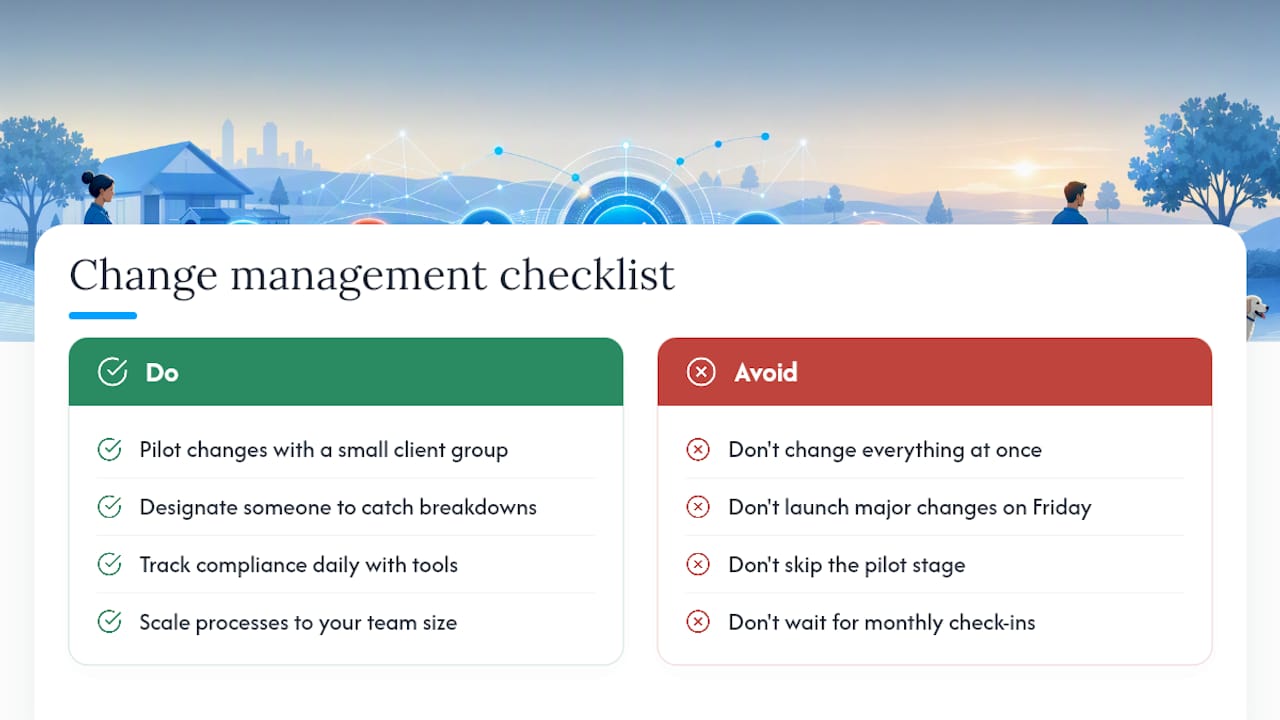
The Dog Gurus was built around the idea that pet care operators need the same rigor larger industries apply to organizational change, scaled down to fit a daycare with 12 employees or a solo pet sitter adding her first hire. We’ve watched an owner roll out a new scheduling workflow by piloting it with five regular clients first, using our AI-powered accountability tools to track compliance daily instead of waiting for a monthly check-in. The pilot caught a double-booking bug in week two, not week eight.
Where owners typically trip up is skipping the pilot stage entirely because it feels slower. It isn’t. It’s the fastest path to a rollout that doesn’t cost you a client.
— Oliver
Get Staff Training, SOPs, and AI Tools Built for This Exact Problem
You’ve just read the framework. Building the pilot plans, SOP templates, and training modules from scratch on top of running your daily operations is where most owners lose momentum, and it’s exactly the gap Thedoggurus closes.
Thedoggurus’s staff products give you role-specific training modules, ready-to-use SOP templates, coaching, and AI-powered accountability tools in one subscription, so you’re not writing your migration audit or your shadowing schedule from a blank page. It’s built specifically for owners managing dog daycare, boarding, grooming, training, or pet sitting operations through exactly the kind of transition this article walks through. If you’re planning a pilot this quarter, check the staff products page for pricing and get your team set up with the tools before your next rollout date.
Sources
- Veterinary change management exercise — Otto
- Leading change in your veterinary hospital — VetMgmt
- Switching kennel software without erasing the owner-visible story — Pet Ops
- Why pet care mistakes keep happening (MoeGo blog)
- Pet grooming integration playbook — Dealflow-OS