The best pet industry leadership today is purpose-driven, people-first, and operationally disciplined. Recent summit conversations and the track records of leaders like Yvonne Hsu, Kristin Peck, and Elise Fennig all point the same direction: teams follow owners who explain the “why,” invest in staff development, and stay financially grounded. Thedoggurus built its coaching and training platform around exactly this pattern. Keep reading for the specific takeaways worth adopting this quarter.
TL;DR:
- Leaders emphasize explaining the reasoning behind policies first, with Yvonne Hsu advocating for clarity before announcing changes to foster faster team adoption.
- Consistency in leadership visibility builds trust, exemplified by Kristin Peck’s weekly presence regardless of organizational circumstances.
- Staff retention efforts should focus on actionable steps like conducting stay interviews, scheduling development paths, and regularly reviewing safety and pricing data.
- Building effective training programs starts with microlearning, pilot projects, and measurable KPIs, supported by AI tools for follow-through and accountability.
- Engaging industry associations and setting concrete networking goals are vital for transforming leadership insights into operational standards and industry connections.
Table of Contents
- What The Latest Pet Industry Leadership Summits Are Teaching Owners
- Three Leaders Worth Studying (And What To Copy From Each)
- A Leadership Playbook You Can Start This Quarter
- Building A Staff Training Program That Actually Sticks
- Events And Associations Where Pet Industry Leaders Connect
- How Thedoggurus Applies These Same Leadership Principles
- Turn Leadership Insights Into a Trained, Confident Team
- Where This Article’s Leadership Takeaways Came From
- Sources
What The Latest Pet Industry Leadership Summits Are Teaching Owners
Pet Industry Leadership Summit-style events (PIDA’s programming among the most consistent) keep circling back to the same four themes: purpose, people, resilience, and technology. That repetition matters. It means these aren’t fads. They’re the operating baseline for anyone serious about leadership in pet services.
Purpose-driven leadership showed up everywhere, as seen in how women lead in pet nutrition innovation. Yvonne Hsu, recognized as Pet CEO of the Year in 2025, treats the first six months in any new leadership role as a window for leaning into mission and empathy rather than issuing directives. Her approach grounds decisions in science and communicates the reasoning behind them, which is why teams under her tend to move faster once change is announced.
People strategy was the second recurring thread. Panels pushed stay interviews over exit interviews, frequent low-stakes feedback over annual reviews, and visible development paths over vague promises of “growth opportunities.”
Immediate priorities pulled from these events:
- Run a stay interview with your top three performers this month.
- Replace one annual review with quarterly five-minute check-ins.
- Audit pricing against current supply costs before the next quarter starts.
- Pilot one AI tool for scheduling or client communication before committing budget.
Operational resilience got serious airtime too, with speakers focused on supply-chain volatility and pricing discipline as leadership responsibilities, not just finance tasks. Turnover in pet care services is notably high compared to many other service industries, which is exactly why the people-first theme keeps dominating summit agendas year after year. Technology conversations stayed practical rather than hype-driven. AI showed up as a scheduling assistant and a training accountability partner, not a replacement for human judgment.
Three Leaders Worth Studying (And What To Copy From Each)
You don’t need a corner office to borrow from executive-level leaders. You need to isolate the one habit that transfers to a ten-person daycare or a solo grooming shop.
Yvonne Hsu, president at Hill’s Pet Nutrition, leads with purpose-driven messaging and science-backed communication. Her habit worth copying: explain the reasoning behind a policy change before you announce the change itself. Staff adopt new procedures faster when they understand the “why” first.
Kristin Peck, CEO of Zoetis, the world’s largest animal health company, is known for authenticity and consistent visibility across her organization. Her habit worth copying: show up the same way, every week, whether things are going well or badly. Predictable leadership presence builds trust faster than occasional grand gestures.
Elise Fennig, who leads at the Pet Food Institute, models trade-association leadership built on member engagement and advocacy. Her habit worth copying: treat relationship-building with peers and regulators as core leadership work, not a side task for slow weeks.
- Hsu: Lead with the “why” before the “what.”
- Peck: Show up consistently, not just during crises.
- Fennig: Make advocacy and peer relationships part of your leadership job description.
A Leadership Playbook You Can Start This Quarter
Reading about leadership traits is easy. Turning them into daily practice at a dog daycare or grooming shop is the hard part. Here’s a prioritized, three-part playbook built for owners running lean teams.
- Fix hiring and onboarding first. Write a one-page role scorecard before you post the job. Run a paid trial shift instead of a single interview. Assign a 30-day buddy to every new hire so questions don’t go unanswered.
- Build retention and development into the calendar, not just the budget. Schedule monthly stay interviews with your strongest staff. Create one visible advancement path (lead handler, trainer, shift supervisor). Offer a small tuition stipend for a pet-care certification.
- Tighten operations and safety together. Audit your off-leash play protocols quarterly. Review pricing against current costs every 90 days. Post safety incident data where staff can see the trend, not just management.
Pro Tip: Track turnover rate, staff utilization, client NPS, and average ticket size monthly. If turnover drops while utilization climbs, your leadership changes are working, not just your marketing.
Use this simple checklist after reading:
- Days 1 to 30: Run stay interviews, audit onboarding, post current safety numbers.
- Days 31 to 60: Launch one development path, adjust pricing if margins are thin.
- Days 61 to 90: Review the four KPIs above and adjust whichever lagged.
Building A Staff Training Program That Actually Sticks
Most leadership development programs fail because they’re built once and never revisited. A curriculum that works covers five areas: safety protocols, people management, day-to-day operations, customer experience, and profitability basics for anyone with supervisory responsibility.
Start with a pilot cohort of five to eight staff members rather than rolling training out company-wide. Combine short microlearning modules with live coaching sessions and an accountability system that checks in between sessions, since most skill loss happens in the gaps between training events, not during them.
- Pick one location or shift for your pilot cohort.
- Set a 60-day timeline with a clear before-and-after metric (client complaints, incident reports, or new-hire time-to-competency).
- Pair every module with a manager check-in within a week.
Pro Tip: If your pilot cohort shows measurable improvement in one KPI within 60 days, you have your business case for scaling the program company-wide.
Platforms combining expert-led training content with AI-driven accountability solve the follow-through problem better than static course libraries alone.
Events And Associations Where Pet Industry Leaders Connect
Trade shows and associations are where isolated leadership habits turn into shared industry standards. Global Pet Expo is the strongest venue for product discovery and executive panels. SuperZoo delivers similar value with a heavier retail and distribution focus. The PIDA Summit concentrates specifically on leadership development, talent strategy, and industry advocacy.
- APPA connects you to broad industry resources and market data.
- PIDA focuses on distributor relationships and leadership summits.
- World Pet Association (WPA) runs SuperZoo and offers retail-specific networking.
Set three concrete goals before any event, follow up with new contacts within 48 hours, and debrief with your team the week after, or the networking fades fast.
How Thedoggurus Applies These Same Leadership Principles
We built our training and coaching model around the exact pattern this article describes: purpose first, people development second, operations third. One daycare client using our staff training modules cut new-hire ramp time significantly by pairing microlearning with weekly manager check-ins instead of a single onboarding day.
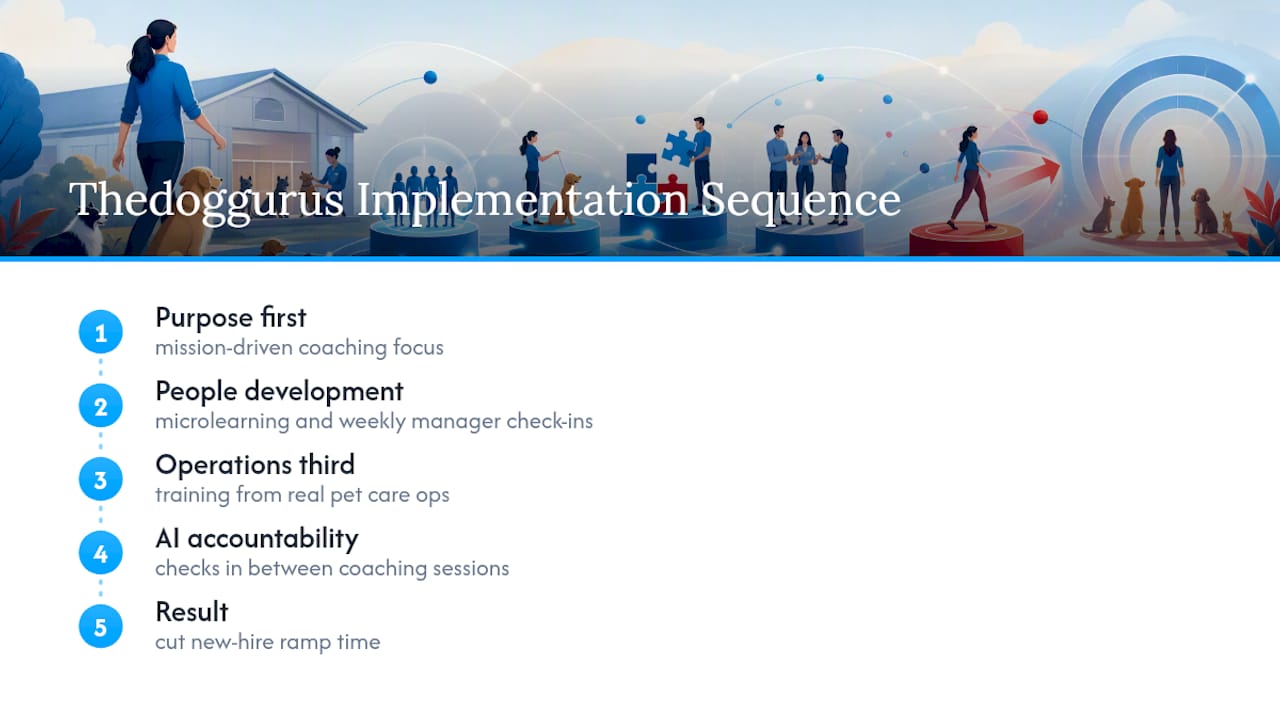
Proof points behind that approach: founder-level operating experience in daycare and boarding, staff training content built from real pet care operations, and an AI accountability layer that checks in between coaching sessions rather than after problems surface.
Owners choose a coached-plus-technology model because it catches small issues before they become turnover statistics.
— Oliver
Turn Leadership Insights Into a Trained, Confident Team
Reading about purpose-driven leadership is one thing. Actually building it into your daycare, grooming shop, or boarding facility is another. That’s where Thedoggurus’s Staff Products subscription comes in: role-specific training modules, onboarding systems, and an AI-powered accountability partner that checks in with your team between coaching sessions instead of leaving them to figure things out alone.
The subscription fits daycares, groomers, trainers, and small chains that need consistent staff development without hiring a full-time training director. Every module ties back to the same priorities covered here: safety, retention, and operational discipline. If you’re ready to put this quarter’s leadership playbook into an actual system your team can use daily, explore Staff Products pricing and start a trial today.
Where This Article’s Leadership Takeaways Came From
The leader profiles and summit themes above draw from primary sources: Yvonne Hsu’s leadership approach at Hill’s Pet Nutrition, Kristin Peck’s executive profile at Zoetis, Elise Fennig’s role at the Pet Food Institute, and event programming from PIDA’s Summit and Global Pet Expo. These remain the primary references behind the strategies outlined here.
Sources
- One percent better every day — Yvonne Hsu on leading with empathy at Hill’s Pet Nutrition
- Kristin Peck — Zoetis executive profile
- Elise Fennig — Pet Food Institute staff
- PIDA Summit 2026
- Global Pet Expo