

Use one-page, checkbox-style SOP templates for each routine procedure. They’re the fastest way to standardize care and train new staff without sitting them down for a two-hour lecture. Below you’ll find a fillable template, a proven writing method, and short sample SOPs for intake, incident response, and closing that you can adapt today.
TL;DR:
- Focus on the top five SOPs: intake, service delivery, handover, incident response, and end-of-day closing, to cover most daily pet care operations.
- Use a one-page, fillable template with clear steps, responsible roles, and contingency plans, and store it where staff can access it easily.
- Write SOPs through live walkthroughs, quick drafting, and frequent reviews, emphasizing simplicity and real-time accuracy over lengthy manuals.
- Continuously monitor compliance by tracking checklist completion, staff questions, and incident reports, updating SOPs based on actual practice.
- Treat SOPs primarily as training tools that capture best practices, not just compliance documents, to ensure consistent, reliable pet care.
Table of Contents
- What Every Pet Care SOP Template Must Include
- Which SOPs Should You Write First?
- A One-Page, Fillable SOP Template You Can Copy
- How Do You Write an SOP Fast Without Overcomplicating It?
- Rolling Out and Maintaining SOPs Without Losing Momentum
- Three Short Sample SOPs You Can Paste and Adapt Today
- How The Dog Gurus Helps You Put SOPs Into Practice
- Where Legal and Regulatory Compliance Fits Into Your SOPs
- Customizing SOPs for Different Pets and Service Types
- How Do You Know if Your SOPs Are Actually Working?
- Why Most SOP Advice Misses the Point
- Ready to Put These Templates to Work?
- Sources
What Every Pet Care SOP Template Must Include
An SOP that gets ignored is worse than no SOP at all. If it’s buried in a binder or written like a legal contract, staff will skip it and wing the procedure their own way. Every effective SOP document needs the same core fields: procedure name, purpose, materials, responsible roles, and clear steps, along with the date it was last updated.
Here’s what a properly built template should always contain:
- Title, version number, and last-updated date so nobody is training on outdated instructions
- Owner by job title (not a person’s name, since staff turn over) who is accountable for keeping it current
- A one-line purpose and scope explaining what the SOP covers and what it doesn’t
- A materials and equipment list, with a photo slot if visual reference helps (leash types, cleaning solution dilution, grooming tool setup)
- Numbered steps with checkboxes, plus a short “if something goes wrong” contingency line for the most likely failure point
- A stated location for the file, whether that’s a shared drive folder, a laminated card at the station, or your staff training platform, and who controls edits
Skip any of these and you’ll end up fielding the same clarifying questions every time a new hire starts.
Which SOPs Should You Write First?
You don’t need fifty SOPs on day one. Start with the five that govern most of what happens in a pet care facility on any given day, and you’ll cover the majority of daily operations before you write a single word about anything else. This lines up with the five-SOP prioritization framework many pet care operators use to get off the ground fast.
- Intake and check-in. Write this one first. It’s the highest-frequency, highest-liability moment of the day, and it sets the tone for every service that follows.
- Service delivery. Daycare group management, grooming sequences, and training session structure each need their own version, since the risks and pacing differ wildly.
- Handover and check-out. This is where medication handoffs go wrong most often, so spell out exactly who confirms what dose was given and when.
- Incident response. Bites, escapes, and medical emergencies need a script staff can follow under stress, not a policy they have to remember cold.
- End-of-day closing. Cleaning, inventory counts, and cash handling belong here, along with a handover note for the opening shift.
Nail these five and you’ve covered the procedures most likely to cause a bad review, an injury, or a compliance headache.
A One-Page, Fillable SOP Template You Can Copy
Here’s the order that works across grooming, daycare, boarding, and training operations, adapted from field-tested pet business documentation:
- Procedure name and category (intake, service delivery, closing, etc.)
- Owner (job title) and last-updated date
- Purpose — one sentence, no fluff
- Materials/equipment needed — bullet list, photo slot optional
- Step-by-step instructions — numbered, with a checkbox next to each
- Contingency line — what to do if the standard step fails
- Where this SOP lives — file path, binder location, or platform link
Formatting matters as much as content. Use short lines, generous spacing, and a font staff can read at a glance while standing, not sitting at a desk. Checkboxes work better than paragraphs because they let a stressed or rushed employee track progress without rereading the whole document. A photo slot next to tricky steps, like proper leash positioning or a dilution ratio, cuts down on guesswork faster than another paragraph of text ever will.
Store a digital master copy where owners can update it centrally, then post a printed version at the point of use, taped to a wall or clipped to a station. Staff shouldn’t have to hunt through a shared drive mid-shift to remember how to do their job.
How Do You Write an SOP Fast Without Overcomplicating It?
Most owners stall out trying to write SOPs from memory at a desk, weeks after they last performed the task. That’s backwards. The fastest, most accurate method puts the task in front of you while someone documents it live.
- Run a live walkthrough. Have the staff member who actually performs the task talk through it step by step while a designated scribe writes down exactly what happens, not what should happen. This walkthrough-and-scribe method captures real practice and builds staff buy-in because they see their own workflow reflected in the final document.
- Draft the one-page version and trial it. Put the draft into the template format above, then run it during normal shifts. Time it. Shadow a different staff member using only the written SOP, no verbal coaching, and see where they get stuck.
- Gather feedback and revise. Fix the steps that caused hesitation or confusion, then publish the version with a date and a sign-off from the owner or manager.
- Set a review cadence. Quarterly reviews keep most SOPs current, but any incident, injury, or equipment change triggers an immediate update rather than waiting for the next cycle.
Pro Tip: For a two-or-three-person team, assign one staff member as the permanent “scribe” for all new SOPs. Consistency in how procedures get documented matters more than who happens to be free that week.
Rolling Out and Maintaining SOPs Without Losing Momentum
Writing the SOP is the easy part. Keeping it alive after week one is where most pet care businesses fail. The Association of Shelter Veterinarians’ Guidelines call for documented protocols that staff can actually access, plus routine monitoring to confirm they’re being followed, not just filed away.
- Assign an owner by role, not by name, and fold new SOPs directly into onboarding checklists and daily shift routines.
- Train with short competency checks and shadow shifts instead of long lectures. Staff retain a five-minute demonstration far better than a fifteen-page manual read at hire.
- Audit weekly during rollout, then shift to monthly once compliance stabilizes, and keep a version history so you can trace what changed and when.
- Tie compliance into daily logs so managers catch drift before it becomes habit, not three months later during a review.
A recommended review cycle runs quarterly, with an immediate-update rule triggered by any incident or equipment change, a standard echoed across shelter and veterinary operational guidance. Skipping that cadence is how a solid SOP quietly becomes obsolete without anyone noticing until something goes wrong. For structuring the audit side of this, an operations manual approach built around sign-off logs makes accountability visible instead of assumed.
Three Short Sample SOPs You Can Paste and Adapt Today
These aren’t full templates, they’re starter drafts. Copy the structure, plug in your facility’s specifics, and trial them this week.
- Intake/check-in. Gather: owner contact, vaccination records, feeding schedule, medication list, behavioral flags. Steps: (1) confirm identity and vaccination status, (2) log any new behavioral notes from the owner, (3) complete a visual health check for limping, discharge, or skin issues, (4) confirm pickup time and authorized pickup persons, (5) file paperwork before the pet enters the play area.
- Incident response. Immediate actions: separate animals involved, secure the area, apply first aid if trained to do so. Roles: one staff member manages the animal, another documents the incident, a manager notifies the owner and, if needed, animal control or a veterinary partner. Post escalation phone numbers at the front desk, not buried in a binder.
- End-of-day closing. Steps: (1) clean and sanitize all play or grooming surfaces, (2) count and log inventory for consumables, (3) reconcile the cash drawer against the day’s transaction log, (4) write a handover note flagging any incidents or medication changes, (5) lock all storage and exterior doors.
How The Dog Gurus Helps You Put SOPs Into Practice
Writing your first five SOPs is a strong start, but scaling that across a growing team is a different challenge. There are platforms that build playbooks, staff training modules, hands-on coaching, and AI-powered accountability tools specifically for dog daycare, boarding, grooming, training, and pet sitting businesses facing this challenge.
The practical payoff is straightforward: faster onboarding because new hires learn from a documented workflow instead of tribal knowledge, more consistent care because every shift follows the same standard, and fewer costly mistakes because nothing depends on one veteran employee remembering every detail. If you’ve written the SOP but still feel like execution depends on who’s working that day, that’s a training and accountability gap, not a template problem.
Where Legal and Regulatory Compliance Fits Into Your SOPs
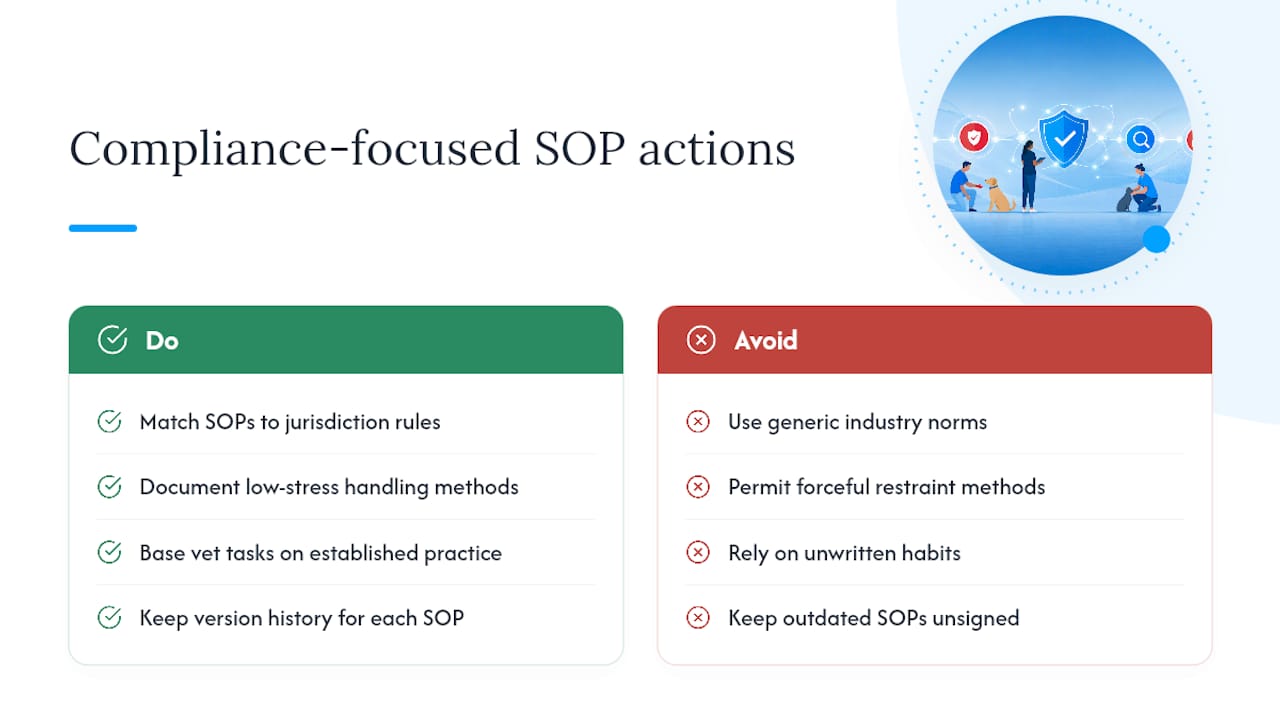
Your SOPs are also your paper trail if a licensing inspector, insurance adjuster, or attorney ever asks how your business handles animal care. Local and state licensing requirements for boarding, daycare, and grooming facilities vary widely, covering everything from vaccination verification to staff-to-animal ratios to sanitation standards, so your intake and cleaning SOPs need to reflect whatever your jurisdiction actually requires, not a generic industry norm.
Clinical and handling procedures deserve particular care. Documented protocols should point staff toward low-stress handling and humane restraint techniques rather than forceful methods, both to protect animals and to reduce injury risk to your team. If your SOPs involve any veterinary-adjacent task, medication administration, wound care, temperature checks, ground them in established practice rather than improvised habit. The WSAVA Principles of Wellness outline best-practice areas like primary care, vaccination, and parasite control that are worth referencing directly when you write feeding, medication, or health-monitoring procedures.
Keep a version history on every SOP tied to a compliance area. If an incident ever triggers a licensing review or insurance claim, being able to show exactly what your written procedure required, and when it was last updated, matters far more than being able to say you “usually” do it a certain way. This is also where a documented sign-off process pays for itself: it proves staff were trained on the current version, not an outdated one sitting in a drawer.
Customizing SOPs for Different Pets and Service Types
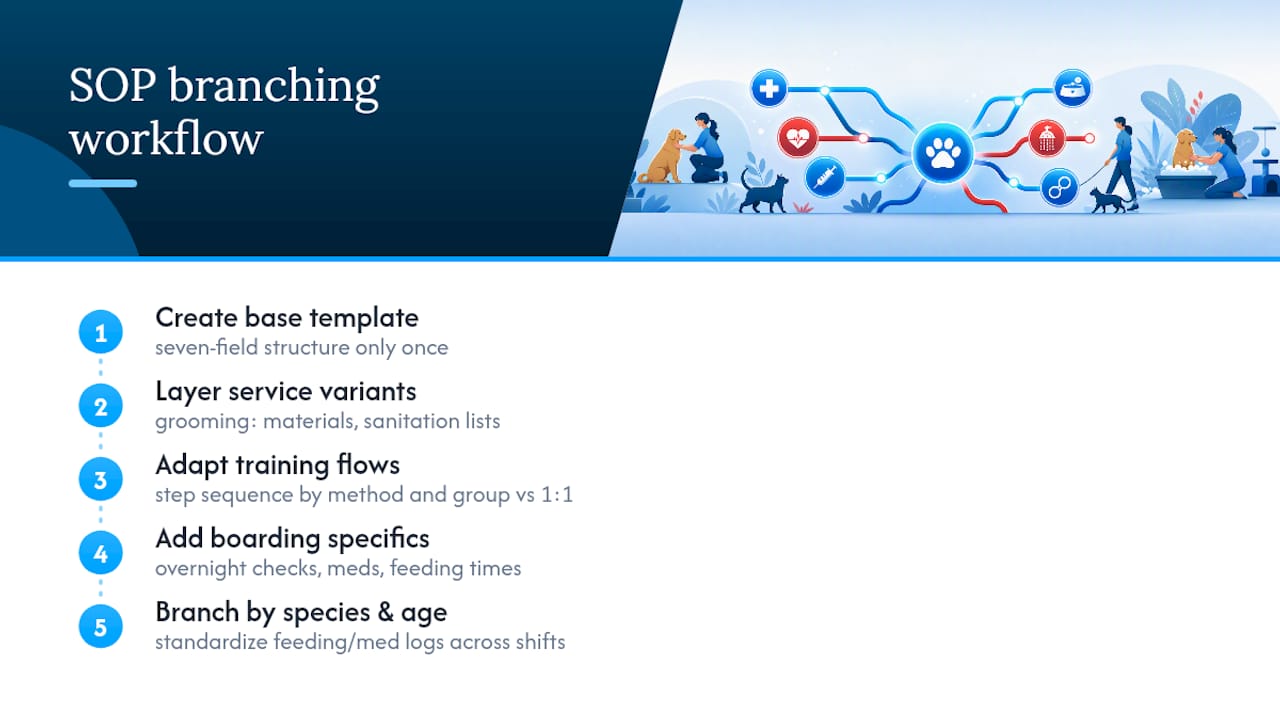
A one-page template only works if the content inside it actually fits the animal and the service. A boarding SOP for a senior dog on a twice-daily medication schedule looks nothing like an intake SOP for a young, high-energy daycare regular, even though both use the identical seven-field structure.
Build a base template first, then layer in service-specific variants. Grooming SOPs need materials lists tailored to coat type and tool sanitation between clients. Training SOPs need step sequences that vary by method and by whether the session is group or one-on-one. Boarding SOPs carry more weight around overnight monitoring, medication timing, and feeding schedules than a same-day daycare visit does. The Merck Veterinary Manual’s routine care guidance is a useful reference point when you’re deciding what vaccination, parasite prevention, or wellness-check details belong in a boarding or long-stay SOP.
Feeding and medication schedules deserve their own attention across every service type, since inconsistency here is one of the fastest ways to lose an owner’s trust. A structured feeding routine framework can help you standardize how staff log meals, portions, and timing across boarding and daycare stays, especially when multiple shifts are handling the same animal.
Don’t try to build one universal SOP that tries to cover cats, dogs, puppies, and senior animals under a single procedure. Write the base structure once, then branch it by species, age, and service type so staff aren’t stretching a daycare SOP to cover a boarding scenario it was never designed for.
How Do You Know if Your SOPs Are Actually Working?
An SOP that nobody follows isn’t a documentation problem, it’s a signal that something in the procedure itself doesn’t match reality. The clearest measure of effectiveness isn’t whether the document exists, it’s whether completed checklists are coming back filled out correctly, shift after shift.
Track a few practical signals: how often checklists are completed in full versus skipped, how many clarifying questions new hires ask about a given procedure after their first week, and whether incident reports keep citing the same failure point. If three different staff members skip the same step, the step is probably unclear or unrealistic, not the staff.
Build a light feedback loop into your review cadence. When you do your quarterly review, pull the last few months of completed checklists and incident notes before you touch the document. Ask the staff who use the SOP daily what slows them down. That feedback, paired with the routine monitoring guidance in the ASV Guidelines, keeps your SOPs anchored to how work actually happens on the floor rather than how you imagined it would go when you wrote the first draft.
Continuous improvement here doesn’t mean rewriting everything constantly. It means treating each SOP as a living document that earns small, evidence-based edits over time, not a one-and-done project you check off and forget.
Why Most SOP Advice Misses the Point
The conventional wisdom on SOPs treats them like a compliance checkbox: write it once, file it, move on. That’s backwards, and it’s why so many pet care businesses have a binder full of SOPs nobody actually opens.
What the evidence here actually supports is treating SOPs as a training tool first and a compliance record second. The walkthrough-and-scribe method works precisely because it documents what your best employee already does correctly, then hands that knowledge to everyone else. That’s the real value: SOPs move knowledge out of one person’s head and into something teachable, which is exactly what a growing team needs most.
Where most owners get it wrong is length. A fifteen-page SOP feels thorough, but staff won’t read it during a busy shift. One page, with checkboxes and a contingency line, beats a comprehensive manual every time it actually gets used. Prioritize your five core SOPs before you write anything else, and revisit them on a real cadence instead of writing them once and hoping they hold up for years.
— Oliver
Ready to Put These Templates to Work?
Writing five solid SOPs gets your foundation in place. Turning that foundation into a team that actually follows it, consistently, across every shift, is a different job, and it’s the one Thedoggurus staff products are built to solve. You get editable SOP templates, role-specific training modules, and hands-on coaching designed for daycare, boarding, grooming, training, and pet sitting teams, not generic office procedures repackaged for pets.
Instead of building your training system from scratch, you start from templates already shaped around the procedures pet care businesses actually run. Check out the Staff Products plans and start a free trial to see how quickly your team can move from scattered tribal knowledge to documented, consistent care.