
Operational AI for professional pet-care businesses automates bookings, client communication, scheduling, record compliance, and routine admin so you reclaim time and grow capacity. Three outcomes operators see most: time recovered (up to 8–15 front-desk hours per week), bookings captured (including after-hours and missed calls), and consistent compliance (vaccination checks, consent records, payment security). The sections below give you a prioritized pilot checklist and a 90-day roadmap you can start this quarter.
Table of Contents
- What can AI actually do for your pet-care business right now?
- Which pilots should you run in the next 30–90 days?
- How do you build a 90-day implementation roadmap?
- What pitfalls and vendor red flags should you watch for?
- Key Takeaways
- Why most pet-care operators underestimate the change-management side of AI
- How Thedoggurus helps you put AI to work this quarter
- Useful sources and vendor evaluation checklist
What can AI actually do for your pet-care business right now?
Artificial intelligence for pets and pet-care operations is not one tool. It is a layer of automation that connects your existing software, handles repetitive tasks, and flags exceptions for human review. Here is where it delivers real value today.
- Booking automation. A chatbot checks groomer availability, books the appointment, sends a confirmation, and writes to your calendar without staff involvement. AI booking assistants work across your website, SMS, and social channels.
- After-hours front desk. Conversational agents handle inbound calls and messages when your team is off. PupPilot-style front-office tools book live appointments, retrieve records, and hand off to staff in the morning with a clean summary.
Pro Tip: Pair every AI tool with your existing pet-management platform first. Map the data fields it reads and writes before you configure anything. Set a human-review threshold for any action that touches a booking, charge, or medical record so nothing changes silently.
Which pilots should you run in the next 30–90 days?
Start with the booking and reminders stack. It is usually the fastest path to recovered revenue, and the time savings fund larger projects later. Here is a prioritized list, ordered by impact-to-effort ratio.
- AI-assisted scheduling optimization — 6–10 hours; medium risk; an AI operating system learns your facility patterns and adjusts time slots dynamically.
Sample timeline:
How do you build a 90-day implementation roadmap?
A staged rollout keeps risk low and gives you real data before you commit to larger investments.
| Phase | Timeline | Owner | Manager | Front Desk | Vendor |
|---|---|---|---|---|---|
| Discovery | Week 1–2 | Approves budget, selects pilots | Maps current workflows | Documents pain points | Scopes integration |
| Pilot build | Week 3–4 | Reviews config | Tests exception rules | Trains on new tools | Configures and tests |
| Live pilot | Week 5–10 | Monitors KPIs weekly | Manages exception queue | Runs daily operations | Provides support |
| Evaluation | Week 11–Week 12 | Scale/stop decision | Compiles KPI report | Flags edge cases | Reviews audit logs |
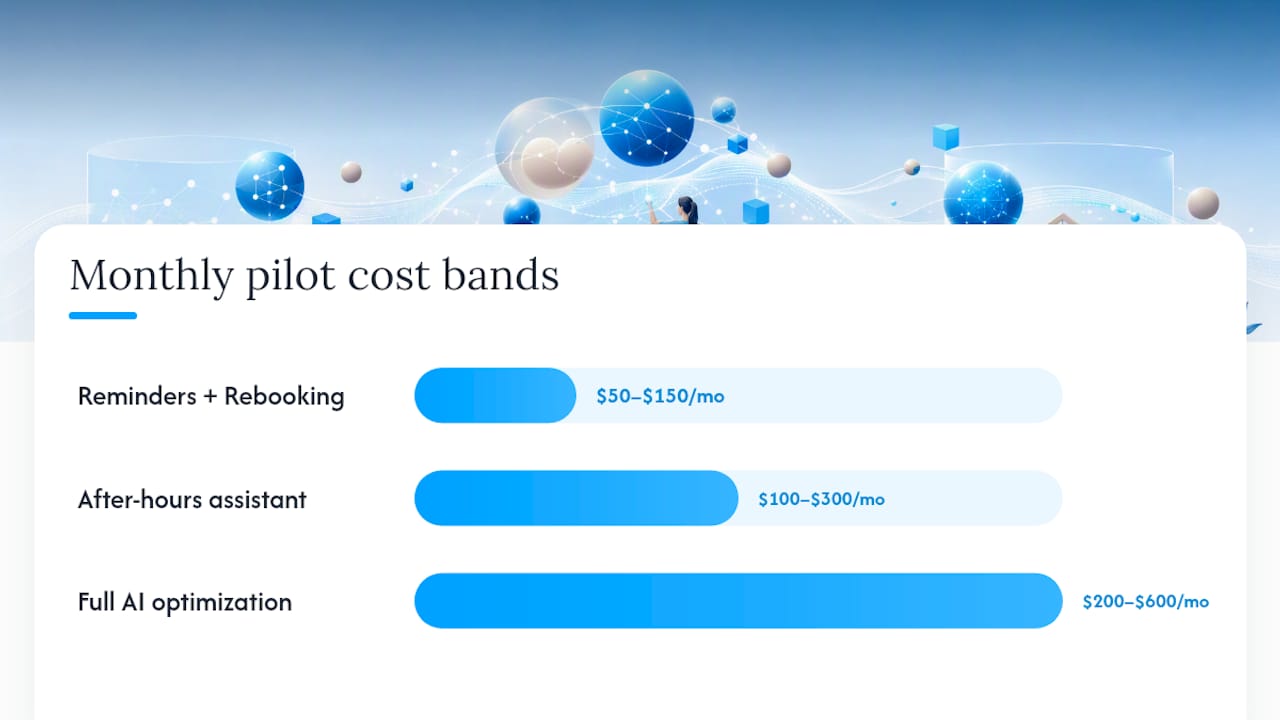
Cost bands for common pilots:
- Reminders + rebooking: $50–$150/month for a basic automation stack
- After-hours booking assistant: $100–$300/month depending on call volume
- Full AI scheduling optimization: $200–$600/month for an integrated platform tier
KPI baseline and targets:
| Metric | Baseline | 90-Day Target |
|---|---|---|
| Bookings recovered (after-hours) | — | Track and report monthly |
| Front-desk hours saved | — | 8–15 hours/week |
| No-show rate | Measure now | Reduce by 20–30% |
| Revenue per customer (90 days) | Measure now | Increase via rebook rate |
| Rebook rate | Measure now | Increase via automated prompts |
For AI scheduling guidance specific to pet-care operations, Thedoggurus covers how scheduling assistants interact with staff availability and labor-cost targets.
What pitfalls and vendor red flags should you watch for?
Do:
- Set human-review thresholds before going live.
- Test exception routing with real scenarios before launch.
- Keep pilots narrow. One or two use cases at a time.
Don’t:
- Automate cancellations or charges without a human approval step.
- Ignore the exception queue. A backlog there means the system is failing.
- Skip staff training because the tool “seems simple.”
Vendor red flags:
- No audit logs or access controls in the product demo.
- No clear human-escalation path for edge cases.
- Opaque pricing that changes after onboarding.
- No API or data-export capability.
Pro Tip: Scope creep kills pilots. Write down exactly which workflows the pilot covers before you start. Any new request goes on a backlog for Phase 2.
Key Takeaways
Operational AI for pet-care businesses delivers the fastest ROI through booking automation and reminders, with 8–15 front-desk hours recovered per week and no-show rates reduced by 20–30% when pilots are run with clear human-review thresholds.
| Point | Details |
|---|---|
| Start with bookings and reminders | This pilot recovers revenue fastest and funds larger automation projects. |
| Set human-review thresholds first | Every action touching a booking, charge, or record needs a staff approval step before full automation. |
| Use a 30/60/90 KPI structure | Measure no-shows, hours saved, and rebook rate at each gate before scaling. |
| Treat data security as a vendor requirement | Require PCI compliance, audit logs, and data-export capability from every AI vendor you evaluate. |
| Thedoggurus accelerates the process | Thedoggurus provides training, playbooks, AI-powered operational tools, and coaching to help you implement and scale. |
Why most pet-care operators underestimate the change-management side of AI
The technology part of an AI pilot is usually the easy part. You pick a tool, configure a workflow, and it either works or it does not. What trips up most operators is the human side: staff who route around the exception queue because it feels like extra work, owners who automate too fast and end up with a backlog of confused clients, and vendors who promise integration but deliver a disconnected add-on.
The operators who get real results treat AI the same way they treat a new staff member. They train it, supervise it, set clear boundaries, and review its work before it goes out the door. That mindset, not the tool itself, is what separates a successful pilot from a frustrating one.
The other thing most articles miss: the biggest ROI in this space is not the flashy scheduling optimizer; it is the boring reminders-and-rebooking stack that runs quietly in the background and recovers revenue you were already losing. Start there. Build confidence. Then go bigger.
How Thedoggurus helps you put AI to work this quarter
Running a pet-care business is demanding enough without becoming an AI expert on top of it. Thedoggurus is the all-in-one platform built specifically for daycare, boarding, grooming, training, and pet-sitting operators who want proven tools and expert guidance, not a DIY experiment.
The platform combines AI-powered operational tools, expert-led courses, role-specific staff training modules, and hands-on coaching in one place. A typical pilot engagement starts with a 30–45 minute demo where you walk through your current workflows, identify your highest-impact pilot, and leave with a concrete 90-day plan. After signup, you get access to owner-focused product bundles and staff training modules built for real pet-care operations.
Ready to see what your first pilot could look like? Review the plans and pricing and book a demo this week.
Useful sources and vendor evaluation checklist
| Resource | What it covers |
|---|---|
| K.AI — Booking Automation for Pet Businesses | Reminder cadences, vaccination blocking, cost bands |
| SmbAI — Dog Daycare & Boarding Guide | Staged rollout roadmap, platform feature priorities |
| AI Business OS — Pet Boarding & Grooming | How AI scheduling optimization works operationally |
| MVP.dev — Pet Boarding Workflow Systems | Governance, audit logs, recovered hours benchmarks |
| PupPilot — AI Front Office | After-hours booking, record retrieval, front-desk automation |
| TailWerks — AI Growth Partner | When to use an AI partner vs. DIY tools |
| Thedoggurus | Training, coaching, AI tools, and playbooks for pet-care operators |
Vendor evaluation checklist (copy into your RFP):
- AI Automation for Pet Groomers and Boarding Kennels: More Dogs, Less Chaos | K.AI
- AI Tools for Dog Daycare & Boarding: 2026 Guide | SmbAI
- How an AI Operating System Works: A Pet Boarding & Grooming Guide | AI Business OS
- Pet Boarding & Grooming Workflow Systems | MVP.dev
- PupPilot — The AI Front Office for Veterinary Clinics
- AI Growth Partner for Pet Businesses | TailWerks
- The Dog Gurus
This article provides general operational guidance, not legal or compliance advice. Confirm your specific data-privacy and PCI obligations with a qualified professional or your state’s relevant authority.