

The recommended default: require 48 hours’ notice for standard bookings and 7 days for boarding or overnight stays, charge 50% of the service fee for late cancellations, and bill the full amount for no-shows. Adjust upward around holidays, when rebooking is nearly impossible.
Copy this into your booking terms:
- “Cancellations made less than 48 hours before a scheduled visit are charged 50% of the service fee. No-shows and same-day cancellations are charged in full. Boarding reservations require 7 days’ notice for a full refund of the deposit.”
Pro Tip: Tighten your window to 10-14 days during major holidays. That’s when rebooking a canceled slot is closest to impossible.
Key Takeaways
A pet business protects its revenue and staff scheduling by pairing a tiered cancellation fee structure with automated card-on-file enforcement and clearly documented exceptions.
| Point | Details |
|---|---|
| Set tiered windows | Use 24-48 hours for walks and single visits, 7+ days for boarding and holiday bookings. |
| Charge fees, not full refunds | Apply 50% fees for late cancellations and 100% for no-shows to protect revenue. |
| Require card on file | Collect payment details at booking so fees charge automatically, not through awkward calls. |
| Document every exception | Log waivers and reserve them for verified emergencies, not repeat late cancellations. |
| Automate with the right tools | Time To Pet and PetPocketbook handle billing automation; Thedoggurus provides the policy templates and training behind it. |
This article is general information, not a substitute for advice from a qualified lawyer. Consult a qualified legal professional about your own circumstances before acting on anything here.
Table of Contents
- Why You Need a Cancellation Policy for Your Pet Business
- How Do You Choose Cancellation Windows and Fees?
- Should You Offer Refunds, Credits, or Account Balances?
- Where Should You Display Your Cancellation Policy?
- How Do You Enforce the Policy Without Losing Clients?
- What Should Your Cancellation Clauses Actually Say?
- Which Tools Make Your Policy Easier to Enforce?
- How Should You Roll Out a New Cancellation Policy?
- Sources
Why You Need a Cancellation Policy for Your Pet Business
A missed boarding reservation doesn’t just cost you one client. It costs you the staff hours you scheduled, the kennel space you turned other families away from, and the payroll you still owe your team whether or not a dog shows up.
Picture a five-night boarding stay canceled the morning of check-in. You’ve likely turned away two or three other inquiries for that same week. Without a fee in place, that revenue is simply gone, and your walker or kennel tech still gets paid for a shift with no dog to care for.
Industry norms give you a benchmark. Grooming and pet-care businesses commonly use 24 to 48 hour notice windows, cancellation fees at typical industry amounts, and no-show fees ranging from half to full service price. That range works just as well for walking and sitting businesses.
- Cashflow stays predictable when late cancellations still generate partial revenue.
- Staff scheduling stays reliable because a policy discourages last-minute drop-offs.
- Booked capacity stays protected instead of sitting empty after a late cancellation.
How Do You Choose Cancellation Windows and Fees?
Your policy should scale with how much is at stake. A single dog walk and a seven-night boarding stay carry completely different risk, so they need different rules.
Base your decision on four factors: how far in advance the client booked, how much revenue sits on that reservation, how realistic it is to fill the slot with another client, and whether it’s peak season. A canceled walk on a Tuesday afternoon is easy to backfill. A canceled boarding week over spring break usually isn’t.
Here’s a starting framework most sitting, walking, and boarding businesses can adapt directly:
| Service Type | Notice Window | Late Fee | No-Show Fee |
|---|---|---|---|
| Dog walking / single visit | 24 hours | 50% of visit fee | full visit fee |
| Overnight pet sitting | 48 hours | 50% of nightly rate | full nightly rate |
| Multi-day boarding | 7 days | Deposit forfeited | Full stay charged |
| Holiday / peak-season boarding | 10-14 days | Deposit forfeited | Full stay charged |
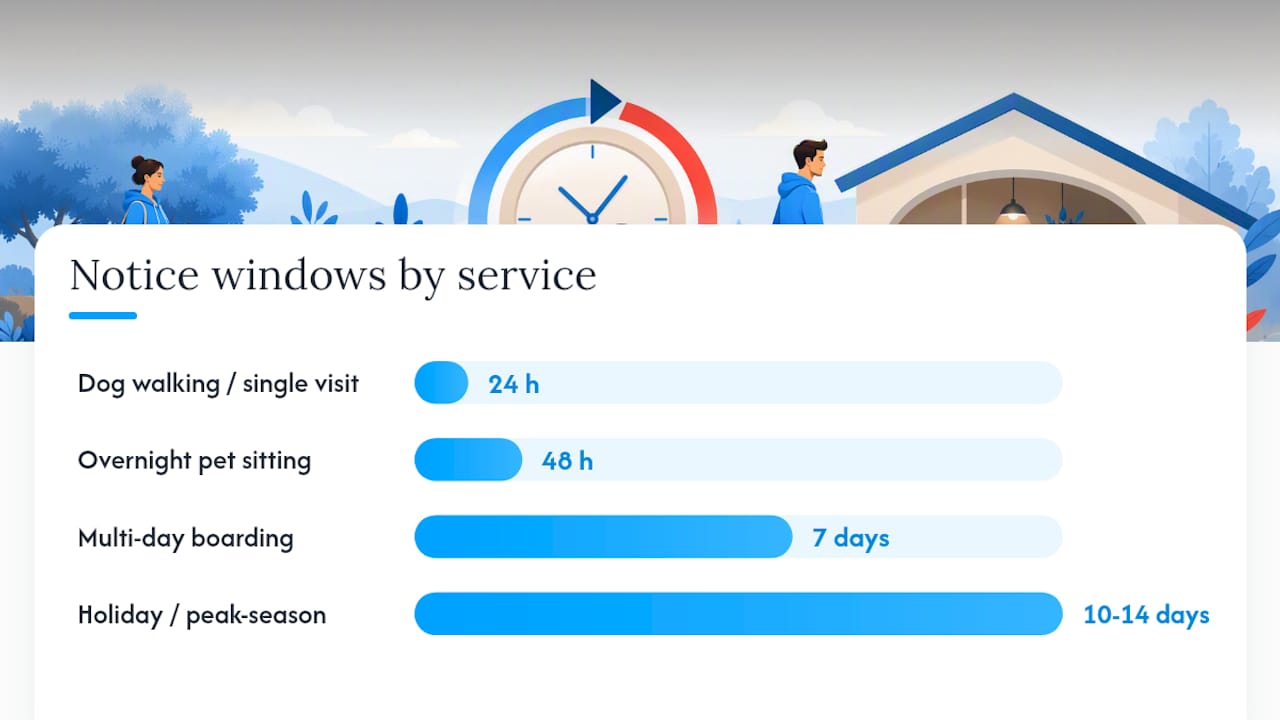
This mirrors what established pet-care terms already use. One widely referenced boarding template sets deposits as non-refundable within 7 days of check-in, 50% refundable 8 to 13 days out, and fully refundable 14 or more days before arrival, while daycare and in-home visit terms often apply a flat 24-hour window with a 50% charge inside it and full charge for same-day cancellations or no-shows.
Deposits and card-on-file requirements do the heavy lifting here. For first-time clients or holiday bookings, ask for full prepayment. This isn’t about distrust. It’s about making sure your pricing strategy actually holds up when plans change.
Should You Offer Refunds, Credits, or Account Balances?
Each option protects a different priority, and most successful pet businesses use all three depending on the situation.
Cash refunds preserve goodwill but hurt your cashflow and complicate your bookkeeping, especially if you’re processing them through multiple payment platforms. Account credits keep the money in your business while still rewarding a loyal client with flexibility. Straight fee retention (no refund, no credit) protects revenue completely but can strain a relationship with a client who had a genuine emergency.
- Use credits for repeat clients rebooking within 60-90 days, or when a cancellation happens outside your control (you had to reschedule, not them).
- Use refunds sparingly, mainly for provider-side errors or double-bookings.
- Retain the fee outright for late cancellations and no-shows from clients who’ve already been reminded of the policy.
A sample line for your terms: “Cancellations inside the notice window are issued as account credit valid for 90 days, rather than a cash refund.” That single sentence sets client expectations and protects the budget you’ve already built around expected revenue.
Where Should You Display Your Cancellation Policy?
A cancellation policy only works if the client actually saw it and agreed to it before booking. Bury it in a footer link, and you’ll spend more time arguing about fees than collecting them.
Show the policy in these places, every time:
- During onboarding, as part of your new-client paperwork.
- On the booking page itself, directly above the “confirm booking” button.
- In the confirmation email sent immediately after booking.
- On every invoice and printed receipt.
Getting explicit agreement matters as much as visibility. Require a checkbox at booking that says “I have read and agree to the cancellation policy,” and back it with a signed service agreement for boarding and recurring clients. Card-on-file at signup doubles as implicit agreement to the fee terms, provided your terms say so explicitly.
- Send a reminder 48 hours before the appointment restating the cancellation window.
- Send a second reminder 24 hours out, with a direct link to reschedule or cancel through your booking portal.
- Use consistent scripting: “Just a reminder, your appointment is in 48 hours. Cancellations after this point are subject to our policy.”
How Do You Enforce the Policy Without Losing Clients?
A policy that’s never enforced isn’t a policy. It’s a suggestion, and clients will treat it that way.
Follow the same five-step workflow every time a late cancellation happens:
- Record the cancellation time against your notice window the moment it happens.
- Notify the client immediately, referencing the specific policy line they agreed to.
- Charge the card on file automatically rather than invoicing manually.
- Document the interaction, including any reason given, in the client’s file.
- Follow up with a brief note confirming the charge and thanking them for their business.
Exceptions exist for a reason, but they need boundaries. Verified emergencies (hospitalization, a death in the family, documented severe weather) are reasonable grounds for a waiver. A client “forgetting” or changing plans is not. One owner or manager should hold final say on waivers, not whoever answers the phone that day.
Pro Tip: Keep a simple waiver log; three or more waived fees from the same client in a year is your signal to stop waiving and start enforcing.
Tiered fees and documented exceptions aren’t unique to pet care. Large healthcare systems run the same model, charging set late-cancellation fees while carving out case-by-case exceptions for emergencies, which is worth borrowing if you want a framework clients already recognize from other industries.
What Should Your Cancellation Clauses Actually Say?
Here are three ready-to-use templates. Adjust the numbers to match your local market and demand, but keep the structure intact.
Dog walking / single visit:
“We require 24 hours’ notice to cancel or reschedule a walk. Cancellations inside 24 hours are charged 50% of the visit fee. No-shows are charged in full.”
Overnight pet sitting:
“Overnight sitting reservations require 48 hours’ notice for a full refund. Cancellations inside 48 hours are charged 50% of the total booking. Same-day cancellations and no-shows are charged in full.”
Multi-day boarding (holiday variant):
Standard bookings canceled 7+ days before check-in receive a full deposit refund. Holiday and peak-season bookings (Thanksgiving, December holidays, spring break) require 14 days’ notice for any refund; the deposit is forfeited for later cancellations."*
Adjust your fee percentages based on how tight your local market is. A high-demand urban market with a waitlist can afford stricter terms than a smaller town where rebooking a canceled slot takes weeks.
- For repeat late cancellations, add escalation language: “Clients with two or more late cancellations in a 12-month period will be required to prepay in full for future bookings.”
- For deposit triggers, state clearly when a deposit becomes non-refundable, not just when it’s due.
Practical templates for pet sitters reinforce this same pattern: notice window, tiered fee, documented exception, all stated in plain language upfront.
Which Tools Make Your Policy Easier to Enforce?
A policy written down means little if enforcing it takes a phone call and an awkward conversation every time. The right software turns enforcement into something automatic.
Your implementation checklist should include:
- Card-on-file collection at the time of booking, not after.
- Automated invoicing that bills the correct fee tier without manual math.
- Automatic cancellation charges triggered by your booking system’s own clock.
- Real-time availability updates so a canceled slot can be resold immediately.
Several platforms built specifically for pet care handle this well. Time To Pet offers client portals with automated invoicing and card-on-file billing built around pet-sitting and dog-walking workflows. PetPocketbook focuses on scheduling and payment automation tailored to boarding and daycare operations, including automatic fee collection. The Dog Gurus brings the operational side, offering coaching, staff training, and playbook templates that help you design the policy itself before you ever plug it into software.
Automation examples worth setting up: an automatic charge triggered the moment a booking is marked as a no-show, and a deposit requirement that kicks in automatically after a client’s second late cancellation.
How Should You Roll Out a New Cancellation Policy?
Rolling out a new policy badly (an email nobody reads, no staff training) guarantees confusion and pushback. Rolling it out well takes about a week of planning.
- Publish the policy on your booking page, invoices, and client portal.
- Train staff on the exact scripts for explaining and enforcing fees.
- Update booking flows to require checkbox agreement before confirming.
- Announce the change to existing clients with 30 days’ notice.
- Monitor results monthly and adjust fee tiers if cancellations spike or drop.
Track four numbers every month: your overall cancellation rate, revenue recovered from fees, the number of client disputes, and your repeat-offender rate. If disputes climb but your cancellation rate doesn’t drop, your scripting probably needs work, not your fee amounts.
Pro Tip: Run a 15-minute team huddle the week you launch a new policy. Staff who can explain the “why” behind a fee handle pushback far better than staff who are just told to charge it.
Balancing Firmness and Goodwill
Enforce consistently for repeat offenders. Waive quickly and warmly for genuine emergencies. That balance is what keeps your team’s schedule protected and your clients’ trust intact.

How The Dog Gurus Helps You Build a Policy That Actually Sticks
Writing the policy is the easy part. Training your team to enforce it the same way every time, without awkward conversations or inconsistent waivers, is where most pet businesses struggle. Thedoggurus gives you the playbook templates, staff training modules, and coaching to build a cancellation policy your whole team applies consistently, not just the one owner who remembers the rules.
Instead of guessing at fee percentages or writing scripts from scratch, you get frameworks built specifically for dog daycare, boarding, grooming, and pet-sitting operations, backed by coaching from people who’ve run these businesses themselves. If you’re ready to stop losing revenue to late cancellations and no-shows, check out The Dog Gurus pricing plans to see which tier fits your team size and get started.
Sources
- Dog Grooming Cancellation Policy: Template + Examples (2026)
- Terms and Conditions for On Paws Pet Care Services
Recommended
- Emergency Evacuations & Safety Protocols in Your Pet Business – The Dog Gurus
- Enhancing Staff Accountability in Pet Boarding and Daycare: The Operations Manual Advantage – The Dog Gurus
- Creating a Budget for Your Pet Care Business – The Dog Gurus
- 3 Tips for Setting Profitable Pricing for Your Pet Care Business – The Dog Gurus