

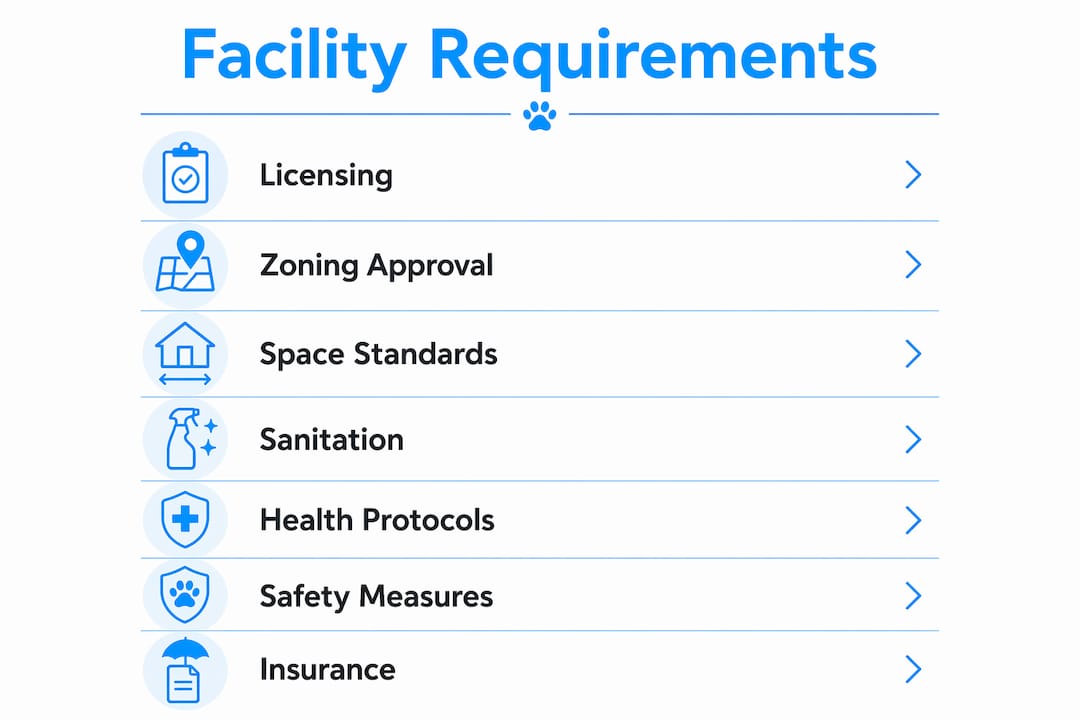
Running a compliant dog boarding facility in the United States means satisfying a layered set of legal, physical, and operational standards that vary by state, county, and city. Here is what every entrepreneur needs to know before opening the doors:
- Licensing and registration are universally required. Every state mandates some form of kennel or pet boarding license, and most localities add their own permit layer on top.
- Facility standards set the floor for animal welfare, covering minimum enclosure sizes, sanitation schedules, ventilation, temperature control, and secure construction.
- Health protocols require documented vaccination records (rabies, DHPP, and Bordetella at minimum), written emergency veterinary care plans, and health observation at least every 24 hours.
- Operational policies must address staff training, behavioral assessments, daily enrichment, and written emergency evacuation procedures.
- Key legal frameworks like California’s Pet Boarding Facilities Act and Michigan’s Kennel Licensing Act set the benchmark for what rigorous compliance looks like at the state level, and understanding them gives you a solid foundation even if you operate elsewhere.
Getting all of this right from day one protects the animals in your care, shields your business from liability, and builds the kind of reputation that keeps clients coming back.
Table of Contents
- What dog boarding facility requirements cover across U.S. jurisdictions
- How to meet facility space, sanitation, and safety standards
- Vaccination and veterinary care protocols your facility must follow
- Operational best practices that go beyond the legal minimum
- Insurance requirements and liability coverage for boarding facilities
- Key Takeaways
What dog boarding facility requirements cover across U.S. jurisdictions
Licensing is the first legal gate you must pass through, and the rules differ significantly depending on where you operate. Most states regulate boarding kennels through their department of agriculture or a comparable animal welfare agency. Michigan, for example, charges a modest kennel license fee, with charges varying based on the number of dogs housed, and with increased fees applied in certain non-compliance scenarios. That fee structure is modest, but the underlying compliance requirements are not.
Zoning clearance is often the harder hurdle. Many residential and mixed-use zones prohibit commercial boarding outright, and some municipalities require a conditional use permit before you can even apply for a kennel license. Verify zoning status with your local planning department before signing a lease or purchasing property. Discovering a zoning conflict after you have invested in build-out is an expensive mistake.
At the federal level, facilities that also breed or sell dogs may fall under the Animal Welfare Act, administered by USDA APHIS. Pure boarding operations typically sit outside federal jurisdiction, but if your business model includes any sales activity, confirm your obligations with APHIS directly.
| Jurisdiction level | Governing body | Typical requirement | Renewal period |
|---|---|---|---|
| State | Dept. of Agriculture / Animal Welfare | Kennel or pet boarding license | Annual |
| County / City | Local animal control or planning dept. | Business permit, zoning clearance | Annual or biennial |
| Federal (APHIS) | USDA | Animal Welfare Act compliance (if applicable) | Annual |
| State (California) | Dept. of Public Health | Pet Boarding Facilities Act compliance | Annual |
| State (Michigan) | Dept. of Agriculture | Kennel Licensing Act registration | Annual |
Inspections accompany every license tier. Inspectors typically review sanitation records, vaccination documentation, enclosure conditions, staff-to-dog ratios, and emergency preparedness plans. Operating without a valid license or ignoring a zoning restriction can result in fines, forced closure, and in some states, criminal misdemeanor charges. The risk simply is not worth it. If you are starting a dog boarding business, build your compliance calendar before you build anything else.
How to meet facility space, sanitation, and safety standards
Physical facility standards are where many new operators underestimate the investment required. Getting these right protects the animals and keeps you on the right side of inspectors.
Minimum space requirements
USDA APHIS publishes minimum space requirements for dogs that serve as a widely referenced federal baseline. The calculation accounts for the dog’s length plus six inches, squared, to determine the minimum floor space per animal. California’s Pet Boarding Facilities Act goes further, requiring that temporary enclosures limit confinement to humane thresholds, with daytime use capped at four hours maximum. Every dog must be able to sit, stand at full height, lie fully stretched out, and turn around without touching walls or other animals.
Structural and material requirements
Enclosure materials must be durable, non-toxic, and easy to disinfect. Concrete and sealed epoxy flooring are the standard choices because they are impervious and drain properly. Wood, bare dirt, brick, and grass floors are not acceptable in most jurisdictions because they cannot be adequately sanitized. Walls and partitions between runs must prevent direct nose-to-nose contact between dogs from different households unless owners have provided written consent.
Sanitation and environmental controls
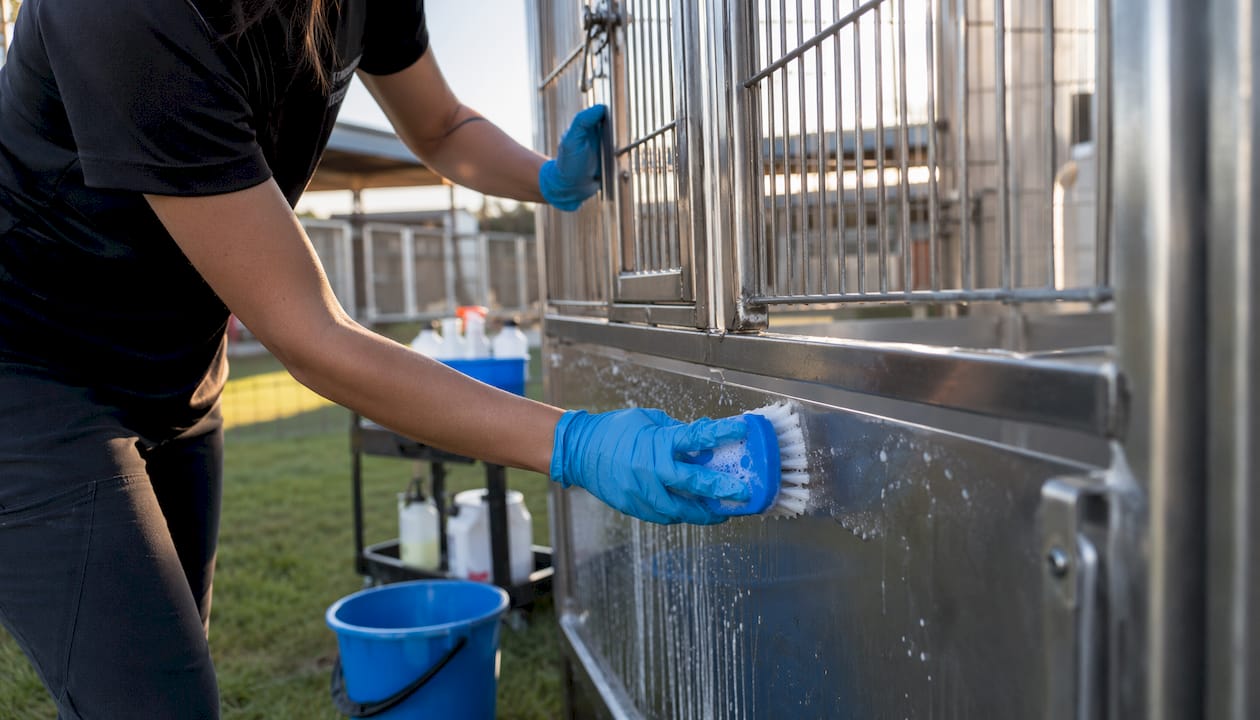
- Enclosures must be cleaned and disinfected at least twice daily, with waste removed immediately.
- Pest control programs must be documented and actively maintained.
- Ventilation must keep housing areas free of dampness, noxious odors, and drafts, with a continuous supply of fresh air.
- Temperature must be maintained within a range appropriate for the species and age of animals present.
- Lighting must be sufficient for staff to observe animals clearly and work safely.
- Drainage systems must prevent standing water in runs and indoor areas.
- Grooming areas must be physically separated from boarding spaces to prevent cross-contamination.
Fire safety and emergency exits
Every facility needs working fire extinguishers, clearly marked emergency exits, and an evacuation plan posted where all staff can see it. Many states and local fire codes require annual fire safety inspections as a condition of your business license. Detailed guidance on building and testing your emergency evacuation protocols is worth reviewing before your first inspection.
Pro Tip: Conduct a mock inspection of your own facility every quarter. Walk through with a checklist that mirrors your state’s actual inspection criteria. Catching a sanitation gap or a missing record before an inspector does is far less costly than a violation notice.
Vaccination and veterinary care protocols your facility must follow
Health documentation is non-negotiable. Every dog admitted to your facility should arrive with proof of current vaccinations, and your staff needs to know exactly what to look for.
Required vaccines
Licensed boarding facilities commonly require proof of vaccination against rabies, DHPP (distemper, hepatitis, parvovirus, and parainfluenza), and Bordetella. Many facilities also require the canine influenza vaccine, particularly in regions where outbreaks have occurred. All vaccines should be administered at least two weeks prior to the first boarding stay so the dog’s immune response has time to develop. Bordetella protection typically lasts six months to one year depending on the vaccine formulation and your facility’s policy.
- Rabies: Required by law in every U.S. state; valid for one or three years depending on the vaccine used.
- DHPP: Core vaccine; typically boosted every one to three years after the initial puppy series.
- Bordetella: Required by most boarding facilities; frequency ranges from every six months to annually.
- Canine influenza (H3N2/H3N8): Increasingly required; two-dose initial series followed by annual boosters.
Veterinary care and emergency planning
State regulations, including those in North Carolina, require that facilities maintain a written emergency veterinary care plan detailing protocols for medical emergencies during and after business hours. This plan must name a licensed veterinarian, provide after-hours contact information, and outline the steps staff will take when an animal shows signs of illness or injury. Animal records, including vaccination history and any medical events during the stay, must be retained for at least one year after the animal’s release.
Health observation must happen at least every 24 hours for every dog in your care. Any animal showing signs of contagious illness must be immediately isolated in a separate, self-contained area that prevents contact with healthy animals. Potable water must be available to every dog at all times unless a veterinarian or the owner has provided written instructions to restrict it, per California’s Pet Boarding Facilities Act.
Statistic callout: Bordetella vaccine protection typically lasts six months to one year, which means many dogs boarding multiple times per year will need more than one dose annually. Build a vaccine verification step into every check-in process, not just the first visit.
Operational best practices that go beyond the legal minimum
Compliance gets you licensed. Strong operations keep dogs safe, staff confident, and clients loyal. The two are not the same thing, and the best boarding businesses treat them separately.
Staff training and recognition skills
Your team is your first line of defense against illness, injury, and behavioral incidents. Staff training should cover how to recognize early signs of respiratory distress, gastrointestinal illness, anxiety, and aggression. California’s regulations explicitly require that staff be trained to follow standardized operational protocols for animal care and emergency response, and that training must be ongoing, not a one-time onboarding event. Schedule quarterly reviews of your safety procedures and document them. That documentation becomes evidence of good faith during inspections.
Behavioral assessments and compatibility screening
- Conduct a temperament evaluation before accepting any new dog for boarding.
- Assess social compatibility separately from individual temperament, since a dog can be friendly in isolation but reactive in group settings.
- Use the results to build a customized care plan that specifies housing type, play group eligibility, and handling notes.
- Document every assessment and keep it in the dog’s file.
Behavioral evaluations reduce in-facility incidents and give you defensible records if a bite or injury claim arises. For guidance on managing problem behaviors in group settings, Thedoggurus has practical frameworks built specifically for boarding and daycare environments.
Daily enrichment and written care policies
California’s Pet Boarding Facilities Act mandates daily enrichment and written animal care policies as licensing conditions. Nebraska’s boarding kennel regulations similarly require that exercise opportunities be appropriate to each dog’s age and health, following a written plan. Enrichment does not have to be elaborate. Puzzle feeders, structured play sessions, and one-on-one interaction time all count. What matters is that it is documented, consistent, and tailored to the individual animal.
Emergency evacuation and disaster response
Every facility needs a written evacuation plan that accounts for fire, flooding, power outages, and other disasters. The plan should assign specific roles to staff members, identify primary and secondary evacuation routes, and specify where animals will be housed temporarily if the facility becomes uninhabitable. Run a drill at least twice a year and log the date and outcome. Some states require documented drills as part of the annual license renewal process.
Pro Tip: Offer a mandatory trial boarding day for all new clients before their first full stay. A trial gives you a real-world behavioral read on the dog, surfaces any care needs the owner may not have mentioned, and significantly reduces the risk of an incident during a longer stay.
Communication and record-keeping
Transparent communication with pet owners is both a best practice and, in many states, a regulatory requirement. Send check-in updates, flag any health observations promptly, and document every interaction in the dog’s file. Operational compliance is dynamic, and routine record-keeping is what proves it during an inspection.
Insurance requirements and liability coverage for boarding facilities
Insurance is not optional for a dog boarding business. It is a foundational business requirement, and the right coverage protects you from the financial consequences of accidents, injuries, and property damage that are an inherent part of working with animals.
Core coverage types
General liability insurance covers third-party bodily injury and property damage claims. If a dog in your care bites a visitor or damages a client’s personal property, general liability responds first. Most lenders, landlords, and licensing bodies require proof of this coverage before you can open.
Care, custody, and control (CCC) coverage is the policy most specific to boarding operations. Standard general liability policies typically exclude animals in your care because they are considered “property” under the policy. CCC coverage fills that gap, covering veterinary costs and the value of an animal if it is injured, becomes ill, or dies while in your facility.
Commercial property insurance covers your building, equipment, and supplies against fire, theft, vandalism, and certain weather events. If you lease your space, your landlord’s policy covers the structure but not your business contents.
Workers’ compensation is legally required in most states the moment you hire your first employee. Dog bites and physical strain injuries are common in boarding environments, and workers’ comp covers medical costs and lost wages for injured staff.
Coverage minimums and professional guidance
Some jurisdictions set minimum liability limits as a licensing condition. As a practical benchmark, many pet care industry advisors recommend a minimum of $1,000,000 per occurrence and $2,000,000 aggregate for general liability. Your CCC coverage limit should reflect the value of the animals you typically board, which can vary widely depending on your client base.
Work with an insurance broker who specializes in pet care businesses. Generic small-business policies frequently contain exclusions that leave boarding operators exposed. A specialist broker will know which endorsements you need and which standard exclusions to watch for. Review your coverage annually as your facility grows, because a policy sized for 20 dogs may be inadequate once you are regularly boarding 60.
Key Takeaways
Dog boarding facility requirements in the U.S. span licensing, facility standards, health protocols, operational policies, and insurance, and every layer demands active, documented compliance.
| Point | Details |
|---|---|
| Licensing is jurisdiction-specific | State, county, and city permits are all required; Michigan charges a kennel license fee of $10 for up to 10 dogs and $25 for more than 10 dogs, with increased fees possible in some circumstances. |
| Space and sanitation are regulated | APHIS minimum space formulas and twice-daily cleaning schedules are baseline standards in most states. |
| Vaccines must be current at check-in | Rabies, DHPP, and Bordetella are universally required; Bordetella vaccine protection typically lasts six months to one year depending on facility policy. |
| Written plans are legally required | Emergency veterinary care plans and animal records must be retained for at least one year post-release. |
| Insurance fills critical gaps | Care, custody, and control coverage is essential because standard general liability excludes animals in your care. |