

A bank or investor will read one number first: your break-even dogs per day. Every other page of your plan exists to make that number believable, which means your revenue formula has to be capacity × average rate × operating days × occupancy, not a hopeful guess. Payroll and build-out costs will dominate your budget, so your plan needs to prove the doors open profitably at realistic, not perfect, occupancy.
TL;DR:
- The break-even point for dogs per day depends on realistic occupancy rates, fixed costs, and a capacity-based revenue formula, not optimistic guesses.
- Revenue is largely influenced by service mix and pricing, with memberships providing a stable income stream that reduces reliance on walk-ins.
- Market demand proof requires local pet ownership data, competitor analysis, and seasonality adjustments, not assumptions.
- Staffing ratios must match peak occupancy hours to ensure safety, with payroll being the largest operational expense.
- Building startup costs heavily depend on facility build-out specifics like flooring, ventilation, and fencing, which should be clearly estimated through contractor bids.
Table of Contents
- Writing the Dog Daycare Business Plan Executive Summary Lenders Actually Read
- What Should Your Dog Daycare Services and Pricing Look Like?
- How Do You Prove Local Demand for a Dog Daycare?
- Staffing Ratios and Daily Operations for Dog Daycare Safety
- Facility Build-Out: What Actually Drives Your Startup Costs
- Financial Plan: Break-Even, Occupancy Scenarios, and Funding Ask
- How to Fill Occupancy in Your First 90 Days
- Licensing, Permits, and Insurance Checkpoints Before You Sign a Lease
- Building Your Lender Package: Templates and Appendices
- What Practitioners Wish First-Time Owners Knew
- What I’d Do the Week After Finishing This Plan
- Sources
Writing the Dog Daycare Business Plan Executive Summary Lenders Actually Read
Your executive summary is the only page some lenders read closely, so it has to carry your whole case in one page. Open with a single sentence describing your facility type, licensed capacity, and service mix. Then move straight into the numbers that prove viability.
A tight summary usually covers:
- Concept line: “A 40 dog capacity daycare and boarding facility in [your area] offering full day care, boarding, grooming, and training add-ons.”
- Licensed capacity and scenario occupancy: conservative, base, and growth dogs/day projections (for example, 18, 28, and 36 dogs/day against a 40 dog cap).
- Average rate and year one revenue: your blended day rate times projected volume, modeled using a capacity-first approach rather than a flat industry average.
- Funding ask and use of funds: how much you need and whether it covers build-out, working capital, or both.
- Break-even dogs/day: one line stating the exact number and the formula behind it.
A sample business plan outline for dog daycares puts the financial section at the center of the document precisely because lenders skip straight to it. Write your executive summary last, after your financial plan is done, so every figure on this page traces back to a real table further in the document.
What Should Your Dog Daycare Services and Pricing Look Like?
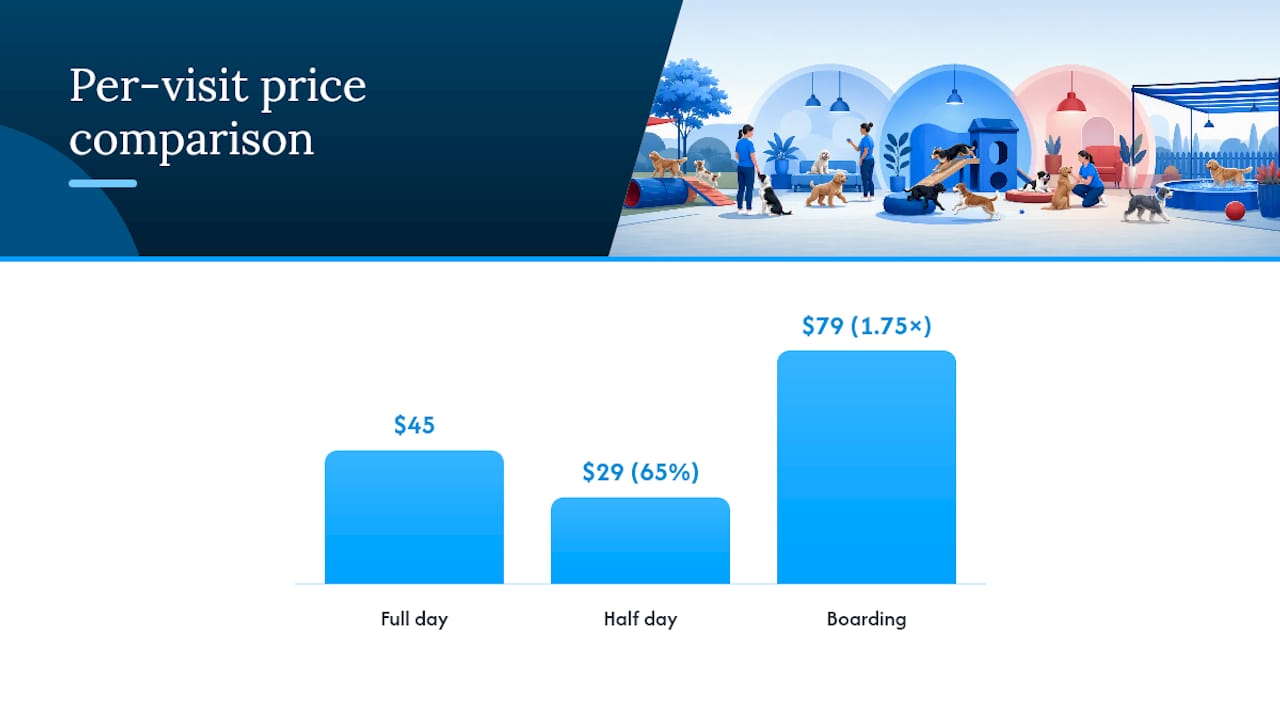
Your service mix determines whether your revenue is lumpy or predictable, and that distinction matters more than most first-time owners expect. A standard menu includes full day care, half day care, monthly memberships, overnight boarding, grooming add-ons, and specialty services like training sessions.
Typical structures worth modeling:
- Full day: $35 to $55 depending on region and amenities.
- Half day: roughly 60 to 70 percent of the full day rate.
- Memberships: bundled packages (10 or 20 day punch cards, or unlimited monthly plans) sold at a discount to lock in recurring visits.
- Boarding: often priced 1.5 to 2 times the day rate, since it includes overnight supervision.
- Add-ons: grooming, nail trims, or training sessions that lift average ticket without adding much overhead.
The revenue formula stays constant no matter how you price: annual revenue = dogs/day × average rate × operating days × occupancy percentage. If you run 40 slots, charge a $45 blended rate, operate 300 days a year, and hit 65 percent occupancy, that’s 40 × $45 × 300 × 0.65, or roughly $351,000 in annual revenue. Aim for memberships to make up 30 to 40 percent of your active client base. That share is what turns a daycare from a business that lives or dies on walk-ins into one with a dependable revenue floor.
How Do You Prove Local Demand for a Dog Daycare?
Lenders don’t fund optimism. They fund evidence, and the market analysis section is where you supply it. Start with dog-owning household density in your service radius, since that number sets the ceiling on your addressable market. The U.S. Census and county pet licensing data are common starting points, cross-referenced against national pet ownership averages.
Build your case with:
- Household and commuter data: dog-owning households within a 5 to 10 minute drive, plus nearby employment centers that generate weekday commute traffic.
- A simple penetration estimate: if 8,000 households own dogs nearby and comparable markets show 2 to 4 percent penetration for paid daycare, your realistic customer pool is 160 to 320 households, not the full 8,000.
- A competitor snapshot: three to five nearby facilities, their capacity, pricing, and any visible gaps (no boarding, no memberships, poor reviews) that support your projected occupancy.
- Seasonality notes: most daycares see weekday demand from commuters and lighter weekend volume, so model realistic dips rather than flat daily averages.
Benchmarking your facility against others in your market, not just guessing at market share, gives your occupancy assumptions the kind of grounding a loan officer can actually verify.
Staffing Ratios and Daily Operations for Dog Daycare Safety
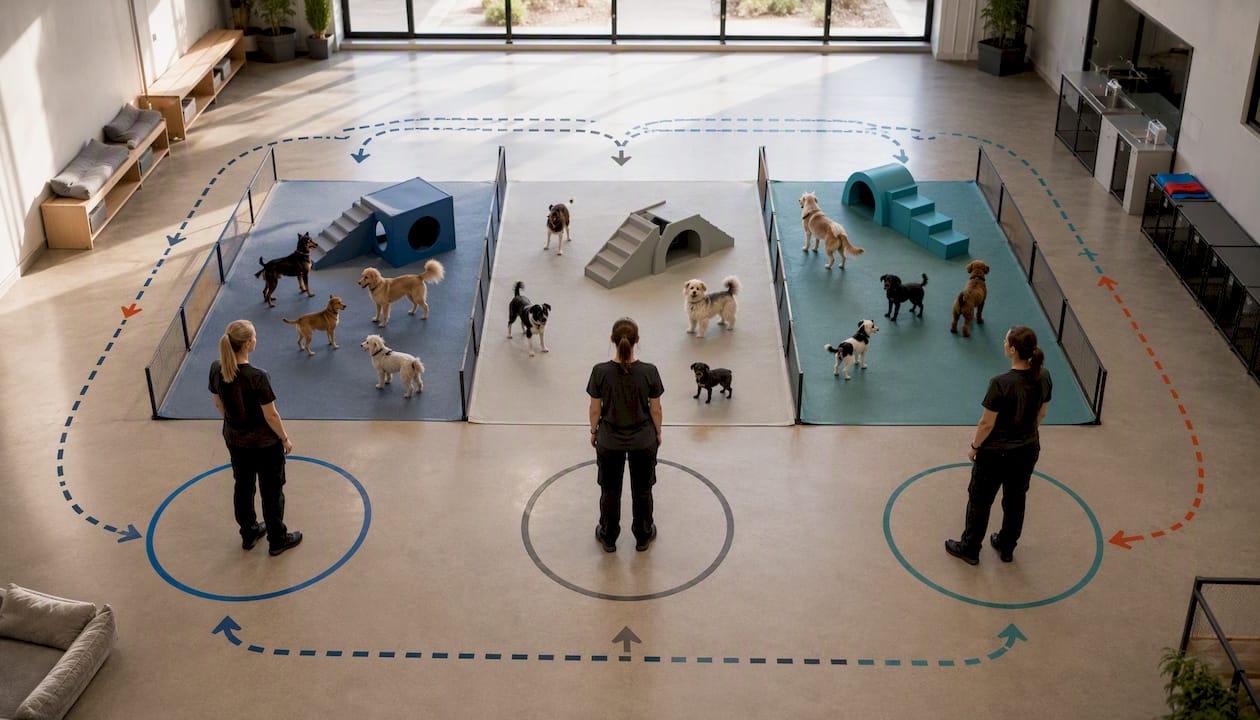
Supervision is the single biggest safety and liability variable in your plan, and it belongs in writing, not just in your head. Industry guidance generally sets staff-to-dog ratios around 1 staff member per 10 to 15 dogs during supervised play, and you should budget staffing to your peak occupancy hour, not your daily average. A facility that’s fine at 9 a.m. can be dangerously understaffed at the 11 a.m. rush if your roster only covers the average.
Build your operations section around this sequence:
- Intake and orientation assessment: every new dog goes through a temperament evaluation and a supervised trial before joining group play, following the same orientation and playgroup structuring that established facilities use to keep incident rates low.
- Shift design: stagger start times so your strongest staff-to-dog ratio lands during your busiest drop-off and pickup windows.
- Manager coverage: at least one experienced lead on-site at all times who can make real-time group-size and mixing decisions.
- Training cadence: new hires shadow for a minimum period before running a group alone, with refreshers tied to group play safety standards.
- Daily checklists: cleaning cadence, incident logging, and vaccination verification at every check-in.
Pro Tip: Payroll usually eats the largest share of your operating budget, and that’s the trade-off for running safely. Price your services to cover staffing at peak, not average, occupancy, or you’ll be tempted to cut corners exactly when demand is highest.
Facility Build-Out: What Actually Drives Your Startup Costs
The build-out is where first-time owners most often underestimate their number, and it’s usually the single largest capital line in the whole plan. Commercial-grade flooring, floor drainage, HVAC modifications for odor and air exchange, and secure fencing between play groups are not optional line items. They’re the difference between passing inspection and reworking your space mid-lease.
Budget around these categories:
- Flooring and drainage: rubberized or sealed concrete with sloped drains for wash-down cleaning.
- HVAC and ventilation: commercial-grade air exchange rated for animal facilities, often a bigger cost than owners expect if the space wasn’t built for it.
- Fencing and play-group separation: durable partitions sized to your space-per-dog requirements.
- Crate and rest areas: quiet zones separate from active play for boarding dogs and rest breaks.
A raw warehouse conversion typically costs more than a space previously used for pet care, since drainage and HVAC retrofits are usually the largest single capital line when starting from scratch. Get contractor bids tied to a written facility checklist, not a generic per-square-foot allowance, and confirm permit and ADA accessibility requirements before you sign a lease.
Financial Plan: Break-Even, Occupancy Scenarios, and Funding Ask
This is the section your lender reads line by line, and it needs to start with capacity, not hope. Take your licensed capacity, apply your staff-to-dog ratio ceiling, and build three occupancy scenarios from there: conservative, base case, and growth.
Break-even dogs/day is calculated as fixed monthly costs divided by the contribution margin per dog per day. Say your fixed costs (rent, payroll base, insurance, utilities) run $18,000/month, and each dog nets $30 after variable costs like food, laundry, and consumables. Divide $18,000 by $30, then by roughly 22 operating days, and you land near 27 dogs/day needed just to cover fixed costs. Anything above that is margin.
Your financial plan needs these tables, no exceptions:
- Startup budget: every one-time cost, from build-out to opening inventory.
- Three-year profit and loss statement: tied to your three occupancy scenarios.
- Cash flow forecast: monthly for year one, showing the ramp from launch to break-even.
- Break-even calculation: shown explicitly, with the formula visible, not buried in a spreadsheet tab.
- Funding ask and use of funds: a clear split between build-out capital and working capital.
Lenders expect a working-capital reserve covering three to six months of fixed costs, because almost no daycare hits break-even occupancy in month one. Build your conservative scenario around the assumption that occupancy ramps slowly, staff costs stay fixed even in slow months, and your reserve exists to bridge that gap rather than paper over it. Reviewing published profit margin benchmarks against your own numbers is a useful sanity check before you finalize the ask.
How to Fill Occupancy in Your First 90 Days
Getting to break-even occupancy fast depends on what you do before you open, not after. Your marketing plan should read like a checklist with dates attached, because vague “social media marketing” lines don’t survive a lender’s second read.
- Days 1 to 30 (prelaunch): set up your Google Business Profile, secure vet and groomer referral partnerships, and open free trial-day bookings to build a waitlist.
- Days 30 to 60: launch membership presales at a discount, run a referral incentive for existing waitlist families, and finalize your local SEO basics (service pages, reviews, location data).
- Days 60 to 90: open full operations, track your show rate against bookings, and start measuring customer acquisition cost against your membership conversion rate.
Track three metrics from day one: cost to acquire a trial customer, the percentage who convert to paid visits, and the percentage who upgrade to a membership. Feed those numbers directly into your occupancy ramp assumptions, since a real show rate of 70 percent against booked trials is a far more honest input than an assumed 100 percent.
Licensing, Permits, and Insurance Checkpoints Before You Sign a Lease
There’s no single federal dog daycare license, which means your requirements are entirely local and easy to underestimate. Check with your city or county business licensing office, your state’s animal care regulations if any exist, and your local fire and health departments before you assume a space works.
Confirm these before signing anything:
- Zoning and use permits: verify the location allows a commercial animal care use before committing to a lease.
- Building and occupancy permits: tied to your build-out plans, not just your current use.
- General liability and professional liability insurance: covering both facility incidents and care-related claims.
- Property insurance: covering your build-out investment and equipment.
- Workers’ compensation: required in nearly every state once you have employees.
Sequence matters here. Confirm zoning feasibility first, get your insurance quotes second, and only then commit to a lease.
Building Your Lender Package: Templates and Appendices
A polished appendix is what separates a plan that gets a second meeting from one that doesn’t. Lenders expect supporting documents, not just narrative pages.
Include:
- Floor plan showing play areas, drainage, and crate/rest zones.
- Lease letter of intent or signed lease, if you have one.
- Owner résumés highlighting relevant experience.
- Sample policies: intake forms, vaccination requirements, and liability waivers.
- Vaccination checklist used at every check-in.
- Sensitivity scenarios: your conservative, base, and growth occupancy tables side by side.
Host your detailed spreadsheets separately and reference them by name in the appendix rather than pasting dense tables into the narrative. Keep formatting consistent, label every table clearly, and number your pages. A naming and registration checklist for your business entity also belongs here if it isn’t already in your company overview.
What Practitioners Wish First-Time Owners Knew
Operators who’ve run daycares for years tend to flag the same two mistakes: understaffing relative to peak demand, and underfunding the build-out because a spreadsheet estimate looked cleaner than a contractor’s bid. Both mistakes are avoidable on paper and expensive in practice.
Facilities that treat membership revenue as an afterthought almost always struggle with cash flow, because a client base built entirely on walk-ins swings wildly with weather, holidays, and local competition. The daycares with steady occupancy are the ones that made memberships and add-ons like grooming and training a core part of the pricing model from day one, not a feature bolted on after opening.
Booking and operations software, like platforms such as Gingr, is worth budgeting for early since it handles vaccination tracking, package billing, and check-in flow, functions that are hard to run manually once you pass 20 or 30 dogs a day.
What I’d Do the Week After Finishing This Plan
I’d confirm zoning and permit feasibility before signing any lease, since that single check prevents the most expensive surprises. I’d build a conservative working-capital buffer and start staff training before opening day, not after. And I’d launch prelaunch marketing and membership presales at least 60 days before the doors open, so occupancy is climbing before rent starts running against an empty building.
— Oliver
Sources
For further reading and templates as you build out your plan:
- How to Write a Dog Daycare Business Plan (2026 Guide)
- Pick your business location — SBA
- Gingr listing — Capterra
- Dog Daycare in Chicago | Pet Care Plus
If you want ongoing support turning this plan into a running, profitable facility, Thedoggurus’s coaching and course plans are built specifically for pet care owners navigating launch, staffing, and growth, with staff training tools to help your new hires get up to speed faster than a generic onboarding packet ever could.