

Every dog daycare and boarding business needs, at minimum, a Business Owner’s Policy (BOP) that bundles general liability, commercial property, and business income coverage, plus explicit Care, Custody & Control (CCC) coverage for the animals in your care. If you employ staff, add Workers’ Compensation. If you transport dogs, add Commercial Auto. That four-part foundation is what a qualified insurer or independent broker should quote you on day one.
Before you call anyone, pull together this information:
- Dog counts: average daily attendance and peak capacity
- Overnight capacity: number of dogs boarded per night and maximum consecutive stay length
- Staff roster and payroll: total annual payroll by role (this drives workers’ comp pricing)
- Facility layout: square footage, play yard configuration, fencing type, fire protection
- Intake and vaccination policies: written protocols you require before a dog enters your facility
- Claims history: any incidents or losses in the past three to five years
Pro Tip: When a carrier quotes CCC coverage, ask them to confirm in writing that group-play incidents are not excluded. Some policies cover animal injuries only when a dog is in a kennel run, not during supervised off-leash play. Get the insurer’s written position before you bind coverage, not after a claim.
Request a Certificate of Insurance (COI) that names any boarding partners, landlords, or franchise entities as additional insureds. The COI should explicitly list your CCC per-occurrence limit and your veterinarian reimbursement amount. An agent who cannot produce those two line items on the COI is not the right agent for a facility-based pet care business.
Table of Contents
- What does dog daycare insurance actually cover?
- Endorsements and coverage gaps you need to ask about
- How much does dog daycare and boarding insurance cost?
- How do you get accurate quotes and choose the right insurer?
- What policy exclusions and red flags should you watch for?
- How is daycare and boarding insurance different from pet-sitting policies?
- What does a solid starter insurance package look like?
- What operational controls reduce your risk and improve your premiums?
- Key Takeaways
- The part of insurance most owners only learn after a claim
- Thedoggurus helps you build the documentation your insurer wants to see
- Useful sources and where to read more
What does dog daycare insurance actually cover?
A standard commercial policy written for a retail shop will not protect you when a dog in your care is injured, goes missing, or dies. You need policies mapped to your specific exposures: animals, people, and property.
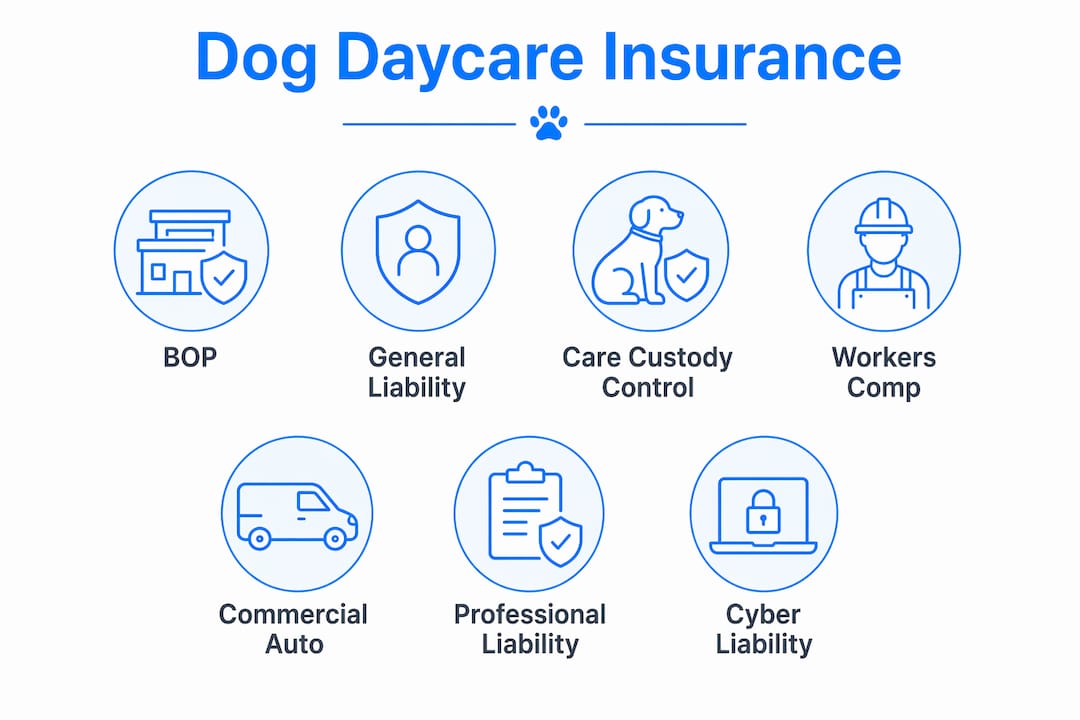
General liability
General liability covers third-party bodily injury and property damage. Think: a client slips on a wet floor in your lobby, or a dog escapes and damages a neighbor’s fence. Most carriers write this at $1 million per occurrence and $2 million aggregate, which are the limits most landlords and commercial lenders require.

Business Owner’s Policy (BOP)
A BOP bundles general liability, commercial property, and business income coverage into one package at a lower combined cost than buying each policy separately. For most small daycare and boarding facilities, a BOP is the right starting point. It covers your building or tenant improvements, equipment, and the revenue you lose if a covered event forces you to close temporarily.
Care, Custody & Control (CCC) / animal bailee
This is the policy most operators get wrong. CCC coverage is distinct from general liability: it triggers specifically when an animal in your care is injured, becomes ill, goes missing, or dies. General liability will not pay for a dog’s emergency vet bill or compensate an owner for a lost pet. CCC is underwritten against your safety protocols, staff training records, and incident history, so the documentation you keep directly affects whether coverage applies.
Workers’ compensation
Required in nearly every state the moment you have employees, workers’ comp covers medical expenses and lost wages when a staff member is bitten, injured during a dog altercation, or hurt in a slip-and-fall. Dog handling is physically demanding work; this coverage is non-optional once you have a payroll.
Commercial auto
Your personal auto policy almost certainly excludes business use. If you or a staff member transports dogs, even occasionally, you need a commercial auto policy that lists the vehicle and describes the business purpose.
Professional liability / Errors & Omissions (E&O)
If you offer training, behavior evaluations, or written assessments, a client can claim your advice caused harm. Professional liability covers defense costs and settlements for those claims.
Cyber liability
If you store client names, payment data, or pet health records digitally, a data breach can trigger notification costs and regulatory penalties. Basic cyber liability is worth adding, especially as more facilities move to software-based management platforms.
| Policy | What it protects | Pets covered? | People covered? | Property covered? |
|---|---|---|---|---|
| General Liability | Third-party injury and property damage | No | Yes | Yes (third-party) |
| CCC / Animal Bailee | Animals in your care | Yes | No | No |
| Commercial Property (BOP) | Your building, equipment, business income | No | No | Yes (yours) |
| Workers’ Compensation | Employee injuries on the job | No | Yes (staff) | No |
| Commercial Auto | Vehicle liability and physical damage | No | Yes | Yes (vehicle) |
| Professional Liability / E&O | Claims from training or advice | No | Yes | No |
| Cyber Liability | Data breach costs | No | No | No |
Endorsements and coverage gaps you need to ask about
Most policy denials in pet care happen not because a carrier refused to cover the industry, but because a specific endorsement was missing or an exclusion was buried in the policy language. Here is what to ask for explicitly.
- Veterinarian reimbursement regardless of fault: This endorsement pays emergency vet bills for animals in your care even when you did nothing wrong. Without it, you may owe a client’s vet bill out of pocket while waiting for a liability determination.
- Dog-bite defense and assault/abuse coverage: Standard general liability may not cover claims that allege intentional acts or negligent supervision. Ask specifically whether defense costs are included for dog-bite allegations.
- Communicable disease language: Kennel cough and parvovirus outbreaks are among the most common claims in boarding facilities. Many policies contain communicable disease exclusions that will void a CCC claim if an illness spreads through your facility. Request clear, written wording on how your policy handles disease transmission.
- Extended CCC limits and per-animal sublimits: Some policies cap CCC at $1,000 per animal or $10,000 aggregate, which is inadequate for a facility caring for 20 or 30 dogs. Negotiate per-animal sublimits and aggregate caps that reflect your actual capacity and the value of the animals you board.
- Volunteer and independent contractor language: If you use contractors for grooming, training, or transport, confirm they are included in your policy definitions. Many policies cover only direct employees.
Pro Tip: Before you bind any policy, ask the carrier to send you the actual endorsement language in writing, not just an agent’s verbal summary. Endorsement wording controls what gets paid. If an agent cannot produce the endorsement document, treat that as a red flag.
Make sure your policy lists every service you provide: boarding, daycare, grooming, training, and transport. Operational exclusions that omit a listed service are one of the most common reasons claims get denied.
How much does dog daycare and boarding insurance cost?
Premiums vary based on your facility size, staff count, claims history, and the specific coverages you carry. That said, published insurer data gives you a useful baseline for budgeting.
The Hartford reports the following sample averages for small boarding customers:
| Business profile | Policy type | Sample annual cost |
|---|---|---|
| Small boarding/daycare (solo or 1–2 staff) | BOP | about $1,687/year |
| Small boarding/daycare (solo or 1–2 staff) | Standalone general liability | about $810/year |
| Small boarding/daycare (with employees) | Workers’ compensation | about $1,032/year |
| Solo or micro-boarder (5 or fewer pets) | Specialist pet-boarder policy | $480–$550/year |
Industry median figures for general liability in pet care run approximately $40–$45 per month ($480–$550 per year) for businesses choosing $1M/$2M limits. Specialist online providers like Insurance Canopy advertise starting rates for qualifying small boarders at the lower end of that range, with same-day COI issuance for eligible applicants.
The major factors that move your premium up or down:
- Dog count and overnight capacity: More dogs means higher exposure and higher premiums.
- Payroll: Workers’ comp is priced as a percentage of total payroll, so growth in staff directly increases this line item.
- Claims history: A clean three-to-five-year loss run is one of the strongest negotiating tools you have.
- Facility construction and fire protection: Sprinkler systems, monitored alarms, and secure fencing all reduce perceived risk.
- Location: Urban facilities with higher property values and litigation rates typically pay more.
- Deductible selection: Raising your per-occurrence deductible from $500 to $2,500 can meaningfully reduce your annual premium. Make sure you can absorb that deductible before you choose it.
For help building insurance costs into your annual operating budget, the pet care business budgeting guide at Thedoggurus walks through how to plan for premiums, payroll, and contingency funds alongside your other fixed expenses.
How do you get accurate quotes and choose the right insurer?
Getting three comparable quotes is the minimum. Here is the workflow that produces apples-to-apples comparisons.
- Prepare a standardized underwriting packet. Include your average and peak dog counts, overnight capacity, hours of operation, staff roster with payroll by role, vaccination and intake protocols, facility photos and a schematic layout, and three to five years of loss runs. If you lack loss runs, prepare an incident log and a brief narrative explaining your safety record.
- Request quotes from at least three sources. Use a mix: a national carrier like The Hartford for packaged BOP options, a specialist online marketplace like Insureon to compare multiple carriers quickly, and a specialist online provider like Insurance Canopy if your operation qualifies for their off-the-shelf pet-boarder program (typically five or fewer pets and stays under 30 days). An independent broker who specializes in kennel and daycare underwriting is worth adding to that list.
- Compare on the same dimensions. Use a tracking sheet with these columns:
| Comparison axis | What to look for |
|---|---|
| CCC per-occurrence limit | $25,000 minimum; $100,000+ for larger facilities |
| Vet reimbursement | “Regardless of fault” language; per-animal and aggregate limits |
| Communicable disease exclusion | Is it present? Can it be removed by endorsement? |
| Group-play coverage | Explicitly included, not just implied |
| General liability limits | $1M/$2M standard; umbrella available? |
| Deductible | Per-occurrence amount you can realistically absorb |
| Time to quote | Online self-quote vs. agent-assisted (1–3 business days) |
| Claims support | Direct insurer line vs. broker intermediary |
- Request the COI before you bind. Confirm it lists: policy number, effective and expiration dates, named insured, additional insureds, CCC per-occurrence limit, vet reimbursement limit, and any umbrella cross-reference.
- Negotiate with your documentation. Present your safety protocols, staff training records, and incident logs. Facilities with structured play schedules, multiple play yards, and documented staff training often receive better rates because carriers can see lower incident risk.
Operational changes like adding a new service, expanding capacity, or moving locations should trigger an immediate policy review. Insurers expect updates, and coverage written for your old operation may not respond to a claim at your new one. Reviewing your coverage annually is the minimum; review it any time your business materially changes.
What policy exclusions and red flags should you watch for?
Many operators assume their standard commercial policy covers animals in their care. It usually does not. These are the exclusions and red flags that matter most.
- “Care, custody, or control” carve-outs in general liability: Some general liability policies explicitly exclude property damage or injury to animals in your care. This is why CCC must be a separate, explicitly underwritten coverage, not assumed.
- Communicable disease exclusions: As noted above, these can void an entire CCC claim if illness spreads between animals. Never assume this exclusion is absent.
- Breed-specific exclusions: Some carriers exclude certain breeds from CCC or general liability. If you accept those breeds, you need a carrier that covers them.
- Intentional acts exclusions: Standard language, but watch for overly broad wording that could be applied to a dog-bite claim where negligent supervision is alleged.
- Declination for group play: If a carrier declines to quote because you run off-leash group play, that is a signal they do not understand kennel/daycare underwriting. Move on.
- Unusually low per-animal sublimits: A $500 or $1,000 per-animal CCC sublimit is inadequate for most facilities. This is a negotiating point, not a fixed number.
- Residual market placement: If a broker tells you the only available market is a surplus lines or residual market carrier, ask why admitted carriers declined. That answer tells you something about your risk profile.
Pro Tip: Always ask whether the agent has placed kennel or daycare accounts before. Agents unfamiliar with pet care underwriting routinely miss CCC gaps and communicable disease exclusions. A specialist broker is worth the extra step.
How is daycare and boarding insurance different from pet-sitting policies?
This distinction matters more than most operators realize. A pet-sitting or dog-walking policy is designed for mobile, one-on-one care in a client’s home. A daycare or boarding policy is designed for centralized, group-based care in your facility. They are not interchangeable.
- Group-play exposure: When 15 dogs interact off-leash for six hours, the probability of an animal-to-animal injury is fundamentally different from a single dog walker with two dogs on a leash. Carriers price and underwrite these risks separately.
- Overnight stays: Boarding adds property risk, extended supervision requirements, and higher potential claim severity. Pet-sitting policies typically exclude overnight facility stays.
- Employee exposures: Facility-based operations almost always have staff, which adds workers’ comp and employer liability exposures that mobile pet sitters rarely carry.
- Facility property risk: Your building, equipment, and tenant improvements are insured under commercial property coverage. A pet sitter working in a client’s home has no equivalent exposure.
Daycare and boarding underwriting differs from dog walking specifically because group-play exposure and overnight stays raise both premium and coverage complexity. Always request a kennel or daycare classification on your quote. If a carrier classifies your facility-based operation as “pet sitting,” the policy may not respond to your most likely claims.
What does a solid starter insurance package look like?
Use these limits as your baseline when requesting quotes. Adjust upward as your capacity and payroll grow.
Core package:
- BOP: $1 million per occurrence / $2 million aggregate general liability, plus commercial property covering your building or tenant improvements, equipment, and three months of business income
- CCC / animal bailee: $25,000–$100,000 per occurrence depending on your capacity; negotiate per-animal sublimits that reflect the value of dogs you typically board
- Workers’ compensation: State-mandated limits based on your total payroll; your agent will calculate the rate by job classification
- Commercial auto: Liability and physical damage coverage when you regularly transport dogs; list vehicle use as “business purpose” on the application
Policy language to request in writing:
- An explicit CCC definition that covers group-play incidents and off-leash supervision
- Veterinarian expense reimbursement “regardless of fault” with a stated per-animal and aggregate limit
- Absence of communicable disease exclusions, or a written endorsement removing them
- Confirmation that all listed operations (boarding, daycare, grooming, training, transport) are covered under the policy
Smaller boarders caring for five or fewer pets with stays under 30 days often qualify for lower-cost, off-the-shelf programs. Larger facilities or those with longer stays typically need a custom commercial placement with higher limits and more negotiated endorsements.
What operational controls reduce your risk and improve your premiums?
Your underwriting outcome is not just about what you buy. It is about what you can prove. Carriers price risk based on what they can see, and documented controls are the clearest signal that your facility runs safely.
- Standardize your intake process. Every dog that enters your facility should complete a written intake form that captures vaccination records, behavioral history, emergency contacts, and authorization for emergency veterinary care. Dog evaluation protocols that screen for temperament and social behavior before a dog joins group play are exactly what underwriters want to see.
- Document every incident. Use a written incident-report template for every bite, injury, altercation, or near-miss. Record the date, dogs involved, staff present, what happened, and what corrective action was taken. This log is your primary defense in a claim and your strongest negotiating tool at renewal.
- Train your staff and keep records. Documented onboarding training, certified handling credentials, and written staff-to-dog ratios all reduce perceived risk. Building a trained support team is not just good operations; it is an underwriting asset.
- Maintain your facility. Secure fencing, slip-resistant surfaces, climate control, monitored fire alarms, and separate play yards for different dog sizes all reduce incident probability. Carriers can see these controls in facility photos and schematics.
- Prepare a complete underwriting packet. A single packet with photos, a schematic layout, sample intake paperwork, staff training records, and three to five years of loss runs reduces quoting time and prevents inconsistent limits across policy sections.
Pro Tip: At renewal, do not just accept the renewal quote. Present any operational improvements you made during the year, whether new fencing, a staff training certification, or a lower incident rate, and ask the carrier explicitly for credits tied to those documented changes.
Incident report template (copy into your operations manual):
- Date and time of incident
- Location within facility
- Dogs involved (names, breeds, owner contact)
- Staff present and their roles
- Description of what occurred
- Injuries observed and first aid administered
- Veterinary care sought (yes/no; clinic name and cost)
- Corrective action taken
- Supervisor signature and date
Safe daycare operations and strong underwriting outcomes are built on the same foundation: consistent protocols, trained staff, and documented evidence that your facility takes risk seriously.
Key Takeaways
A dog daycare or boarding business needs a BOP plus explicit Care, Custody & Control coverage as its foundation, with Workers’ Compensation added the moment you hire staff and Commercial Auto whenever you transport dogs.
| Point | Details |
|---|---|
| Start with BOP plus CCC | A BOP alone will not cover animal injuries; CCC must be explicitly underwritten and listed on your COI. |
| Know your premium benchmarks | The Hartford’s sample averages: BOP about $1,687/year, standalone general liability about $810/year, workers’ comp about $1,032/year. |
| Compare apples-to-apples | Track CCC limits, vet reimbursement language, communicable disease exclusions, and group-play coverage across every quote. |
| Documentation lowers premiums | Intake forms, incident logs, and staff training records are underwriting assets that support better rates and faster renewals. |
| Thedoggurus provides the systems | Thedoggurus offers intake form templates, incident-report tools, and staff training modules that directly support your underwriting packet. |
The part of insurance most owners only learn after a claim
There is a pattern that shows up repeatedly in pet care businesses: an operator buys what they think is solid coverage, a dog is injured during group play, and the claim gets denied because the policy’s CCC language excluded “animal-to-animal incidents during unsupervised group activity.” The operator assumed the agent had handled it. The agent assumed the policy was standard. Nobody read the endorsement.
What actually protects you in a claim is not the policy summary. It is the specific endorsement language, the COI with explicit limits, and the incident documentation you hand to the adjuster on day one. Operators who keep a physical or digital binder with their current COI, all endorsement pages, their intake forms, and their incident log move through claims faster and with fewer disputes. That binder is also what makes renewal conversations productive: you walk in with proof of your controls, and you ask for credits rather than just accepting the renewal rate.
The other thing worth saying plainly: the right broker with veterinary SEO services matters more than the right carrier. A broker who has placed kennel and daycare accounts understands what questions to ask underwriters, which exclusions to push back on, and how to position your safety documentation to get better terms. A generalist broker who has never placed a pet care account will miss the CCC gap every time.
Thedoggurus helps you build the documentation your insurer wants to see
Getting the right dog daycare insurance is only half the equation. The other half is having the operational systems that make your facility insurable at favorable rates and keep claims from happening in the first place.
Thedoggurus gives pet care business owners the tools that underwriters actually ask for: standardized intake and vaccination forms, incident-report templates, staff training modules with documented completion records, and a COI checklist you can hand directly to your broker. When you show up to a quoting conversation with a complete underwriting packet, you reduce quoting time, prevent coverage gaps, and make a stronger case for lower premiums. These are not generic business tools. They are built specifically for dog daycare, boarding, grooming, and training operations by people who have run those businesses.
See how the platform works and what it includes by exploring Thedoggurus’ plans, or start with the pet business software guide to see which tools pair best with your current operation.
Useful sources and where to read more
- The Hartford: Dog Boarding Insurance — Published sample premium figures for small boarding customers (BOP, general liability, workers’ comp) and an overview of BOP options for kennel operators.
- Insurance Canopy: Pet Boarding Insurance — Online specialist with streamlined quoting for small boarders; useful for understanding off-the-shelf program eligibility thresholds and same-day COI options.
- Covered By Us: Pet Kennel & Boarding Facility Insurance — Detailed explanation of CCC underwriting, common coverage gaps, and why specialist brokers matter for kennel and daycare accounts.
- Time To Pet: Dog Daycare and Boarding Insurance Guide — Practical overview of the full insurance bundle needed for facility-based pet care, including the underwriting differences between daycare and mobile services.
- NAHF: Dog Daycare Insurance Cost — Industry median premium figures for general liability in pet care, with context on typical limit choices.
- Travelers Insurance: Pet Care Services — National carrier overview of BOP options for pet care businesses, including boarding kennel liability endorsements and grooming liability coverage.
- NEXT Insurance: Pet Boarding Insurance — Online self-quote platform for general liability, commercial property, and workers’ comp for pet boarding businesses; useful for fast baseline quotes.