
Most small dog daycare owners budget a moderate annual amount for a basic insurance package, while medium-sized commercial facilities typically budget a higher annual range. Larger operations with overnight boarding, multiple staff, and higher daily capacity often pay more once all required policies are stacked. Those figures come from market estimates for U.S. pet care businesses, and they assume standard $1M per-occurrence / $2M aggregate general liability limits.
Your single most important next step: gather your annual revenue, average daily dog count, employee headcount, and full services list before requesting any quotes. Those four numbers drive your premium more than almost anything else.
At a glance: sample annual budget scenarios
- Home-based or solo owner: a range suited to GL + Animal Bailee coverage with low capacity and no employees
- Small commercial facility: a moderate range covering BOP, Animal Bailee, and Workers’ Comp for a small staff
- Medium facility with boarding: a higher range for a full policy stack including BOP, Animal Bailee, Workers’ Comp, E&O, and possibly Commercial Auto
Median general liability premium for U.S. pet care businesses: $43/month. A Business Owner’s Policy (BOP) runs a median of $86/month — roughly double, but it bundles property coverage that standalone GL leaves out.
Table of Contents
- What makes dog daycare insurance different from standard business coverage?
- Policy-by-policy breakdown: what each one covers and what it doesn’t
- How much does dog daycare insurance actually cost?
- What underwriters look at and how you can lower your premiums
- How to choose the right policy and what to ask when you get quotes
- Where should you get quotes: specialty insurers, national carriers, or marketplaces?
- The risk-reduction playbook that insurers reward
- Key Takeaways
- Why cheap premiums are the wrong goal
- Thedoggurus Staff Products support your insurance conversations
- Useful sources and where to get quotes fast
What makes dog daycare insurance different from standard business coverage?
Dog daycare insurance is not a single policy. It is a combination of general business liability coverage plus animal-specific protections that most standard small-business policies exclude entirely.
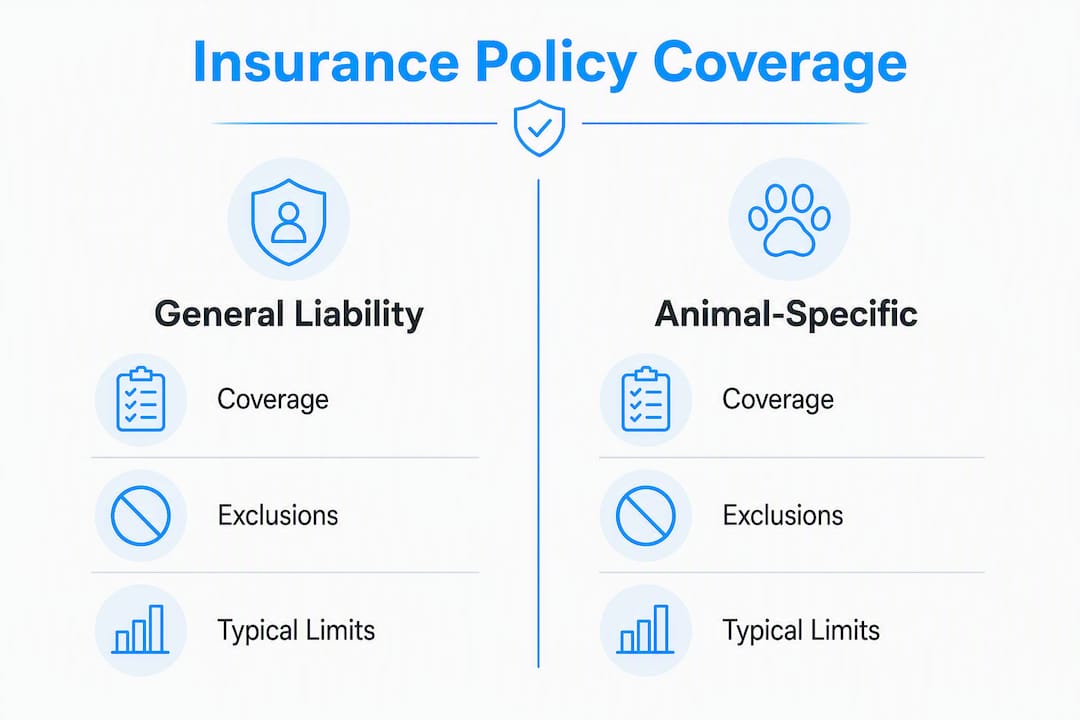
The critical distinction is Animal Bailee coverage, also called Care, Custody & Control (CCC). Standard general liability protects you if a dog bites a visitor or a client slips in your lobby. It does not cover injury, illness, death, or loss of a pet while that animal is in your care. Animal Bailee coverage fills that gap and is the policy that pays when a dog escapes, gets injured during group play, or dies unexpectedly on your watch. For any facility handling client animals, it is non-negotiable.
Here are the standard policy types most U.S. dog daycare and boarding operations carry:
- General Liability (GL): Third-party bodily injury and property damage claims
- Business Owner’s Policy (BOP): GL + commercial property bundled, usually at a discount
- Animal Bailee / Care, Custody & Control: Injury, death, or loss of client pets in your care
- Workers’ Compensation: Required in most states once you have employees; covers on-the-job injuries
- Professional Liability / E&O: Claims arising from advice, training, or service failures
- Commercial Property: Your building, equipment, and supplies (if not covered by a BOP)
- Commercial Auto: Vehicles used for pet transport or off-site services
- Cyber Liability: Data breaches involving client records and payment information
Policy-by-policy breakdown: what each one covers and what it doesn’t
Understanding what you’re buying at the policy level prevents expensive surprises at claim time. Here is a practical comparison of the core coverages.
| Policy | What it covers | Common exclusions | Typical limits | When you need it |
|---|---|---|---|---|
| General Liability | Third-party injury, property damage, advertising injury | Animals in your care; intentional acts | $1M per occurrence / $2M aggregate | Always |
| Business Owner’s Policy (BOP) | GL + commercial property bundled | Professional errors; auto; workers’ comp | Varies by carrier | Any commercial location |
| Animal Bailee (CCC) | Injury, death, escape, or loss of client pets | Pre-existing conditions; intentional harm | Per-pet sublimits ($2,500–$10,000+); per-occurrence limits | Any facility handling client animals |
| Workers’ Compensation | Employee medical costs, lost wages from on-the-job injury | Independent contractors (varies by state) | Statutory limits by state | Required in most states with employees |
| Professional Liability / E&O | Claims from training advice, service failures, negligence | Bodily injury covered by GL; intentional acts | $1M per claim typical | If you offer training or behavioral advice |
| Commercial Property | Building, equipment, kennels, supplies | Flood, earthquake (separate riders) | Replacement cost or ACV | If you own or lease a commercial space |
| Commercial Auto | Business vehicle accidents, cargo | Personal-use vehicles; rideshare | $100K–$1M liability typical | If you transport dogs |
| Cyber Liability | Data breaches, ransomware, client notification costs | Physical damage; prior breaches | — | If you store client payment or health data |
A few notes on limits and deductibles. Choosing a $500 deductible versus a $1,000 deductible on your BOP can shift your annual premium by $100–$200. Higher per-pet Animal Bailee sublimits cost more but matter enormously when a high-value breed is in your care. Per-pet limits commonly range from $2,500 to $10,000, and the right number depends on the average value of dogs your clients bring in.
A BOP is almost always the smarter buy for small-to-medium daycares over separate GL and property policies. Licensed agents consistently recommend it because the bundle pricing beats buying each policy individually, and the coverage gaps are smaller.
How much does dog daycare insurance actually cost?
Here is where the numbers get specific. Premiums vary by facility size, services, location, and claims history, but these market-based ranges give you a solid planning baseline.
Per-policy monthly estimates for U.S. pet care businesses:
- General Liability: median cost around $43/month source; market range typically varies depending on specific policy details
- BOP: median cost near $86/month according to market data
- Animal Bailee endorsement: monthly costs vary depending on per-pet sublimits
- Workers’ Compensation: median monthly cost varies significantly by state and payroll
- E&O / Professional Liability: typically $50–$100/month for small operations
- Commercial Auto: $100–$200/month per vehicle
Sample annual budgets by facility size:
| Facility type | Policies included | Est. monthly | Est. annual | Assumed limits |
|---|---|---|---|---|
| Home-based / solo owner | GL + Animal Bailee | — | — | $1M/$2M GL; — per-pet bailee |
| Small commercial (1–3 staff) | BOP + Animal Bailee + Workers’ Comp | — | — | $1M/$2M GL; $10K per-pet bailee |
| Medium facility with boarding | BOP + Animal Bailee + Workers’ Comp + E&O | — | — | $1M/$2M GL; $10K per-pet bailee; $1M E&O |
One practical comparison worth running: a standalone GL policy at $43/month plus a separate commercial property policy at $40–$60/month totals $83–$103/month. A BOP covering both runs around $86/month at the median. The BOP wins on price and simplicity for most small facilities, though the property coverage limits may differ, so confirm replacement-cost values before signing.
For budgeting your full pet care business costs, treat insurance as a fixed annual line item and build in a 10–15% buffer for mid-year endorsement additions or coverage upgrades.
What underwriters look at and how you can lower your premiums
Underwriters price dog daycare risk based on a specific set of operational factors. Knowing which levers you control lets you present your business in the best possible light at quoting time.
Primary premium drivers:
- Annual revenue: Higher revenue signals more exposure and drives premiums up across most policy types.
- Daily dog capacity: More dogs on-site at once means more potential incidents. Underwriters are highly sensitive to this number, so accurate reporting matters.
- Staff count and ratios: Low staff-to-dog ratios increase incident risk. Documented ratios that meet or exceed industry standards work in your favor.
- Group play model: Open free-play groups carry more risk than structured, size-separated play. Documented separation protocols reduce exposure.
- Services offered: Adding overnight boarding, grooming, or pet transport each adds a coverage layer and raises premiums.
- Claims history: A single large claim can increase renewal premiums by 20–40% or trigger non-renewal. A clean three-year history is a genuine pricing advantage.
- Location and state: Workers’ comp rates vary by state. Urban locations with higher property values push property premiums up.
- Vaccination and health intake policies: Documented vaccine requirements reduce disease-transmission claims and signal operational discipline to underwriters.
Pro Tip: The three most cost-effective operational investments for premium reduction are written staff training logs, documented group-play separation protocols, and a formal vaccination intake checklist. These are exactly the items underwriters ask about during renewal conversations, and having them ready can shift your risk classification.
Facilities that implement safe group play standards, such as those described at safe group play standards, and document them consistently give underwriters concrete evidence of lower incident frequency. That documentation is not just good operations — it is a pricing tool.

How to choose the right policy and what to ask when you get quotes
Walking into a quoting conversation prepared saves money and prevents coverage gaps. Here is what to collect and what to ask.
Before you request any quote, have these ready:
- Gross annual revenue (last 12 months or projected for new businesses)
- Average daily dog count and maximum daily capacity
- Full services list: daycare, boarding, grooming, training, transport
- Employee count and total annual payroll
- Facility type: home-based, leased commercial, owned building
- Claims history for the past three to five years
- Current vaccination and intake policies (written copies if you have them)
Questions to ask every insurer or agent:
- What is the per-pet sublimit on Animal Bailee, and can I increase it?
- Does the policy cover group play incidents, or are there exclusions for off-leash environments?
- Is overnight boarding covered under the same policy, or does it require a separate endorsement?
- What is the deductible on Animal Bailee claims specifically?
- How are certificates of insurance issued — online, same-day, or through an agent?
- What triggers a premium increase at renewal, and what is your claims-handling process?
- Are there exclusions for specific breeds?
Pro Tip: When comparing a marketplace/broker quote to a carrier-direct quote, look past the headline premium. Confirm that the Animal Bailee sublimits, group-play endorsements, and certificate issuance speed are identical before deciding. A $15/month savings means nothing if the bailee limit is half what you need.
A BOP from a national carrier may look cheaper than a specialty pet insurer’s package, but the specialty policy often includes animal-specific endorsements the BOP excludes. Read the exclusions page, not just the declarations.
Where should you get quotes: specialty insurers, national carriers, or marketplaces?
Each route has a different strength. The right starting point depends on your business size, how quickly you need a certificate, and how complex your coverage needs are.
| Provider | Est. cost (monthly) | Best for | Key coverages available | How sold | Certificate speed |
|---|---|---|---|---|---|
| The Dog Gurus — Staff Products | Platform subscription | Owners reducing claims exposure and preparing underwriting documentation | Training records, incident logs, onboarding templates for insurer review | Direct SaaS subscription | Immediate (documentation tools) |
| PCI / Pet Care Insurance | From $29.43/mo | Owners wanting pet-industry-specific policy wordings and Animal Bailee endorsements | GL, Animal Bailee, BOP, Workers’ Comp, E&O | Specialty direct carrier | Fast online quoting |
| Insureon | $43/mo median (GL) | Owners who want multiple carrier quotes in one session | GL, BOP, Workers’ Comp, E&O, Commercial Auto | Online marketplace/broker | Same-day certificates available |
| The Hartford | Varies by quote | Established facilities wanting a national carrier relationship | BOP, Commercial Property, Workers’ Comp, GL | Direct carrier / agent | Standard agent process |
Where to start based on your situation:
- New or home-based operation: Start with Insureon for fast multi-carrier comparison, then cross-check with PCI for animal-specific endorsements.
- Small commercial facility adding boarding: PCI’s specialty wordings are worth the direct conversation; their Animal Bailee terms are built for this exact scenario.
- Established medium facility: The Hartford’s BOP infrastructure handles complex property and liability needs; pair it with a specialty Animal Bailee endorsement if their bailee terms are thin.
- Any size, preparing for renewal: Get your documentation in order first. Thedoggurus’s Staff Products give you the training logs and incident records that move the underwriting conversation in your favor before you request a single quote.
The risk-reduction playbook that insurers reward
Operational discipline is the most underused premium lever in this industry. Documented systems reduce claims frequency and give underwriters a concrete reason to offer better terms at renewal.
Implement and document these before your next quote or renewal:
- Intake and vaccination checks: Require proof of current rabies, Bordetella, and DHPP vaccines before a dog’s first day. Log every submission with date and expiration.
- Dog evaluation protocol: Every new dog completes a structured temperament assessment before joining group play. Document the evaluator, date, and outcome. A solid evaluation process is one of the first things an underwriter will ask about.
- Group play separation protocols: Written rules for size grouping, play-to-rest ratios, and staff positioning during off-leash time. Keep a daily log.
- Staff training records: Every team member completes documented onboarding covering bite prevention, emergency response, and incident reporting. Retain completion records.
- Incident reporting templates: A standard form for every bite, injury, escape, or near-miss. Include date, dog involved, staff present, action taken, and follow-up. Three years of clean or well-managed incident logs is a tangible underwriting asset.
- Daily capacity limits: A written policy capping dogs per play group and per staff member. Exceeding capacity is a common contributing factor in claims.
- Vet contact protocol: A documented procedure for emergency veterinary care, including the name and contact of your primary vet and a backup.
Pro Tip: When submitting for a new policy or renewal, include a one-page operations summary: your vaccination policy, staff-to-dog ratio, training completion rate, and incident history with resolution notes. Underwriters rarely see this level of preparation from small daycares, and it signals a lower-risk operation before they even run the numbers.
Managing problem behaviors with documented protocols also reduces the frequency of incidents that generate claims in the first place — which protects your three-year claims history, the single most durable pricing advantage you can build.
Key Takeaways
Dog daycare insurance cost ranges from roughly $500/year for a solo home-based operation to $3,500+ for a larger facility with boarding, multiple employees, and full coverage stacked.
| Point | Details |
|---|---|
| Budget by facility size | Small operations: $500–$1,200/year; medium commercial: $1,200–$2,500/year; larger with boarding: $2,500–$3,500+/year. |
| Animal Bailee is non-negotiable | Standard GL does not cover client pets; Animal Bailee (CCC) is a separate, required coverage for any facility handling animals. |
| BOP beats standalone GL + property | A BOP at the $86/month median typically costs less than buying GL and commercial property separately while closing coverage gaps. |
| Documentation lowers premiums | Training logs, incident records, and vaccination policies give underwriters concrete evidence of lower risk and improve renewal terms. |
| Audit annually | Review coverage every year when capacity, staff count, or services change; adding boarding or transport requires policy upgrades. |
| Thedoggurus Staff Products | Thedoggurus’s Staff Products provide the training records, onboarding templates, and incident logs that support underwriting conversations and claims reduction. |
Why cheap premiums are the wrong goal
The instinct to find the lowest premium is understandable. Insurance feels like a cost with no return — until the day it isn’t.
What most owners underestimate is how directly their operations determine their insurance outcomes. A facility with documented staff training, written play protocols, and a clean incident log is not just a safer place for dogs. It is a materially different risk in an underwriter’s eyes, and that difference shows up in renewal pricing, coverage availability, and claims outcomes.
The owners who get burned are not the ones who paid too much for insurance. They are the ones who bought the cheapest policy, skipped the Animal Bailee endorsement to save $40/month, and then faced a $6,000 veterinary bill for a client’s dog that was not covered. Or the ones who had no incident documentation when a claim was disputed and lost the argument.
Treat insurance and operations as the same investment. The documentation you build to satisfy an underwriter is the same documentation that protects you in a dispute, trains your staff more consistently, and builds the kind of facility that clients trust with their dogs. The premium is just the price of admission. The operational system is what actually keeps you protected.
Thedoggurus Staff Products support your insurance conversations
Running a dog daycare means you’re already managing a hundred moving parts. Insurance quoting shouldn’t add chaos to that list.
Thedoggurus’s Staff Products are built specifically for this: staff training modules, onboarding documentation, incident reporting templates, and playbook bundles that give you exactly what underwriters ask for during quoting and renewal. Instead of scrambling to pull together training records or explain your protocols verbally, you walk into the conversation with organized, professional documentation that signals a well-run operation.
The practical payoff is twofold: your team operates more safely day-to-day, and your insurer sees a lower-risk facility at renewal. Both outcomes protect your bottom line. Visit the Staff Products page to see the full documentation bundle and start building the records that make your next insurance conversation easier.
Useful sources and where to get quotes fast
Get quotes here:
- Insureon: Online marketplace for fast multi-carrier comparison; same-day certificates available for qualifying businesses.
- PCI / Pet Care Insurance: Specialty pet-industry insurer with animal bailee-specific policy wordings; online quoting starts at $29.43/month.
- The Hartford (thehartford.com): National carrier for established facilities needing BOP and commercial property coverage.
- Independent agents: For complex operations with multiple locations, transport services, or prior claims, a licensed independent agent can access markets not available online.
Research and further reading:
- Time To Pet: Dog Daycare and Boarding Insurance Guide — practical policy breakdown for facility-based dog care
- K9sky: Dog Daycare Business Insurance Guide — cost ranges and underwriting factors by facility size
- PetEditorial: Animal Bailee Insurance Guide — detailed explanation of per-pet and per-occurrence sublimits
- Rebarkable: Best Pet Insurance for Dogs — buyer-guide context on pet insurance products and market expectations
- Thedoggurus: Creating a Budget for Your Pet Care Business — full budgeting framework for pet care operations