

A dog walking franchise is worth buying only if you can absorb a franchise fee plus ongoing royalties and need brand recognition to accelerate market entry. For most professional pet care operators who already run daycare, grooming, or training businesses, the math rarely works in the franchise’s favor. SBDCNet confirms that profitability in pet care is driven by marketing skill, service reputation, and the ability to scale into higher-margin services, not by franchise status.
Two criteria decide it for most owners:
- Cost structure: Franchise fees plus royalties (typically 6–10% of gross revenue) permanently compress your margins. If you already have operational systems, you’re paying for infrastructure you don’t need.
- Speed to scale: If you’re entering a new market cold with no local reputation, a franchise’s brand and territory support can shave months off your launch. If you have an existing client base, that advantage disappears.
The honest verdict: A dog walking franchise makes sense for first-time operators entering unfamiliar markets who prioritize speed over margin. For experienced pet care business owners, platforms like Thedoggurus deliver the same training, systems, and operational playbooks without royalties.
Table of Contents
- How does a dog walking franchise compare to going independent?
- What do startup costs and ongoing financials actually look like?
- How do you vet a dog walking franchise before signing?
- What operational realities do franchisors often understate?
- What’s the step-by-step timeline from application to first revenue?
- What are the real alternatives to buying a franchise?
- What questions should you ask franchisors directly?
- Key Takeaways
- The case for building over buying
- Thedoggurus gives you franchise-level systems without the royalties
- Sources and further reading
How does a dog walking franchise compare to going independent?
| Dimension | Franchise | Independent owner | Platform + coaching (Thedoggurus) |
|---|---|---|---|
| Best for | First-time operators, new markets | Experienced owners with local reputation | Operators wanting systems without royalties |
| Initial investment | $15,000–$25,000 (fee) plus additional setup costs | $500–$2,000 (lean start) | Low monthly subscription |
| Ongoing fees | 6–10% royalty + marketing fund | None beyond operating costs | Flat subscription |
| Training & support | Structured onboarding, franchisor-led | Self-directed or hired consultants | Expert-led courses, AI tools, coaching |
| Territory/exclusivity | Protected territory (contractual) | Self-defined, no protection | No territory limits |
| Brand & marketing | National brand, co-op marketing | Build your own local brand | Marketing playbooks + personal brand support |
| Speed to market | 10–16 weeks from signing | 4–8 weeks with systems in place | 2–6 weeks with playbooks |
The franchise model trades long-term margin for short-term certainty. That’s a reasonable trade for someone starting from zero. For a grooming or daycare operator adding dog walking as a revenue line, it’s usually a poor deal.
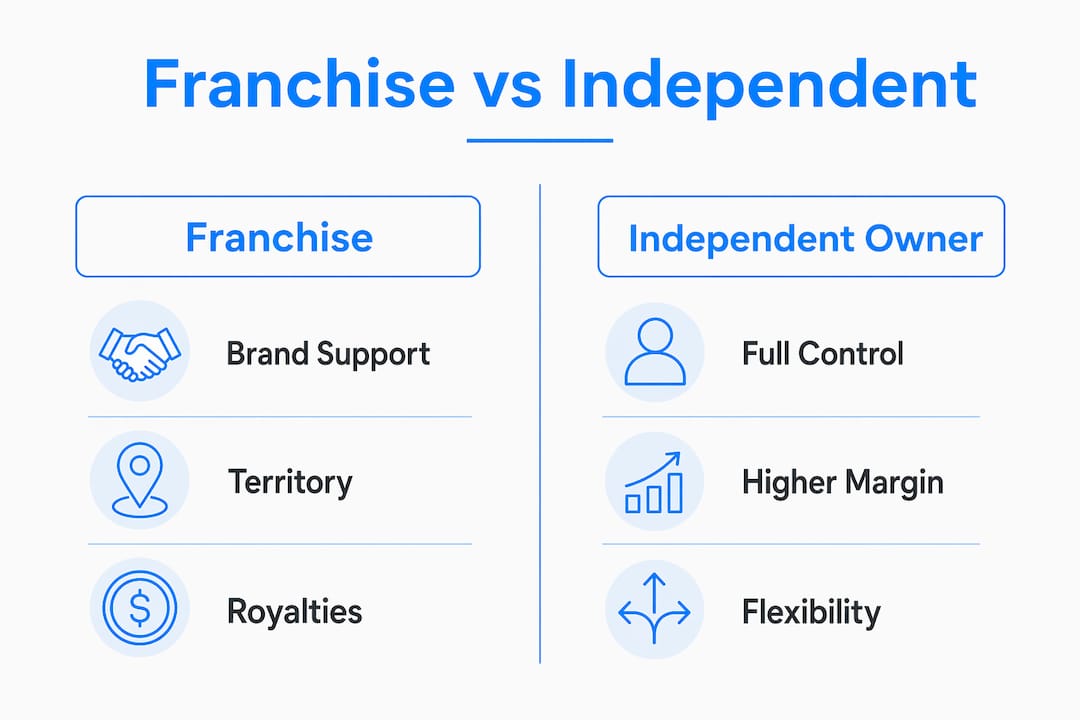
Pro Tip: If you want territory protection and brand support but can’t justify royalties, consider a hybrid: define your own service zone tightly, invest in local SEO and social media marketing, and use a coaching platform for operational systems. You get 80% of the franchise benefit at 20% of the ongoing cost.
What do startup costs and ongoing financials actually look like?
Startup costs vary more than most franchise marketing materials suggest. Here’s a realistic breakdown:
- Franchise fee: $15,000–$25,000 (one-time, paid at signing)
- Insurance and bonding: $500–$2,000 per year minimum; Care.com’s guide flags this as a core early cost that new owners consistently underestimate
- Business registration (LLC): $150–$4,000 depending on state, per Time To Pet’s cost breakdown
- Equipment and supplies: $500–$2,000 (leashes, first aid kits, GPS devices, uniforms)
- Local marketing launch: $1,000–$3,000 for initial territory promotion
- Software and scheduling tools: $50–$200/month
| Cost item | Range |
|---|---|
| Franchise fee | Varies based on franchisor and location |
| Insurance and bonding | Annual costs depend on coverage and location |
| Business registration | Costs vary widely by state |
| Equipment and supplies | Dependent on services offered |
| Local marketing | Initial promotional expenses vary |
| Software/subscriptions | Recurring fees based on chosen platforms |
| Total first-year outlay | Can range from moderate to substantial depending on choices |
Statistic callout: SBDCNet notes that part-time pet care operations can launch with minimal initial outlay, but full professional setups require significantly higher investment. Franchise minimums typically start around $32,000 all-in.
A simple 12-month snapshot: if you charge $25 per 30-minute walk, run 8 walks per day with 2 walkers, and operate 5 days a week, gross revenue approaches $104,000 annually. After a 8% royalty ($8,320), payroll, insurance, and software, net margin lands around 15–22% in year one, assuming strong route density. Break-even on the franchise fee alone takes 18–24 months at that pace. Adding grooming revenue or training upsells accelerates that timeline considerably.
How do you vet a dog walking franchise before signing?
Due diligence on a franchise offer follows a clear sequence. Don’t skip steps.
- Obtain the Franchise Disclosure Document (FDD) at least 14 days before signing anything. The FDD is legally required and covers fees, obligations, litigation history, and franchisee contact lists.
- Verify earnings claims. Item 19 of the FDD may or may not include financial performance representations. If it doesn’t, ask why, and treat vague verbal promises as red flags.
- Contact 6–10 current and former franchisees. The FDD must list them. Call former franchisees especially; they have no incentive to oversell.
- Review termination and renewal clauses. Short termination notice periods combined with large exit penalties are a serious warning sign.
- Check training scope. Who pays for travel to training? Is ongoing support included or billed separately?
- Confirm regional marketing fund accountability. Ask for an audit of how the fund was spent in the past two years.
Red flags to watch for: vague unit economics in Item 19, mandatory vendor relationships that lock you into overpriced suppliers, and franchisors who discourage you from speaking with former franchisees.
Pro Tip: Hire a franchise attorney to review the FDD before you sign, and bring in a CPA to model the unit economics. Ask the attorney specifically about exit clauses and territory enforcement. Ask the CPA to stress-test the break-even timeline at 60%, 80%, and 100% of projected revenue.
What operational realities do franchisors often understate?
The day-to-day running of a dog walking service is more operationally demanding than most franchise sales presentations suggest.
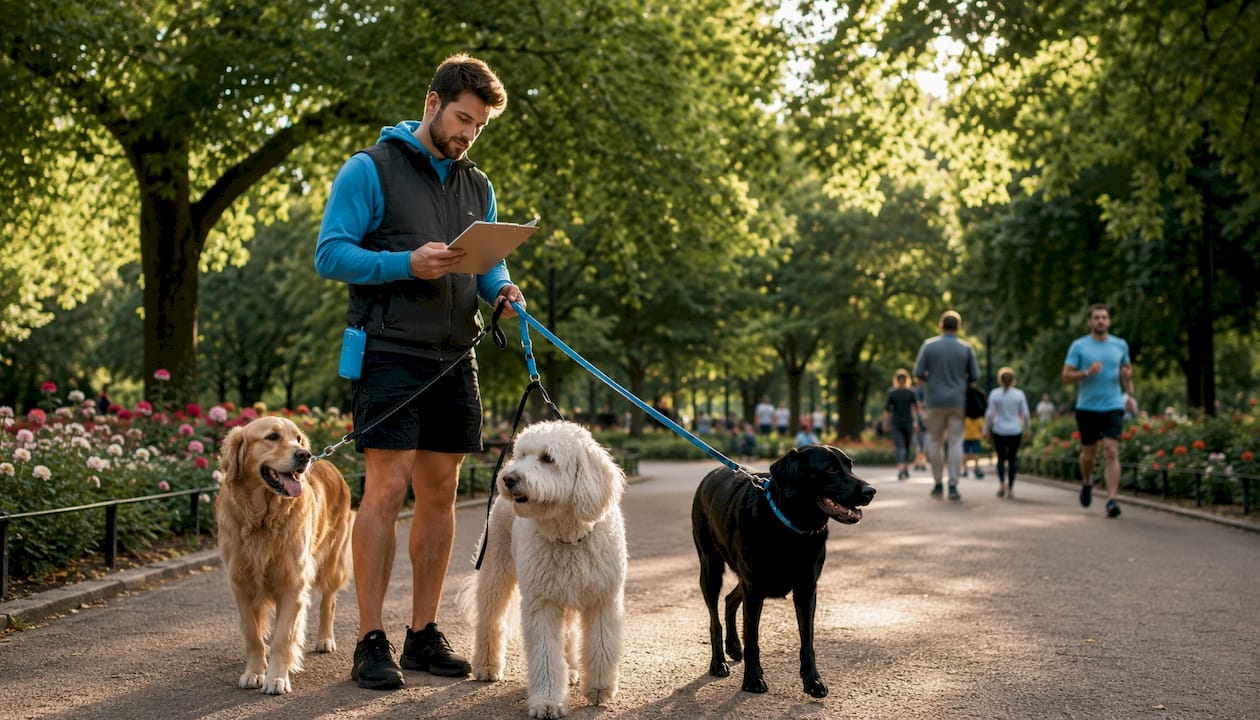
Staffing is the biggest variable. Hiring W-2 employees gives you control over training, scheduling, and accountability, but it adds payroll taxes and HR overhead. Using 1099 contractors cuts costs but creates liability exposure and inconsistent service quality. High-performing local operators like Sniff and Go use W-2 employees with CPDT-KA trainer oversight, GPS verification, and daily walk journals as their core quality signals. That model costs more but builds the client trust that drives retention.
Route density determines whether you’re profitable or just busy. Spreading walkers across a wide geographic area kills margins. Windy City Paws demonstrates the neighborhood-based model: same-walker assignments, GPS verification, and online scheduling within tight geographic zones. Your franchise territory may be large on paper; your profitable operating zone will be much smaller.
Safety and quality checklist franchisors may underemphasize:
- Daily walk journals sent to clients after every visit
- Written emergency procedures and vet contact protocols
- Consistent walker-to-client assignments (not rotating staff)
- Pet first aid certification for all walkers (Pet Sitters International recommends ongoing certification as a market differentiator)
- GPS verification on every walk
Pro Tip: Before launch, map your territory by neighborhood density. Prioritize the 2–3 zip codes with the highest dog-owner concentration and build route density there first. Expanding too fast across a wide area is the single most common reason new walking businesses stall on profitability.
What’s the step-by-step timeline from application to first revenue?
- Weeks 0–4: Submit inquiry, receive FDD, begin review with your attorney and CPA.
- Weeks 2–8: Secure financing (SBA loans, SBDC counseling, or personal capital); complete legal review; negotiate territory boundaries.
- Weeks 6–12: Complete franchisor training and onboarding; set up business registration, insurance, and bonding; hire first walkers.
- Weeks 10–16: Launch local marketing; activate scheduling software; begin client onboarding.
- Months 1–12: Track first revenue, monitor route density, and measure break-even progress monthly.
Owner’s responsibilities: financing, hiring, local marketing execution, client relationships.
Franchisor’s responsibilities: training delivery, brand assets, territory enforcement, marketing fund management.
Common bottlenecks: financing delays (add 2–4 weeks if SBA-backed), slow local hiring in competitive labor markets, and territory disputes if the FDD’s boundary definitions are vague.
What are the real alternatives to buying a franchise?
Three paths exist for operators who want the benefits of a franchise without the royalties:
- Build independent brand and systems. Highest control, highest effort. Works well for operators with an existing client base and strong local reputation. The investment goes into personal brand development and operational playbooks rather than a franchise fee.
- Join a platform or co-op. Shared marketing and referral networks with lower fees than a franchise. Less structured than a franchise but more flexible.
- Subscribe to coaching and SaaS (Thedoggurus). The most direct franchise alternative for professional operators. You get structured training, operational playbooks, AI-powered tools, and financial benchmarking without paying royalties on every dollar you earn.
Thedoggurus replicates the core franchise benefits that actually move the needle:
- Staff training modules and onboarding playbooks
- AI-powered scheduling and routing tools
- Financial benchmarking and profitability tracking
- Leadership development and team management frameworks
- Expert coaching from operators who have built and run pet care businesses
The case for a platform over a franchise: Lower recurring cost, full control over your territory, and the ability to add higher-margin services like grooming or training on your own terms. Thedoggurus owner products are built specifically for operators who want to scale without giving up a percentage of every walk they book.
Adding dog training revenue or professional grooming services alongside walking is far easier when you control your own business model.
What questions should you ask franchisors directly?
Ask these before any discovery day or signing:
- What is the average gross revenue for franchisees in their second year?
- What percentage of franchisees renew at the end of their initial term?
- How many franchisees have exited in the past 24 months, and why?
- Is my territory exclusive, and how is it enforced if another franchisee encroaches?
- What vendors am I required to use, and what are their pricing structures?
- What does initial training cover, and who pays for travel and accommodation?
- What are the renewal terms and fees?
- What happens to my client list if I exit the franchise?
Red flags: evasive answers on earnings, fewer than 5 franchisee references provided, mandatory vendor relationships with no pricing transparency, and termination clauses that allow the franchisor to exit with 30 days’ notice while requiring 6–12 months from you.
30-second franchisee reference call script: “Hi, I’m considering buying a franchise with [brand]. I’d love 5 minutes of your honest feedback. What’s working well, and what do you wish you’d known before signing? Would you do it again at the same investment level?”
Key Takeaways
A dog walking franchise makes financial sense only for first-time operators entering new markets who need brand support and can absorb royalties; experienced pet care owners almost always build better margins through independent systems or a coaching platform.
| Point | Details |
|---|---|
| Franchise cost reality | Most franchisees see one-time startup fees advertised between $15,000–$25,000, but total all-in first-year costs can approach $32,000 or more when including insurance, registration, marketing, and required operating expenses. Ongoing royalties of 6–10% of gross revenue apply. |
| Profitability driver | Marketing skill, route density, and service mix matter more than franchise status for long-term profit. |
| Due diligence non-negotiable | Always review the FDD with a franchise attorney and call at least 6 current and former franchisees before signing. |
| Staffing model matters | W-2 employees cost more but deliver the consistent quality and training outcomes that retain clients. |
| Thedoggurus alternative | Thedoggurus provides training, playbooks, AI tools, and coaching without royalties, giving operators franchise-level systems at a fraction of the ongoing cost. |
The case for building over buying
Most operators who ask me whether to buy a dog walking franchise are really asking a different question: “How do I scale faster without starting from scratch?” That’s a fair concern. But a franchise is one answer to that question, not the only one, and often not the best one for someone who already runs a professional pet care operation.
The royalty structure is the part that rarely gets modeled honestly during the sales process. At 8% of gross revenue on a $100,000 book of business, you’re writing a $8,000 check every year for brand recognition that a strong local reputation and consistent service quality can build in 12–18 months anyway. The operators I’ve seen scale fastest are the ones who invested that money into team culture, pricing strategy, and route density instead.
If you want the structure of a franchise without the royalties, the playbooks exist. Use them.
Thedoggurus gives you franchise-level systems without the royalties
Pet care operators who want proven systems, expert training, and operational support don’t need to sign a franchise agreement to get them.
Thedoggurus is built for exactly this situation. You get onboarding playbooks, role-specific staff training modules, AI-powered scheduling and routing tools, financial benchmarking, and live coaching from operators who have scaled real pet care businesses. No royalties. No territory restrictions. No mandatory vendor relationships.
The owner products and pricing are designed to replace the support structure of a franchise at a fraction of the ongoing cost, so you keep more of every dollar your walkers earn. Whether you’re adding dog walking to an existing daycare or grooming operation, or building a dedicated walking service from the ground up, Thedoggurus gives you the tools to launch with confidence and grow with control. Visit Thedoggurus to explore owner plans and book a demo today.
Sources and further reading
- SBDCNet: Pet Care Services Business Snapshot — Use for startup cost ranges, profitability drivers, and franchise vs independent comparisons.
- Pet Sitters International — Use for certification standards, ongoing training requirements, and industry benchmarks.
- National Association of Professional Pet Sitters (NAPPS) — Use for professional membership resources, insurance access, and business templates.
- Care.com: How to Start a Pet Sitting Business — Use for step-by-step startup cost guidance and licensing requirements.
- Time To Pet: Costs to Start a Pet Sitting or Dog Walking Business — Use for itemized cost ranges by business registration type and state.
- Thedoggurus: Owner Products and Pricing — Use to evaluate coaching and SaaS alternatives to franchising.