

Being Green – Saving Greenbacks & Trees
Too often small businesses think that being green is just something for tree hugging San Franciscans in their Birkenstocks. Well, as a small business owner located in San Francisco (but trust me never in Birkenstocks), I can tell you that nothing could be further from the truth. Pet Camp, the first certified green overnight pet care facility in the country, is proof that you can save trees and greenbacks at the same time.
In fact, I would suggest that being green ONLY makes sense if you can both save trees and money. We’ve made all of our environmental decisions the same way we’ve made our other business decisions – was there a good return on the investment?. Now granted, how each business defines “good” can differ- from the length of time you’re willing accept for a return on the investment to what you include in the calculation (financial savings, marketing, “feeling good” about your business, etc.) – but it still needs to be a sound business decision and not just the environmentally correct decision.
Like many things in life, being green is easier if you have help. Pet Camp doesn’t have a team of environmental engineers, environmental attorneys, or an “Office of Environmental Innovation” to ask for help when looking at ways to be more environmentally friendly. We needed to find partners to assist us on our green pathway.
We worked with non-profits, local governments, our garbage company, and even our utility company to find ways to reduce our environmental impact while saving us money. It turns out that many utility companies will actually give you money NOT to use electricity because it turns out that paying you is cheaper than building a new power plant and since finding new landfills is no easy task, many waste haulers will incent you (which means you will save money) to divert waste from a landfill. We currently divert over 80% of waste from landfills which ends up saving us considerable amounts of money!
So once you’ve decided to head down the green pathway and you’ve got some partners to walk with you, you need to think about the direction you want to go and, frankly, how much money you want to spend. Sure some environmental efforts require a lot of upfront capital, and may not be worth it if you don’t own your building or have a long term lease. But may don’t and being green is something you can incorporate into your operations at every level.
Supplies cost money – you don’t want to waste them, but too often people think if 2 ounces of (cleaner, soap, disinfectant) are good, 4 ounces must be better. Automating your laundry machine and dishwasher will reduce use of expensive and environmentally impacting chemicals. Use foaming guns to apply less disinfectant more uniformly and effectively. Of course natural resources also cost money – put timers or motion detectors on light switches, nozzles on hoses, and low flow aerators on your faucets. None of these basic steps are expensive to implement and they can save you money (and help you save the environment).
Once you take these first steps you need to prioritize your efforts; what is the biggest bang for your buck? At Pet Camp we focused first on our electricity usage. In 2000 when we started our efforts our electricity bill at our Main Campground was $25,000 – last year it was closer to $6,000 (and the cost of electricity has not gone down).
How did we do it? First, we focused on the low hanging fruit – those things easy to do with quick returns on our efforts and investments. If you still have regular 2” fluorescent bulbs, change them to T-5s or T-8s or even LEDs and get rid of those HID bulbs in your highbay! These changes will not only save you on your electric bill but reduce labor costs since you won’t need to change your bulbs as often. If you can convert your heavy duty electrical equipment (pool heaters, dishwashers, washing machines) from single phase to three-phase you will have more efficient operation, equipment that lasts longer and a smaller electric bill.
After those, you’re onto some bigger ticket items. We installed 2 High Volume Low Speed Fans. These fansare 20’ foot diameter ceiling fans that move lots of air very slowly, using as much energy as a 65 watt bulb. This allowed us to turn off 13 small energy hog fans.
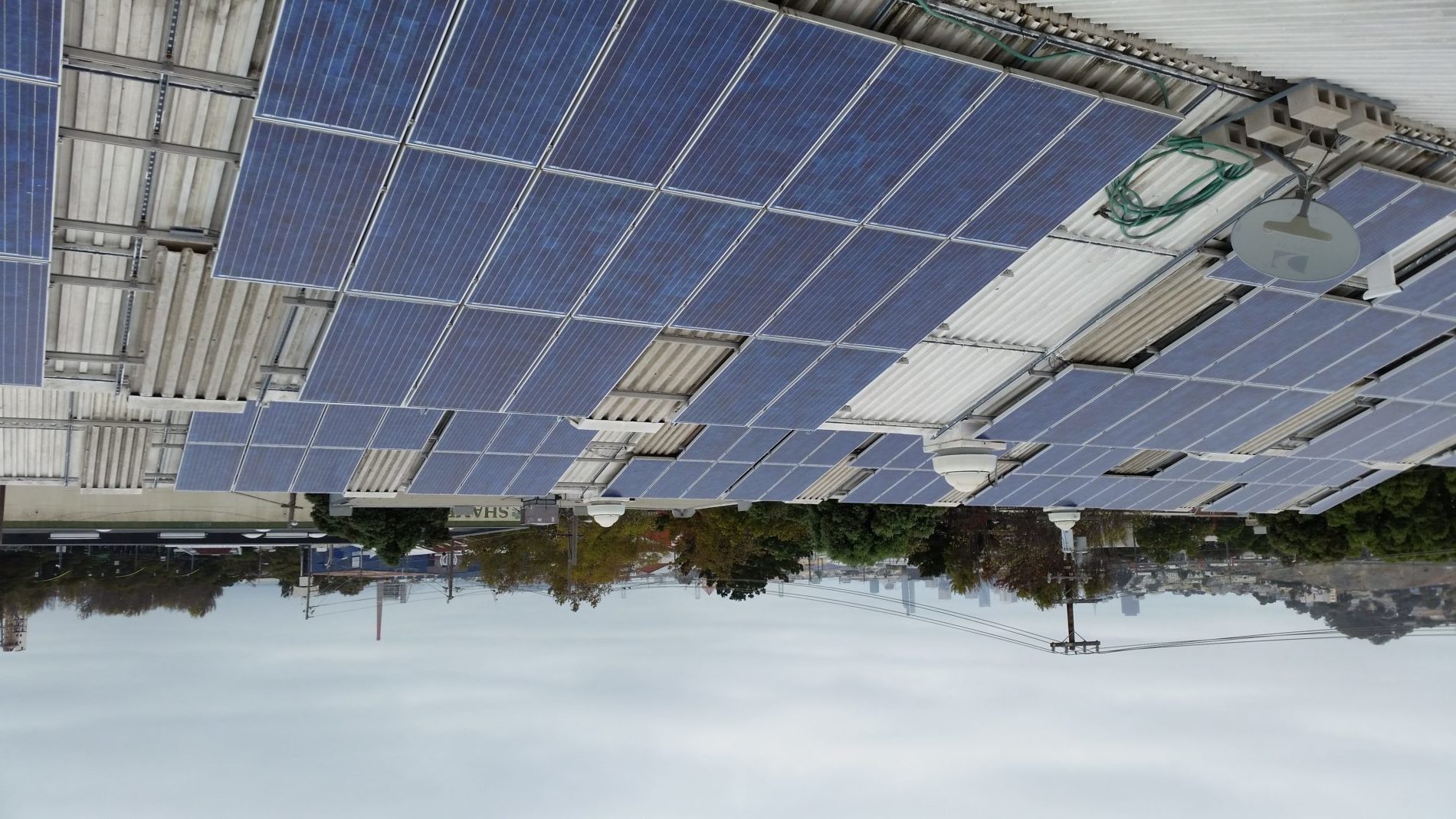
We also have 152 solar panels on our roof to provide us with electricity. These are big commitments and you need to make sure it’s worth your investment but there are plenty of financial incentives out there to lessen your burden and an equal number of creative ways to finance these projects (purchase, leases, tax credita and loans). For these large commitments it’s critical to work with both your environmental partners and your financial partners and advisors.
Our next biggest cost item is natural gas. We installed a tankless water heater with solar thermal panels to pre-heat water at our Cat Safari location. This system works great in combination to reduce the use of natural gas to provide hot water, but there are limitations as to the volume of hot water produced and it would not work at our Main Campground where hot water needs are greater. The warm air from our Safari Solarium at Cat Safari also passively heats the building.
Lastly, our primary vehicle for pick up and drop off services (our Pet Camp Express) runs on CNG (compressed natural gas) which in addition to costing about $1.00 less per gallon equivalent of regular gasoline also produces less greenhouse gases.
Our next challenge in drought stricken California is water. Frankly, by using pressure washers instead of regular hoses; low flow nozzles everywhere; a shampoo application machine; and drip irrigation we’re already efficient water users – but we are still big water users and we need to look harder at using grey water and water storage options (should it ever rain again in California). These are projects that will take us both time to research and money to implement and we will only move forward if they “make sense.”
So where does all of this leave us this Earth Day? I think it leaves us knowing that:
- There are lots of opportunities to both save the environment and save some cash
- Environmental decisions can be and should be made the same way other business decisions are made; and
- You can make sound environmental decisions without compromising on your core mission of providing quality care.
Family owned and operated Pet Camp has been providing loving, fun and safe care for San Francisco’s dogs and cats for almost 20 years. Certified as a Green Business in 2005, Pet Camp’s two San Francisco locations and over 35,000 square feet provide a unique environment for up to 160 dogs and 80 cats to explore, play, swim (the dogs at least) and so much more. Pet Camp is the San Francisco Bay Area’s most awarding winning overnight and day care facility and demonstrates on a daily basis that there is substantial overlap between the core values of caring for pets and caring for the environment.