

The most reliable way to hire dog daycare and kennel staff is to ask 50 role-specific questions grouped by purpose, score every candidate on a one-page rubric, and verify hands-on skills and vaccinations before making an offer. Thedoggurus, Indeed’s kennel attendant question bank, and a current pet first-aid certification are the three reference points worth keeping in front of you throughout this process.
- Use grouped interview questions for dog daycare roles: general fit, background and experience, and in-depth situational prompts.
- Verify health and safety requirements, including vaccination records and hands-on animal-handling skills, before any offer goes out.
- Score every candidate consistently with a one-page rubric so hiring decisions stay objective across your whole team.
Key Takeaways
The most reliable way to hire dog daycare staff is to combine grouped interview questions, a one-page scorecard, verified health documentation, and a paid trial shift before any offer is made.
| Point | Details |
|---|---|
| Use a structured scorecard | Score every candidate on the same 1–5 rubric to keep hiring decisions objective and defensible. |
| Verify vaccinations before the offer | Record first-aid certification and vaccination checks as pass/fail on the scorecard. |
| Run a paid trial shift | A 2–4 hour observed shift reveals real handling skill that interview answers cannot. |
| Follow a 30–60–90 plan | Documented onboarding milestones reduce management time and improve 90-day retention. |
| Thedoggurus hiring system | Thedoggurus provides scorecards, question banks, and onboarding templates built for pet care operations. |
Table of Contents
- What should your pre-interview checklist and scorecard include?
- The 50 interview questions for daycare and kennel roles
- What do strong candidate answers actually look like?
- How do you run practical skills tests and a trial shift?
- What health and safety verifications should you require?
- What questions are illegal to ask in a job interview?
- How should you onboard new hires in the first 90 days?
- How do you evaluate cultural fit in a dog daycare team?
- How do you assess empathy and patience with animals?
- What are typical wages for dog daycare staff in the U.S.?
- What legal employment documents do you need before hiring?
- How do you verify candidate references and previous employers?
- What most owners get wrong about hiring for daycare
- Thedoggurus gives you the hiring tools to get this right
- Sources
What should your pre-interview checklist and scorecard include?
A three-step hiring framework works well for pet care businesses: screen applicants, interview the best matches, and prepare new hires to self-manage. Before the first candidate walks in, run through these pre-interview items:
- Job description finalized and posted with physical requirements listed
- Application packet sent, including a directional task (e.g., “Describe a time you handled an anxious dog in three sentences”) to test instruction following
- Reference list and availability confirmation requested upfront, including weekends and overnights
- Interview location confirmed as pet-friendly, or trial shift scheduled on-site
- Candidate asked to bring vaccination proof and photo ID
Interview Scorecard
Score each category 1–5. Any Pass/Fail flag that reads “Fail” disqualifies the candidate before a final offer.
The 50 interview questions for daycare and kennel roles
Mixing general, behavioral, and job-specific questions gives you the most complete picture of candidate fit. Use the groups below to build your interview guide.
General fit and culture (15 questions)
- Why do you want to work in dog daycare or boarding?
- What does a great day at work look like for you?
- How do you handle a fast-paced, physically demanding shift?
- Are you available on weekends, evenings, and holidays?
- Can you commit to overnight shifts if the role requires them?
- How do you respond when a supervisor gives critical feedback?
- Describe your ideal team dynamic.
- What would your last coworkers say about your reliability?
- How do you stay calm when multiple things go wrong at once?
- What do you know about our facility and the services we offer?
- How do you feel about cleaning kennels and handling waste throughout the day?
- Have you ever had to enforce a rule a client disagreed with?
- What motivates you to show up on a tough day?
- How do you prioritize tasks when everything feels urgent?
- What does “safe dog play” mean to you?
Background and experience (15 questions)
- How many years have you worked directly with dogs?
- Have you supervised group play with more than ten dogs at once?
- Do you hold a pet first-aid or CPR certification?
- Have you ever administered medication to an animal? Describe the process.
- What breeds or temperaments do you find most challenging?
- Have you worked with a dog that had a bite history?
- Describe your experience with kennel sanitation and disinfection routines.
- Have you ever filed an incident report? Walk me through it.
- What animal-behavior training or coursework have you completed?
- Have you worked in a facility that required vaccination verification for dogs?
- Describe a time you identified a dog showing signs of illness.
- Have you ever had to separate dogs during a conflict?
- What record-keeping systems have you used?
- Have you communicated a pet health concern to an owner? How did you handle it?
- What physical tasks in this role do you feel most confident performing?
In-depth situational and behavioral questions (15 questions)
- A dog in your care stops eating and seems lethargic. What do you do?
- Two dogs escalate to a fight during group play. Walk me through your response.
- An owner calls upset because their dog came home with a scratch. How do you handle it?
- You notice a coworker skipping a sanitation step. What do you do?
- A dog refuses to enter its kennel and is becoming aggressive. What’s your approach?
- You’re alone on shift and a dog shows signs of a possible allergic reaction. What are your next steps?
- How do you document an injury that happens during your shift?
- A new dog arrives and immediately shows resource-guarding behavior. How do you respond?
- You’re behind on feeding rounds because of an incident. How do you catch up safely?
- An owner gives you verbal medication instructions that differ from the written card. What do you do?
- Describe how you would introduce a new dog to an established play group.
- A dog in your care has a known escape history. What precautions do you take?
- How do you manage your own stress during a high-incident shift?
- A client asks you to bend a facility rule “just this once.” How do you respond?
- You disagree with a policy your manager has set. How do you handle it professionally?
Optional prompts for trial shifts or follow-up conversations (5 questions)
- Role-play: Call an owner to update them on their dog’s behavior today.
- Demonstrate how you would administer a liquid medication using a syringe (dummy meds).
- Walk me through how you would set up an enrichment activity for a group of five dogs.
- Show me how you would complete an end-of-shift incident log entry.
- Describe how you would plan a day’s schedule if two dogs had special dietary needs and one had a vet appointment.
What do strong candidate answers actually look like?
Indeed’s 50-question kennel attendant resource pairs sample answers with common questions. Use the five models below to calibrate your scoring before interviews begin.
Feeding, hydration, and record-keeping
Emergency evacuation and owner communication
Calming a distressed dog
Administering medication
Handling a client complaint
Pro Tip: Run a calibration exercise before your first round of interviews. Have every interviewer score the same model answer independently, then compare scores. Gaps of two or more points on the same answer signal that your rubric needs clearer language.
How do you run practical skills tests and a trial shift?
Observing a candidate’s actual handling of a dog reveals competence that resume answers never will. Keep tests short, controlled, and supervised.
- Leash control: Ask the candidate to walk a calm, staff-familiar dog on leash. Watch for loose-leash technique, body positioning, and how they respond if the dog pulls.
- Crate setup and sanitation: Have the candidate set up a crate, clean a kennel surface with your facility’s disinfectant, and explain the contact time required.
- Simulated medication administration: Use a dummy syringe and water. Ask the candidate to walk through the full sequence: read the card, confirm the dose, administer, log.
- Written incident note: Give a brief scenario and ask the candidate to write a one-paragraph incident report. Evaluate clarity, detail, and accuracy.
Trial-shift template (2–4 hours, paid)
- Start-of-shift briefing: review the day’s dog roster, special instructions, and emergency contacts.
- Observed group play rotation: supervisor watches candidate read dog body language and manage space.
- Cleaning round: candidate completes a full sanitation cycle under observation.
- Owner-update role-play: candidate calls a mock owner with a behavior update.
- Debrief: supervisor scores the trial using the same scorecard from the interview.
Pro Tip: Keep all skills tests supervised and use staff dogs or trained volunteer dogs only. Document written consent from dog owners before any candidate interacts with their pet. Check your liability insurance policy to confirm trial-shift coverage before scheduling.
What health and safety verifications should you require?
Staff qualifications for dog daycare include dog-behavior knowledge, basic canine first aid and CPR, communication skills, and physical stamina. Verify each before making an offer.
Record every verification result on the scorecard before extending a final offer. A single “Fail” row stops the process until the candidate provides documentation.
What questions are illegal to ask in a job interview?
Avoid any question that touches on age, religion, pregnancy, disability specifics, marital or family status, national origin, or sexual orientation. These are protected categories under federal and most state employment laws.
That phrasing gets you the job-relevant answer without crossing into protected territory. For edge cases, consult your state’s labor department or an employment attorney, and document that you asked every candidate the same questions in the same order.
How should you onboard new hires in the first 90 days?
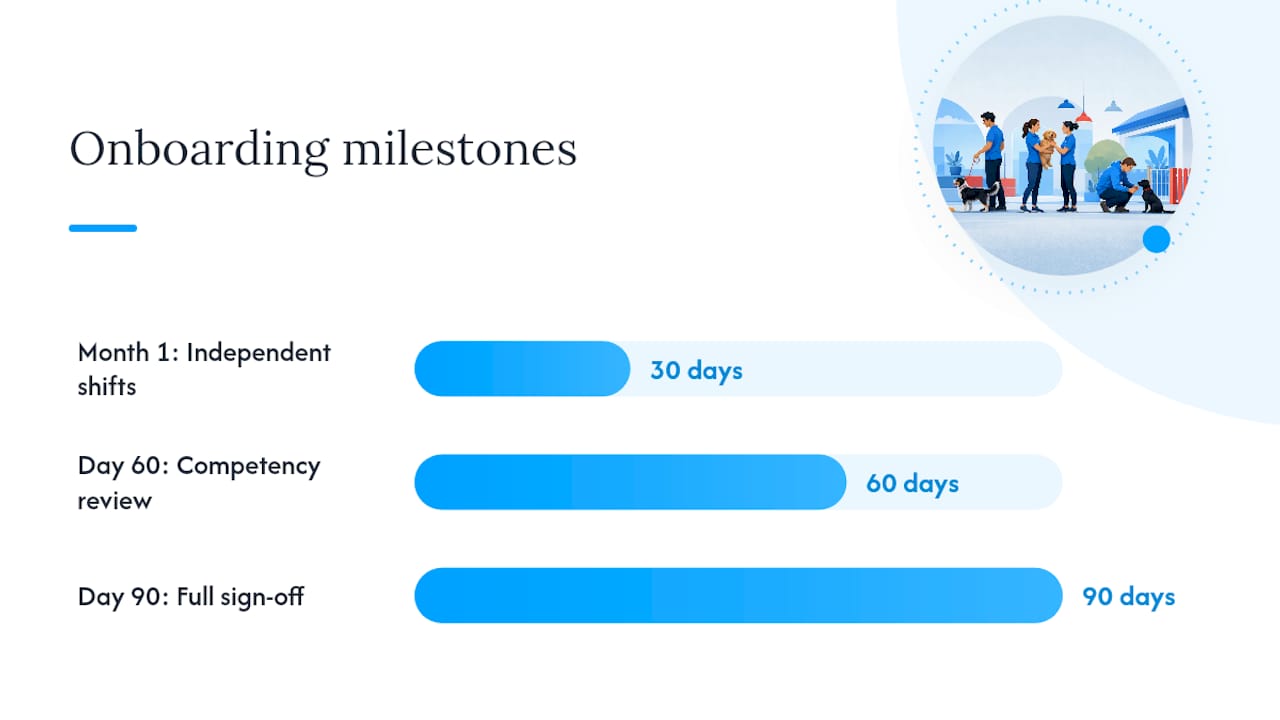
Documented 30–60–90 onboarding plans reduce management time and improve new-hire reliability. Use this schedule as your baseline.
- Day 1: Facility tour, safety briefing, emergency contacts, and policy sign-off.
- Week 1: Supervised shifts covering feeding, sanitation, and basic handling. Daily check-ins.
- Month 1: Independent shifts with weekly supervisor reviews. Documentation training completed.
- Day 60: Competency review against scorecard categories. Identify any gaps.
- Day 90: Full sign-off on all core modules: animal handling, sanitation, medication, customer communication, and enrichment scheduling.
Retention starts here. Early feedback loops, pay-competitiveness checks, and cross-training across roles keep good staff engaged past the 90-day mark.
How do you evaluate cultural fit in a dog daycare team?
Dog daycare teams work in close quarters under pressure. Cultural fit is less about personality and more about how a candidate handles conflict, shares information, and supports teammates during a hard shift. Ask candidates how they’ve covered for a struggling coworker, or what they do when a team member makes a mistake. Watch for blame-shifting versus ownership.
Hiring the right employees directly affects safety and client trust. A candidate who is great with dogs but dismissive of teammates creates a different kind of risk. Look for people who treat the team’s success as their own.
How do you assess empathy and patience with animals?
Ask candidates to describe a dog they found genuinely difficult to work with, and listen for specificity. A strong answer names the behavior, explains what the candidate tried, and reflects on what they learned. Vague answers (“I love all dogs”) signal limited experience. Candidates who can describe managing problem behaviors without frustration or judgment tend to stay calm when it matters most.
What are typical wages for dog daycare staff in the U.S.?
Bureau of Labor Statistics, the median annual wage for animal care and service workers was $33,750 as of May 2023, which translates to roughly $16.23 per hour. Entry-level kennel attendants in many U.S. markets start near minimum wage, while experienced handlers with first-aid certification or grooming skills often earn $18–$22 per hour. Facilities in high cost-of-living metros typically pay at the upper end of that range. Offering competitive pay, clear advancement paths, and cross-training opportunities reduces turnover significantly.
What legal employment documents do you need before hiring?
Every new hire in the U.S. requires a completed Form I-9 (employment eligibility verification) and a signed W-4 for federal tax withholding. Most states add their own withholding forms. Run a background check through a compliant third-party provider such as Checkr or Sterling, and follow the Fair Credit Reporting Act’s adverse-action procedures if a result affects your decision. Keep all documents in a secure personnel file, separate from the interview scorecard.
How do you verify candidate references and previous employers?
Call references directly rather than relying on written letters. Ask each reference three specific questions: how the candidate handled a stressful situation, what they would improve about the candidate’s performance, and whether they would rehire them. That last question is the most revealing. For previous employers, confirm job title, dates of employment, and eligibility for rehire. Document every call with date, time, and the reference’s name.
What most owners get wrong about hiring for daycare
Most operators spend the most time on the interview and the least time on what comes before and after it. An application packet with a directional task, like asking candidates to describe their emergency response in three steps, tells you more about attention to detail than any interview question. And a candidate who aces the interview but receives no structured onboarding often fails within 60 days, not because they lacked skill, but because expectations were never made explicit.
The scorecard matters for a different reason than most owners think. It is not primarily about consistency across candidates. It is about protecting you legally. When a hiring decision is challenged, a documented, consistently applied rubric is your clearest defense. Good intentions are not enough. Systems are.
Thedoggurus gives you the hiring tools to get this right
Hiring great daycare staff takes more than a good list of questions. Thedoggurus gives pet care business owners a complete hiring and training system: ready-to-use interview scorecards, role-specific question banks, hands-on training modules, and a full 30–60–90 onboarding plan built for dog daycare, boarding, grooming, and pet-sitting operations.
The platform’s staff accountability tools and modular training let you onboard faster, reduce management time, and build a team that runs safely without you watching every shift. Visit Thedoggurus to start a trial and access the full hiring kit today.
—
Sources
- 3 Steps to Hiring the Right Staff for Your Pet Care Business
- Securing Top Talent: Essential Interview Questions for Hiring Animal Care and
- What Staff Qualifications Are Needed to Run a Dog Daycare
- 50 Kennel Attendant Interview Questions (With Sample Answers)