

How big is the U.S. pet business market right now?
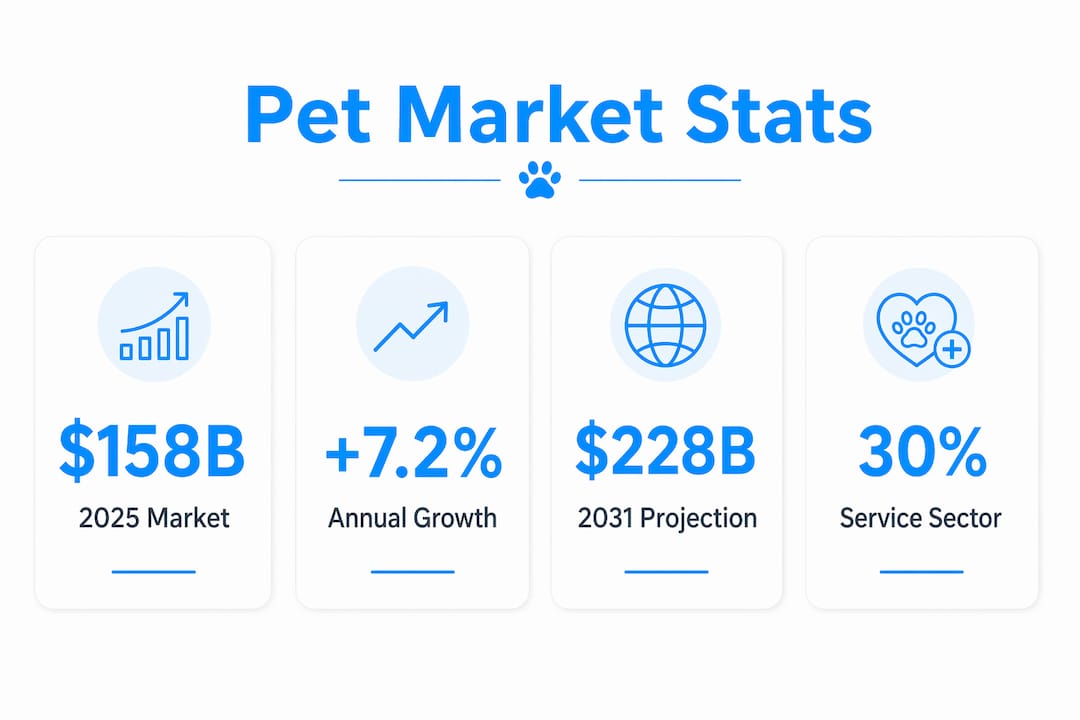
The U.S. pet industry hit $158 billion in 2025, and it shows no signs of slowing down. Analysts project the market will reach $228 billion by 2031, growing at roughly 6.6% annually. For entrepreneurs evaluating where to put their energy, those numbers tell a clear story: this is one of the most resilient consumer markets in the country.
Here is a snapshot of where that spending goes:
| Expenditure Category | Estimated Annual Spend |
|---|---|
| Pet food and treats | $68.3 billion |
| Veterinary care | Growing segment |
| Pet supplies and equipment | Significant share |
| Grooming and boarding | Fast-growing services |
| Pet pharmacy (e.g., Chewy Pharmacy) | Expanding rapidly |
Key facts every entrepreneur should know:
- The APPA reports 196.9 million pets currently living in U.S. households.
- Pet food and treats alone account for the largest spending category, at $68.3 billion annually, significantly more than other categories.
- Service categories like grooming, training, and boarding are growing faster than product sales.
- The “humanization” of pets is pushing owners toward premium products and specialized care.
Where does pet spending actually go?
Pet food dominates the budget, but the services side of the market is where the most interesting growth is happening. Grooming, boarding, training, and specialty pharmacy are all expanding as owners treat their animals more like family members than property.

| Category | Market Position | Growth Signal |
|---|---|---|
| Pet food and treats | Largest category | Premiumization trend |
| Veterinary care | Core recurring spend | Telehealth expanding |
| Supplies and equipment | Broad, competitive | Tech products growing |
| Grooming and boarding | High-margin services | Strong demand |
| Training services | Niche, high value | Underserved markets |
| Pet pharmacy | Chewy Pharmacy leading online | Rapid digital shift |
| Specialty nutrition | Emerging premium niche | High margins |
Pet technology, including GPS trackers, automated feeders, and health monitors, is one of the fastest-growing subcategories. Owners who already spend heavily on food are often the first to adopt these products. The APPA’s National Pet Owners Survey tracks these shifts annually and remains the most reliable benchmark for category-level spending data.
Pro Tip: If you are evaluating which category to enter, look at services over products. Grooming, training, and boarding carry higher margins and face less direct price competition from large online retailers.
Who owns pets in America, and what do they want?
Pet ownership in the U.S. is broad and growing, with 196.9 million pets spread across tens of millions of households. Millennials are now the largest group of pet owners, and they spend more per pet than any previous generation. Seniors are also a growing ownership segment, particularly for companion animals.
The defining consumer trend is pet humanization. Owners increasingly describe their pets as “fur babies,” and that emotional bond directly drives premium spending. A dog owner who thinks of their pet as a family member will pay for specialized nutrition, professional training, and enrichment services without much hesitation.
- Millennials drive the premiumization trend, favoring organic food, specialty care, and tech-enabled products.
- Senior pet owners prioritize health-focused services and reliable, trustworthy providers.
- Dual-income households with no children spend disproportionately on pet services.
- Urban pet owners are the core market for boarding, daycare, and professional dog walking.
- Social media has accelerated demand for photogenic, shareable pet products and experiences.
Who are the major players in U.S. pet retail?
The retail side of the pet industry is dominated by a handful of national chains, but local and online operators are carving out real market share. Understanding the competitive landscape helps you position a new venture more precisely.
Brick-and-mortar chains:
- Petco operates stores nationwide, offering pet food, supplies, toys, beds, and pet technology products, plus medication and in-store services.
- PetSmart carries a full range of pets, supplies, and food, with most locations offering grooming, boarding, and training services.
- Pet Supermarket focuses on a wide range of supplies including food, toys, and health and nutrition products.
- Pet Food Experts serves as a key wholesale distributor supplying independent pet retailers across the country.
Online and specialty:
- Chewy Pharmacy has become a dominant force in pet medication and prescription food, making it a direct competitor to in-store pharmacy services.
- Pet Wants Chicago North represents the franchise model for premium, locally sourced pet food, showing how specialty nutrition can succeed at the neighborhood level.
Local service businesses illustrate the diversity of the market. Make Your Dog Epic in Tulsa, OK, and All Dogs Unleashed Dog Training Dallas in Carrollton, TX, are examples of specialized training businesses that have built strong local followings by focusing on a specific service rather than competing broadly.
What are the most profitable pet business opportunities?
The most profitable pet businesses are not always the most obvious ones. Niche services attract higher margins by appealing to the emotional “fur baby” mindset rather than competing on price with mass-market retailers.
Here is how the main business models compare:
- Low investment, service-based: Dog walking, pet sitting, and basic grooming can launch for under $1,000. They require time more than capital, and profitability depends on building a reliable client base.
- Facility-based: Dog daycare, boarding, and full-service grooming salons require significant upfront investment but offer multiple revenue streams and real scaling potential.
- Specialized training: Businesses like Make Your Dog Epic and All Dogs Unleashed command premium rates because they solve specific behavioral problems owners genuinely need fixed.
- Premium and medical services: Offerings like Medi-Paws medical support or enrichment programs attract dedicated owners willing to pay above-market rates.
Professional pet sitters who carry insurance and bonding consistently outperform casual operators on both trust and profitability. That gap widens as a business grows and takes on staff.
Pro Tip: Focus on a niche that faces less price competition. A specialized training program or premium boarding facility will always out-earn a generic “we do everything” service in the same market.
How do you grow and scale a pet care business?
Growth in this industry comes down to two things: operational discipline and client trust. The businesses that scale past the solo-operator stage are the ones that invest early in systems, not just services.

Specialized software that automates scheduling and client communication removes the biggest bottleneck most facility owners face. Manual scheduling and paper-based intake processes create errors, slow down staff, and frustrate clients. Digitizing those workflows frees you to focus on care quality and growth.
Key practices for sustainable growth:
- Invest in staff training and hiring systems before you need them, not after.
- Use contracts and clear service agreements with every client from day one.
- Track occupancy, revenue per client, and staff cost ratios monthly.
- Build referral relationships with local veterinarians and groomers.
- Collect and respond to reviews consistently across Google and Yelp.
Pet Sitters International emphasizes that pairing genuine passion for animals with rigorous business fundamentals is what separates thriving businesses from those that plateau. That combination, care plus systems, is the foundation of every successful pet care operation.
What licenses and regulations apply to pet businesses?
Licensing requirements vary by state and business type, but every pet business needs at least a basic business license from its local municipality. Facility-based operations like boarding kennels and daycare centers face additional requirements.
Most states require kennel licenses for any facility housing animals overnight. Grooming businesses may need a cosmetology or animal grooming license depending on the state. Dog trainers are largely unregulated at the state level, though professional certifications from bodies like the Certification Council for Professional Dog Trainers (CCPDT) carry real market credibility.
Pet Business Insurance is not optional once you are working with other people’s animals. General liability coverage protects against property damage and injury claims. If you employ staff, workers’ compensation is required in most states. Bonding adds another layer of client trust, particularly for in-home services.
How should you market a pet business?
Word of mouth remains the most effective marketing channel for pet businesses, particularly at the local level. PSI members consistently report referrals as their top source of new clients, which means delivering excellent service is itself a marketing strategy.
Beyond referrals, the highest-return tactics for marketing a pet business include a well-optimized Google Business Profile, active social media showing real pets in your care, and partnerships with local vets and groomers. For businesses ready to invest in paid growth, targeted local paid ads can accelerate client acquisition significantly. Building veterinary SEO visibility is also worth prioritizing early, since pet owners search online before they call.
What challenges should you prepare for?
Seasonality is the most predictable challenge in pet services. Boarding and daycare demand spikes around major holidays and summer travel, then drops sharply in slower months. Building cash reserves during peak periods is the practical answer, not a luxury.
Competition from large chains and app-based platforms puts constant pressure on pricing. The best defense is specialization and relationship depth. A client who trusts you with their dog’s medical needs or behavioral training is far less likely to switch for a lower price. Staff retention is the other persistent challenge. High turnover in pet care raises training costs and disrupts client relationships, which is why investing in team culture and onboarding pays back quickly.
Key Takeaways
The U.S. pet industry, valued at $158 billion in 2025 and projected to reach $228 billion by 2031, rewards entrepreneurs who combine genuine animal care with disciplined business operations.
| Point | Details |
|---|---|
| Market size and growth | The industry hit a very large market size recently and is projected to continue growing steadily through the next decade. |
| Largest spending category | Pet food and treats account for the largest share of total expenditure at $68.3 billion, significantly exceeding other categories. |
| Pet population | The APPA reports a very large number of pets in U.S. households, with humanization driving premium spending. |
| Best profitability path | Niche and specialized services command higher margins than mass-market product retail. |
| Startup cost range | Service-based businesses can launch with relatively low startup costs; facility-based models require more capital investment. |
Ready to turn your pet care passion into a profitable, scalable business? Thedoggurus gives you the expert courses, AI-powered tools, and coaching you need to grow with confidence. Whether you are just starting a pet care business or ready to scale an existing operation, the platform is built for exactly where you are right now.
Explore Thedoggurus plans and pricing and see which tier fits your business goals.