

A pet care playbook is a set of operational SOPs, staff training modules, and accountability systems that tell your team exactly what to do, when, and how — removing guesswork from every shift. To start today: (1) pick your single highest-risk area (off-leash play, grooming, or emergency response), (2) write a one-page SOP covering the trigger, the steps, and the responsible person, and (3) assign an owner who signs and dates it by end of week. That’s your first playbook. Documented procedures reduce incidents, cut onboarding time, and give you the paper trail licensing inspectors and insurers expect to see.
Key Takeaways
Documented pet care playbooks, built in priority order and rolled out over 30–90 days with named owners and tracked sign-offs, are the single most reliable way to reduce incidents, pass inspections, and scale a pet care business without losing consistency.
| Point | Details |
|---|---|
| Start with Priority 1 playbooks | Build intake, off-leash safety, and emergency response SOPs before anything else. |
| Use a staged 30/90/180 rollout | Pilot with core staff, then expand and audit — don’t launch everything at once. |
| Track KPIs from day one | Incident rate, training completion, and time-to-onboard reveal whether playbooks are working. |
| Assign named owners to every SOP | One person responsible per procedure means it gets updated; shared ownership means it doesn’t. |
| Thedoggurus accelerates the process | Ready-made templates, training modules, and AI accountability tools replace months of SOP writing. |
Table of Contents
- What do pet care playbooks actually cover?
- Core playbooks every pet care business should build first
- Templates and checklists you can copy and adapt right now
- How to roll out playbooks in 30, 90, and 180 days
- What tools should you use to host and track playbooks?
- How do you know if your playbooks are working?
- Safety, licensing, and insurance documentation your playbooks must include
- How to adapt playbooks for each service type
- How these playbooks were developed and validated
- Why the binder on the shelf is the real problem
- Thedoggurus gives you ready-made playbooks, training, and coaching
- Sources
What do pet care playbooks actually cover?
These are business-facing operational documents, not consumer pet-care how-to guides. A playbook for your facility covers the processes your team runs every day: intake screening, play group management, cleaning schedules, emergency escalation, staff onboarding, and pricing logic. It does not cover advice for pet owners on feeding, enrichment, or home training.
What’s in scope:
- Operations: daily routines, capacity management, scheduling
- Safety: off-leash play protocols, grooming equipment rules, emergency response
- Staff: onboarding checklists, training sign-offs, CPD logs
- Communication: client intake forms, incident notifications, vaccination record requirements
- Profitability: pricing procedures, occupancy targets, upsell workflows
What’s out of scope: consumer pet-care tips, breed-specific feeding guides, or general animal behavior content aimed at pet owners.
Format guidance: keep individual SOPs to one page. Group related SOPs into modular playbook chapters (e.g., a “Safety” chapter containing play, grooming, and emergency SOPs). Use checklists for daily tasks and full step-by-step procedures only for high-risk or infrequent events.
Core playbooks every pet care business should build first
Seven playbooks cover the majority of operational risk in any pet care facility. The table below ranks them by priority and gives you a realistic build estimate.
| Priority | Playbook | Key Elements | Build Time |
|---|---|---|---|
| 1 | Intake & client screening | Consent form, vaccination records, behavioral flags, medication log, emergency contact | 2–3 hrs |
| 1 | Off-leash / play safety | Group size limits, staff-to-dog ratios, escalation triggers, play behavior protocols, incident log | 3–4 hrs |
| 1 | Emergency response | Named vet contact, owner notification template, staff roles, emergency protocol, post-incident report | 2–3 hrs |
| 2 | Cleaning & sanitation | Surface schedule, product dilutions, disinfection log, disease outbreak steps | 1–2 hrs |
| 2 | Staff onboarding | Role checklist, training modules, sign-off sheet, 30-day milestone review | 3–5 hrs |
| 3 | Scheduling & capacity | Max occupancy by zone, waitlist rules, peak-day staffing triggers | 1–2 hrs |
| 3 | Pricing & profitability | Rate card, discount rules, package logic, revenue-per-spot targets | 1–2 hrs |
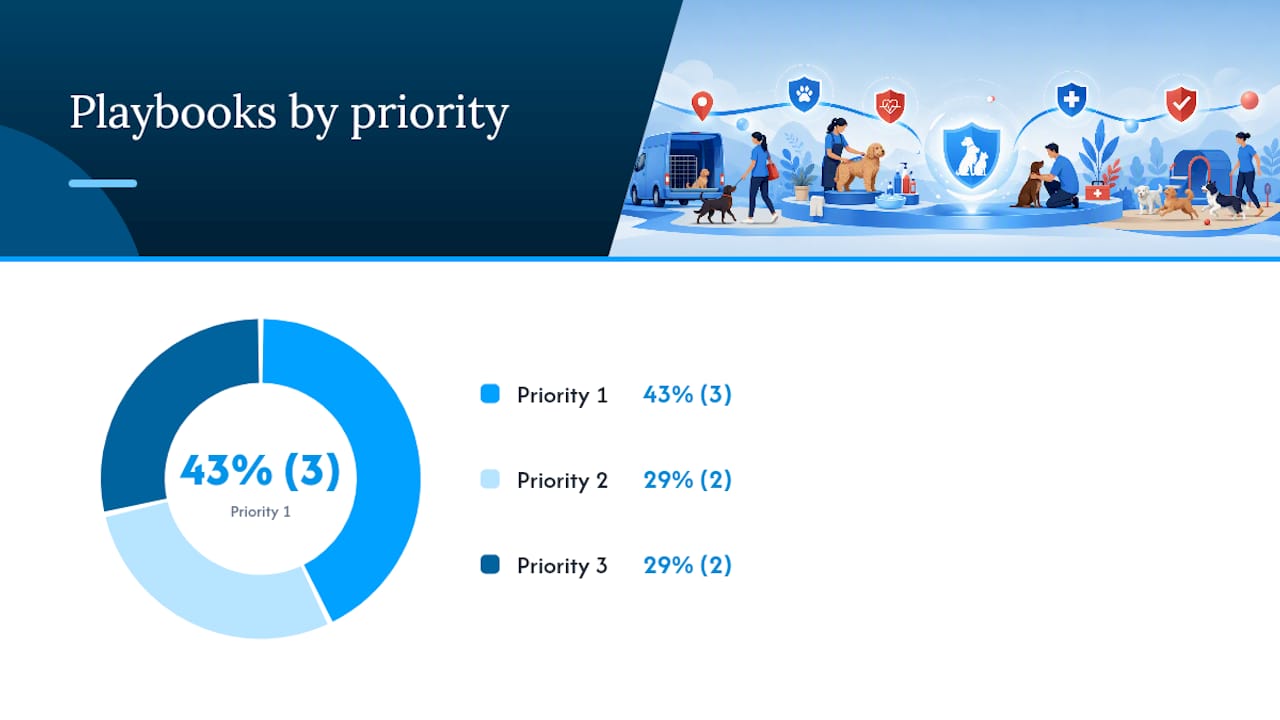
Licensing guidance requires written procedures covering feeding, cleaning, disease prevention, health monitoring, and a documented emergency plan — so Priority 1 playbooks are not optional. Staff must also hold canine first-aid training, and CPD records must be available for inspection.
Templates and checklists you can copy and adapt right now
Each template below maps to a specific playbook chapter. Copy the structure, fill in your facility’s details, and assign an owner before you file it.
Client intake template (lives in: Intake & Screening playbook — owned by front desk or manager)
- Pet name, breed, age, weight, spay/neuter status
- Vaccination records required: rabies, DHPP, Bordetella (date and provider)
- Current medications: name, dose, frequency, administration method
- Behavioral flags: bite history, resource guarding, separation anxiety
- Emergency contact (name, cell, backup contact, preferred vet)
- Owner signature and date
Playgroup screening checklist (lives in: Off-Leash Safety playbook — owned by lead handler)
- Temperament assessment completed (date and assessor name)
- Group size within posted ratio limits
- Handler positioned for full visual coverage
- Escalation trigger defined: any dog pinned, yelping, or showing whale eye
- Incident log accessible and timestamped
Incident report template (lives in: Emergency Response playbook — owned by shift supervisor)
- Date, time, location, animals involved
- Description of event (objective, no blame language)
- Witness names and statements
- First aid administered (who, what, when)
- Owner notified: time and method
- Veterinary referral: yes/no, clinic name, outcome
- Follow-up actions and sign-off
Cleaning checklist (lives in: Sanitation playbook — owned by kennel staff, verified by supervisor)
- Surface, product used, dilution ratio, contact time, initials, time completed
- Mandatory fields for boarding: food bowls, bedding, kennel surfaces, play area floors
- Optional for higher-risk grooming services: tub drain, dryer housing, restraint equipment
Staff training sign-off sheet (lives in: Onboarding playbook — owned by manager)
- Module name, date completed, trainer name, staff signature
- Competency check: observed, passed, date
- Mandatory for grooming and boarding staff: dryer safety, restraint protocols, sanitation between pets
How to roll out playbooks in 30, 90, and 180 days
A staged rollout minimizes service disruption and lets you refine templates based on real events before you go facility-wide.
- Days 1–30 (Pilot): Build Priority 1 SOPs. Run a safety protocol drill with your core team. Assign playbook owners. Collect feedback from staff on gaps or unclear steps.
- Days 31–90 (Full rollout): Publish all seven core playbooks. Run induction training for every staff member. Complete first round of sign-off sheets. Log training records.
- Days 91–180 (Audit and refine): Conduct a full playbook audit against any incidents or near-misses. Run monthly micro-learning refreshers (10–15 minutes per topic). Schedule annual sign-offs and CPD logs.
Training cadence: induction on day one, weekly micro-learning for the first 90 days, monthly refreshers ongoing, annual full sign-offs. Staff training programs that follow this cadence consistently outperform one-time orientation sessions.
Pro Tip: When a team member pushes back on a new SOP, ask them to help improve it rather than just follow it. Operators who involve staff in refining templates during the pilot phase see faster adoption and fewer workarounds. One revision session per playbook, with the person who raised the concern in the room, is usually enough.
What tools should you use to host and track playbooks?
Your tool stack does not need to be expensive. It does need to be searchable, version-controlled, and accessible on the floor.
- SOP/LMS platform: look for searchable SOPs, version history, training completion tracking, and role-specific content delivery. An AI-powered platform that acts as a 24/7 accountability partner removes the need for a manager to chase sign-offs manually.
- Scheduling tool: connects capacity playbooks to real bookings; triggers staffing alerts when occupancy hits defined thresholds.
- Incident logging: a digital form (even a Google Form) that timestamps entries and auto-notifies the owner and vet contact beats a paper log every time.
- Staff communication: a group channel (Slack, Teams, or a dedicated app) for micro-learning drops and SOP update alerts.
- POS/booking integration: links pricing playbooks to actual transactions, making rate-card compliance auditable.
When your incident report form auto-notifies the shift supervisor, the owner, and the partner veterinarian the moment it’s submitted, you’ve turned a passive document into a live safety system. That’s the difference between a playbook that sits in a binder and one that actually protects pets and your license.
How do you know if your playbooks are working?
Track these KPIs from day one so you have a baseline to compare against after the 90-day rollout.
Primary KPIs:
- Incident rate per 1,000 service-hours (target: declining quarter over quarter)
- Occupancy utilization: booked spots vs. available spots
- Revenue per available spot
- Training completion rate (target: 100% before any staff member works unsupervised)
- Staff turnover rate
- Time-to-onboard: days from hire to solo shift
Reporting cadence: weekly check on incident log and training completions (manager); monthly review of occupancy and revenue per spot (owner); quarterly full audit of all KPIs with playbook update decisions (owner plus senior staff).
Statistic callout: Auditable training records and signed SOP acknowledgements are among the first documents licensing authorities request during inspections — and the primary evidence insurers examine when evaluating a claim.
Safety, licensing, and insurance documentation your playbooks must include
Every playbook library needs a compliance layer. Operators must train staff in animal welfare, handling, hygiene, feeding, disease control, and first aid — and keep accurate records of all of it.
Vaccination and health policy checklist:
- Required vaccines listed by service type (daycare, boarding, grooming)
- Record format: paper or digital, with expiry dates tracked
- Minimum intake data: vaccine dates, current meds, behavioral flags, known allergies
- Outbreak protocol: isolation procedure, owner notification, facility closure trigger
Incident documentation requirements:
- Timestamped log entry within 15 minutes of event
- Witness statement (name, role, what they observed)
- Veterinary escalation decision and outcome
- Owner notification: time, method, and staff member who made contact
Emergency contacts and insurer communication:
- Named partner veterinarian with after-hours number
- Nearest emergency animal hospital address and phone
- Insurer claims contact and policy number posted in the manager’s office
- Post-incident insurer notification within 24 hours for any injury requiring veterinary care
For emergency steps you can share directly with pet owners after an incident, a short, plain-language owner communication template in your emergency playbook covers the bases without creating liability.
How to adapt playbooks for each service type
Core playbooks give you the foundation. Each service line needs a handful of targeted adjustments.
- Daycare: add daily behavior observation logs, enrichment activity records, and a written screening protocol before any dog joins a play group. Behavior screening before admission prevents fear, anxiety, and aggression in the group.
- Boarding: extend health monitoring to overnight checks (every 2–4 hours), add a feeding log per pet, and document a “welfare check” trigger for any dog that refuses food or water for 12+ hours.
- Grooming: document dryer type, maximum run time, monitoring frequency, and a hard rule that no pet is left unattended in a heated cage dryer. Grooming SOPs must also cover restraint protocols and sanitation between pets to reduce litigation risk.
- Training: add session notes per dog, progress benchmarks, and a client communication template for reporting outcomes after each session block.
- Pet-sitting: include a home-access protocol (key handling, alarm codes), a solo-staff check-in schedule, and a remote incident escalation path since there’s no on-site supervisor.
Worked example — high-risk grooming intake: A brachycephalic dog (Bulldog, Pug, French Bulldog) flagged at intake triggers a modified grooming SOP: no heated dryer, hand-dry only, maximum appointment duration of 90 minutes, and a vet-release form signed before the first appointment. Test this customization with two or three dogs in a pilot week before applying it facility-wide.
How these playbooks were developed and validated
The playbook frameworks in this article draw on the operational experience of the team at Thedoggurus, who built and ran dog daycare, boarding, and grooming operations before developing training materials and templates for other operators.
The templates went through multiple pilot rounds with real facilities — tracking incident rates, training completion, and inspection outcomes before the final versions were published. Feedback from those pilots drove specific changes: shorter SOPs (one page per procedure), a cleaner sign-off format, and a behavior-flag field added to the intake form after a near-miss in a pilot facility.
Validation markers operators should look for in any playbook source:
- Templates tested in live operations, not just written from theory
- Metrics tracked before and after adoption (incident rate, onboarding time)
- Feedback loop: staff input incorporated into revised versions
- Alignment with licensing inspection requirements and insurer expectations
The group play safety standards published by Thedoggurus reflect this same operator-first development process.
Why the binder on the shelf is the real problem
Most pet care businesses already have some version of a playbook. The problem is that it lives in a binder no one opens, or in the founder’s head, which leaves the business one resignation away from chaos.
The operators who get the most out of documented procedures are not the ones who write the most detailed SOPs. They’re the ones who make the playbook the default — the thing staff reach for before they ask the manager. That shift happens when the playbook is searchable, when training is tied to it, and when sign-offs are tracked. A document no one can find is not a system. A system your team uses every day, even when you’re not there, is what actually protects the pets in your care and the license on your wall.
The one tactical move that changes everything: assign a named owner to every SOP, not just the playbook as a whole. When one person is responsible for keeping a procedure current, it gets updated. When “everyone” owns it, no one does.

Thedoggurus gives you ready-made playbooks, training, and coaching
Building playbooks from scratch takes time most operators don’t have. Thedoggurus gives you the shortcut: ready-made playbook templates, staff training modules, and an AI-powered learning platform that tracks completion and holds your team accountable around the clock.
Operators who use Thedoggurus get faster staff onboarding, lower incident rates, inspection-ready documentation, and measurable training completion — without spending weeks writing SOPs from a blank page. The platform covers dog daycare, boarding, grooming, training, and pet-sitting, with role-specific content so every team member gets exactly what they need. Book a short demo to see the playbook library, the training modules, and the accountability dashboard in action. You’ll know within 20 minutes whether it fits your operation.
Sources
- Dog Day Care Pre-inspection document (Animal Welfare (Licensing of Activities Involving Animals) England Regulations 2018) – London Borough of Barking and Dagenham
- Pet Grooming Salon SOPs: Safety, Sanitation & Operations | WorkProcedures
- How to Start a Dog Day Care Business | Costs, legals & equipment | CPD Online
- Pet Care Franchise: 90-Day Launch Roadmap for Owners | PetFranchiseGuide