

What about punishing bad behavior?
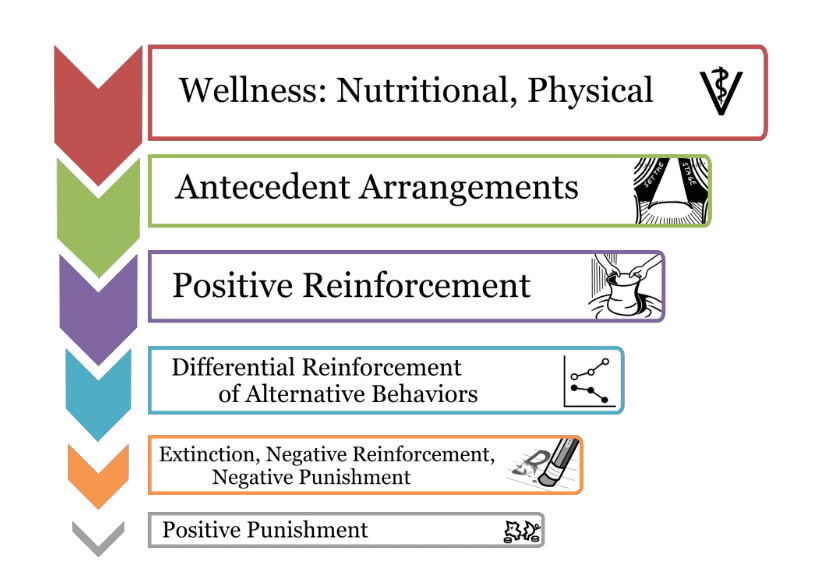
Human beings are hard wired to discipline undesirable behavior. It is in our nature. So it’s not uncommon for people to ask me if it’s ok to punish the bad behavior of the dogs in daycare. My simple answer to that question is “No”. But to get more into the heart of the matter, I’ll refer to a recently released statement called “Least intrusive, minimally aversive” (LIMA) approach to training.
Those who work with dogs should understand that there are four quadrants of operant learning for animals. What most people refer to as punishment is more accurately called “positive punishment” since usually when this question comes up people are referring to punishing a dog in order to get the dog to stop doing something. Positive punishment is one of the four quadrants of animal learning. It can work. Therefore, some people feel they are justified in using punishment. The ends justifies the means. However, I would challenge everyone who works with dogs to adhere to LIMA which requires you to increase the use of positive reinforcement and lessen the use of punishment in work with companion animals. LIMA protocols are designed to be maximally humane to learners of all species.
LIMA is a great protocol to use as you work with the dogs in your facility. By looking at the chart, I find that very rarely, if ever, do I get to the point where I need to apply positive punishment to a behavior of a dog in daycare. If you haven’t reviewed the LIMA hierarchy, I’d recommend giving it a look and really asking yourself if it’s worth punishing dogs just so that they can have fun in daycare.
But what about aggressive behaviors such as fence fighting or resource guarding? Some would argue that with those types of behaviors, punishment is more justified. If you understand dog behavior is on a continuum, you will understand why it is important not to punish dogs when they show aggression.
Ideally, I want dogs to use as little force as possible when they decide to display signs of aggression. If a dog curls his lip at me or growls and I back away, I have taught the dog that low levels of aggression work. Do I want to teach a dog that aggression works? Not necessarily…but in that instant, when I am getting the lip curl or the growl, I have reached a critical point in which I am no longer in training mode. I will move away to avoid a situation in which the dog’s aggression must escalate. I can use my experience to plan future training protocols later.
However, if I punish that lip curl or the growl, I have done nothing except teach the dog that low levels of aggression do not work. Could this lead to the dog giving up and stopping the display in the future? Maybe. HOWEVER, I’m more worried that this may cause the dog to escalate to higher levels of aggression immediately in the next similar situation. This is how you can end up with dogs that seem to bite without warning. That is definitely not what I want in daycare because I rely on my staff’s skills of observation to keep the dogs safe.
Reading the dog’s body language is the key to the staff’s success, so do not punish the dogs for providing you with information you need to read. If a dog is showing unwanted behavior in daycare, seek to resolve the problem using positive methods. If that’s not possible, then perhaps daycare isn’t the right place for a dog. After all, you wouldn’t punish a child merely to force him to have fun at Disneyland, would you? Daycare is supposed to be fun!