

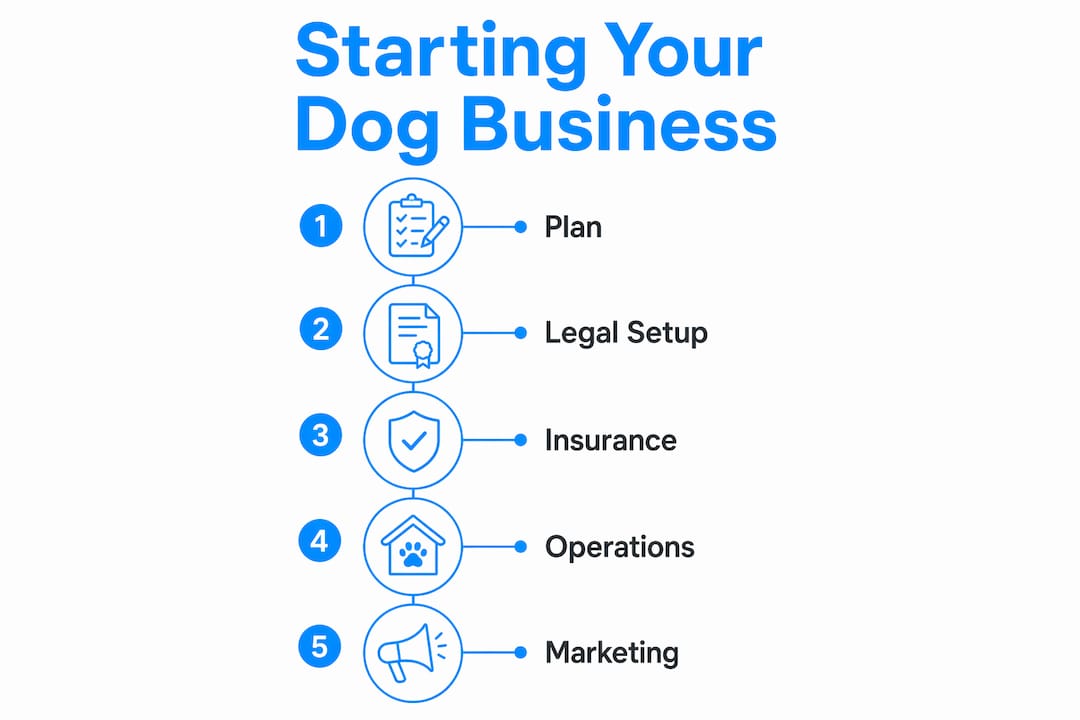
If you want low startup cost and fast cash flow, dog walking is your fastest path in. If you prefer high-margin solo work, dog training is worth serious consideration. Facility models such as daycare and boarding require real capital but offer the strongest long-term revenue ceiling. Your first three moves, regardless of model: get your legal structure and insurance in place, build a core operations playbook, and claim your Google Business Profile.
Must-have trust signals before you take your first client:
- Proof of current vaccinations for every dog in your care
- General liability insurance (plus care/custody & control coverage)
- A signed client contract covering cancellation, emergencies, and vaccination standards
- A written intake and meet-and-greet process
Pro Tip: Many high-value clients ask for proof of insurance before they book. Treat your certificate of insurance as a marketing asset, not just a legal formality.
Table of Contents
- Which dog-business model is right for you?
- What legal and insurance steps do you need before opening?
- How do you build operations that keep dogs safe and the business scalable?
- What do startup costs and pricing actually look like?
- How do you attract clients and justify premium pricing?
- What software do you need to run a dog business efficiently?
- How do you scale from solo operator to a multi-staff business?
- Key Takeaways
- The operational mistake that costs owners the most
- How Thedoggurus helps you build a safer, more profitable pet business
- Useful sources and resources
Which dog-business model is right for you?
Pet care entrepreneurship covers a wide range of models. Below is a quick comparison to help you match the right one to your budget and goals.

| Model | Startup Cost | Time Intensity | Revenue Ceiling | Scale Difficulty |
|---|---|---|---|---|
| Dog walking | $500–$2,000 | High (physical) | Moderate (solo) | Medium |
| Pet sitting | Low startup cost | Flexible | Moderate | Medium |
| Dog training | — | High (skill-based) | High (per session) | Medium |
| Mobile grooming | — | High | Moderate–High | Medium |
| Grooming shop | — | High | High | High |
| Dog daycare/boarding | $50,000–$200,000+ | Very high | Highest | High |
| Retail/add-ons | Varies | Low–Medium | Supplemental | Low |
How to choose your model:
- Low capital, fast start: Dog walking and pet sitting get you earning within weeks.
- Skill-based premium: Canine training services command the highest per-hour rates for solo operators.
- Long-term scale: Daycare and boarding generate the most revenue but demand operational systems from day one.
- Risk tolerance: Facility models carry higher fixed costs and a 12–18 month path to profitability.
What legal and insurance steps do you need before opening?
Getting the legal foundation right protects your personal assets and signals professionalism to clients from the start.
Business structure:
- Sole proprietorship — simplest to set up, but your personal assets are exposed to business liability.
- LLC — costs $50–$300 to form (varies by state), separates personal and business liability, and often provides tax flexibility. Recommended for anyone handling other people’s dogs.
- Get a free EIN from the IRS and open a dedicated business bank account immediately.
Insurance checklist:
- General liability — covers property damage and third-party injuries
- Care, custody & control — covers injury or death of a dog in your care
- Commercial auto — required if you transport dogs
- Workers’ compensation — mandatory in most states once you hire employees
- Pet-sitting policies typically run a few hundred dollars per year for solo operators; facility policies run higher.
Permits and policies:
- Check local zoning before operating a home-based boarding or daycare
- Kennel licenses are required in many counties for overnight boarding
- Require proof of current vaccinations (rabies, Bordetella, DHPP) from every client before intake
- Use a signed client contract covering emergency vet authorization, cancellation terms, and breed or behavior policies
Pro Tip: Your state’s Secretary of State website lists LLC filing fees and requirements. For permit questions, call your county health or animal control office directly — requirements vary significantly by jurisdiction.
How do you build operations that keep dogs safe and the business scalable?
Safety is the foundation of every safe dog daycare. Without written protocols, one incident can end your business.
Build these core playbooks first:
- Intake and meet-and-greet — assess temperament, check vaccination records, and document behavioral history before a dog joins any group.
- Vaccination verification — log every dog’s records and set expiration reminders.
- Aggression screening — define clear pass/fail criteria so staff make consistent decisions, not judgment calls.
- Off-leash play rules — group size limits, supervisory ratios, and intervention protocols.
- Emergency response — written steps for dog fights, injuries, and medical emergencies, including your designated emergency vet.
Industry veterans consistently report that delaying standardized playbooks is the single most common operational mistake. Standardized procedures reduce incidents and make it possible to train new staff reliably.
Staffing and daily operations:
- Assign clear roles: who does intake, who supervises groups, who handles client communication
- Run competency checks before any new hire works unsupervised with dogs
- Keep daily cleaning schedules, vaccination logs, and incident reports in writing
- Use client communication templates for updates, incidents, and policy reminders
A solid staff training program is what separates a business that scales from one that stays chaotic.
What do startup costs and pricing actually look like?
Knowing your numbers before you open prevents the most common cash-flow surprises.
Startup cost ranges:
| Model | Estimated Startup Cost | Typical Path to Profitability |
|---|---|---|
| Dog walking | $500–$2,000 | Several weeks to a few months |
| Pet sitting | Low startup cost | Several weeks to a couple of months |
| Mobile grooming | Substantial startup cost | Several months |
| Dog daycare/boarding | $50,000–$200,000+ | 12–18 months |
Sample pricing bands (U.S. market):
- 30-minute walk: typical market pricing
- 60-minute walk: typical market pricing
- Overnight pet sitting: average rates vary by market
- Daycare day rate: varies by location
- Grooming session: varies by breed and size
Key financial metrics to track:
- Margin by service — grooming and training typically yield higher margins than boarding once staff costs are added
- Average revenue per dog per day — the core benchmark for daycare and boarding
- Occupancy rate — for boarding, target 70%+ to cover fixed costs
- Break-even — calculate your fixed monthly costs (rent, insurance, payroll) and divide by your average revenue per dog per day to know your minimum occupancy
Solo walkers working full-time can generate a moderate monthly income. Adding services can increase earnings, but scaling beyond that without staff is challenging.
How do you attract clients and justify premium pricing?
Trust and consistency are what separate a $25/walk business from a $40/walk business.
- Google Business Profile — claim it, fill every field, and ask satisfied clients for reviews. This is your highest-ROI local marketing move.
- Photo and route updates — send GPS check-ins or photos after every visit. Clients who see their dog mid-walk become loyal, long-term clients.
- Standardized onboarding emails — a welcome sequence that covers your policies, what to expect, and emergency contacts builds confidence before the first visit.
- Referral partnerships — connect with local vets, groomers, and pet stores. These relationships generate warm leads that convert at far higher rates than cold advertising. Local SEO for pet professionals can amplify your visibility in these same channels.
- Loyalty incentives — a simple punch card or referral discount keeps existing clients engaged and brings in new ones at low cost.
Pro Tip: Ask your vet partners to keep a small stack of your business cards at the front desk. A recommendation from a trusted vet carries more weight than any paid ad.
What software do you need to run a dog business efficiently?
The first software decision you make often determines whether your business scales cleanly or becomes unmanageable. Adopt platforms early, before the chaos forces you to.
Software categories every dog business needs:
- Booking and scheduling — automates appointment management and reduces no-shows
- Billing and payments — integrated invoicing keeps cash flow predictable
- Route optimization and GPS check-ins — removes cognitive load for walkers and gives clients real-time visibility
- Staff training and LMS — role-specific learning modules that onboard new hires consistently
- Incident reporting — a written record of every incident protects you legally and improves protocols
- HR and payroll — essential once you hire your first employee
When evaluating any platform, check for:
- Built-in onboarding resources for staff
- Reporting and benchmarking dashboards
- Integrations with your booking and billing tools
- Mobile access for field staff
Pro Tip: Time To Pet is widely recommended by operators for scheduling and client communication automation. Pair it with a dedicated LMS for staff training and you have the core of a scalable tech stack.
How do you scale from solo operator to a multi-staff business?
Scaling a dog business is a leadership challenge as much as an operational one. Your role shifts from doing the work to managing the people who do it.
When to hire — watch for these triggers:
- You are turning away clients due to capacity.
- Your revenue has been consistent for 90+ days.
- You are spending more than 20% of your time on admin instead of service delivery.
KPIs that predict scale success:
- Utilization/occupancy rate — are you filling available slots?
- Revenue per employee — are new hires generating more than they cost?
- Client retention rate — are clients coming back month after month?
- Incident frequency — are your safety protocols holding under higher volume?
Growth paths and trade-offs:
- Build a team — highest control, requires strong staff onboarding systems and clear role definitions
- Open a second location — multiplies revenue potential but demands a proven operational model first
- License or franchise — fastest geographic expansion, but requires relinquishing some control and building a replicable system others can run
Owners who invest early in benchmarking and coaching transition from side gig to profitable business significantly faster than those who wait.
Key Takeaways
Building a profitable dog-related business requires the right model for your capital, a legal and insurance foundation, and operational systems in place before you scale.
| Point | Details |
|---|---|
| Match model to capital | Dog walking starts at $500–$2,000; facility models require $50,000–$200,000+ and 12–18 months to profitability. |
| Insurance is a marketing tool | A $200–$500/year policy builds client trust and is often required by high-value clients before booking. |
| Playbooks before growth | Standardized intake, safety, and training protocols reduce incidents and make hiring reliable staff possible. |
| Track the right numbers | Monitor occupancy rate, revenue per dog per day, and client retention to know when and how to scale. |
| Thedoggurus accelerates the process | Thedoggurus provides operational playbooks, role-specific staff training, and benchmarking tools built specifically for dog daycare, boarding, grooming, and training businesses. |
The operational mistake that costs owners the most
The most expensive mistake in this industry is not a bad hire or a slow month. It is starting to grow before you have written systems.
Most owners build their first year on memory and instinct. They know the intake process because they do it themselves. They know the off-leash play rules because they wrote them in their head. Then they hire their first employee, and none of that knowledge transfers. The new hire improvises. An incident happens. The owner steps back in to manage the fallout, and growth stalls.
The fix is not complicated, but it requires doing it before you need it. Write your intake checklist. Document your vaccination policy. Build a one-page emergency response protocol. These do not need to be perfect. They need to exist in writing so someone else can follow them.
Owners who build playbooks early consistently report that their second hire is dramatically easier than their first. The system does the training, not the owner. That is the difference between a business that scales and one that keeps the owner trapped in the day-to-day.
How Thedoggurus helps you build a safer, more profitable pet business
Running a dog business is hard enough without building every system from scratch.
Thedoggurus gives pet care business owners the operational playbooks, role-specific staff training modules, and benchmarking analytics they need to grow with confidence. The platform is built by founders who have run pet care businesses themselves, so every course and coaching session reflects what actually works in the real world, not theory. Whether you are launching a dog daycare startup or scaling an existing grooming or boarding operation, Thedoggurus puts proven systems in your hands from day one. The AI-powered learning platform keeps your team accountable around the clock, so you spend less time putting out fires and more time leading your business forward. Visit Thedoggurus to explore plans and start building the business you set out to create.
Useful sources and resources
Key references used in this guide:
- How to Start a Dog Walking Business — FindLaw — legal structure, contracts, and licensing overview
- Dog Walking Startup Costs and Margins — StartCosts — pricing bands and solo revenue benchmarks
- Pet Business Revenue by Niche — Digital Dashboard Hub — facility buildout costs and profitability timelines
- Pet Sitting Insurance Guide — Time To Pet — insurance types and cost ranges
- Startup Costs for Pet Sitting and Walking — Time To Pet — software and operational cost guidance
- How to Start a Dog Walking Business — FitSmallBusiness — LLC formation steps and EIN guidance
- Pet Sitters International — petsit.com — industry standards and operational best practices
- Dog Daycare Owner Salary — MoeGo — scaling benchmarks and owner role evolution
For permits and local licensing: Contact your county animal control office or local health department. Requirements for kennel licenses, zoning, and home-based boarding vary by jurisdiction and are not standardized at the federal level.