

The single best action you can take today to improve the customer experience at your dog daycare is this: systematize transparent, daily communication with every pet parent. Not occasionally. Not when something goes wrong. Every single day, for every single dog. That one shift, more than any facility upgrade or loyalty program, is what turns first-time visitors into long-term clients.
Start here. You can do all three of these in the next 24 hours:
- Assign an owner. Name one person responsible for daily client communication.
- Pick a template. Choose a report card format your team can complete in under five minutes per dog.
- Set a cadence. Decide when updates go out (end of day for daycare, midday for boarding).
Your 30-day plan in one sentence: In week one, your manager builds the report card template and confirmation sequence; in weeks two and three, staff trains on it; by day 30, every client receives a consistent daily update without you touching it.
Pro Tip: Don’t wait until your system is perfect to start. A simple text with one photo and two sentences beats a polished template you haven’t launched yet.
Key Takeaways
Systematizing daily report cards and a structured onboarding sequence is the fastest path to higher retention, fewer no-shows, and stronger referrals in your dog daycare or boarding business.
| Point | Details |
|---|---|
| Start with report cards | A specific, photo-rich daily update builds more trust than any single facility upgrade. |
| Onboarding drives retention | A 30-day structured sequence with a welcome packet and timed touchpoints turns first visits into long-term clients. |
| Incident transparency protects you | Notify parents within 30 minutes and document every incident to preserve trust and reduce liability. |
| Track four core KPIs | Repeat booking rate, NPS, no-show rate, and report card completion rate—review monthly for actionable insights. |
| Thedoggurus accelerates the build | Thedoggurus provides the training modules, SOP templates, and coaching to implement this CX system without starting from scratch. |
Table of Contents
- Why consistent communication drives bookings and trust
- What are the key communication touchpoints you need to own?
- How do you onboard new customers so they stay?
- What should your drop-off script cover?
- Why do report cards keep pet parents coming back?
- How should you handle incident reporting?
- What post-visit follow-up actually drives rebooking?
- What personalization tactics create “wow” moments?
- What communication mistakes cost you the most?
- What tools and training make great CX repeatable?
- Which metrics tell you if your CX is actually improving?
- Your 30–90 day implementation roadmap
- What most daycare owners get wrong about client communication
- Thedoggurus gives you the CX system, not just the advice
- Useful sources
Why consistent communication drives bookings and trust
The business case for investing in client communication is straightforward. Retaining existing customers is far more profitable than acquiring new ones, and in pet care, that retention is almost entirely driven by trust. Pet parents are not just buying a service. They are handing you their family member. Every communication touchpoint is either building that trust or eroding it.
Consistent communication reduces no-shows because clients feel accountable and informed. It speeds up incident resolution because parents already trust your transparency. It generates referrals because satisfied clients share report cards and photos with friends. And it increases your Net Promoter Score because parents who feel connected to their dog’s day are far more likely to leave a five-star review.
Operationally, the benefits compound. Fewer panicked phone calls at pickup. Faster onboarding for new clients. Staff who know exactly what to say and when. These are not soft wins. They directly reduce your labor cost per client and increase your revenue per booking.
What are the key communication touchpoints you need to own?
Every client interaction from first inquiry to rebooking is a touchpoint you can either systematize or leave to chance. Here is the full sequence, with recommended cadence and channel.
| Touchpoint | Suggested Cadence | Primary Channel |
|---|---|---|
| Lead capture / inquiry response | Within 1 hour | Email or phone |
| Onboarding welcome packet | Day 1 after booking | |
| Meet-and-greet / evaluation confirmation | 48 hours before | SMS or email |
| Reservation confirmation | Immediately on booking | Email + SMS |
| Pre-arrival reminder | 48 hours and 24 hours before | SMS |
| Drop-off check-in script | Every visit | In-person |
| Daily update / report card | End of day (daycare) or midday (boarding) | App or email |
| Incident notification | Within 30 minutes of event | Phone + written follow-up |
| Pickup summary | At pickup | In-person |
| Post-visit follow-up | Within 24 hours of pickup | Email or SMS |
| Rebooking prompt | 3–5 days after visit | SMS or email |
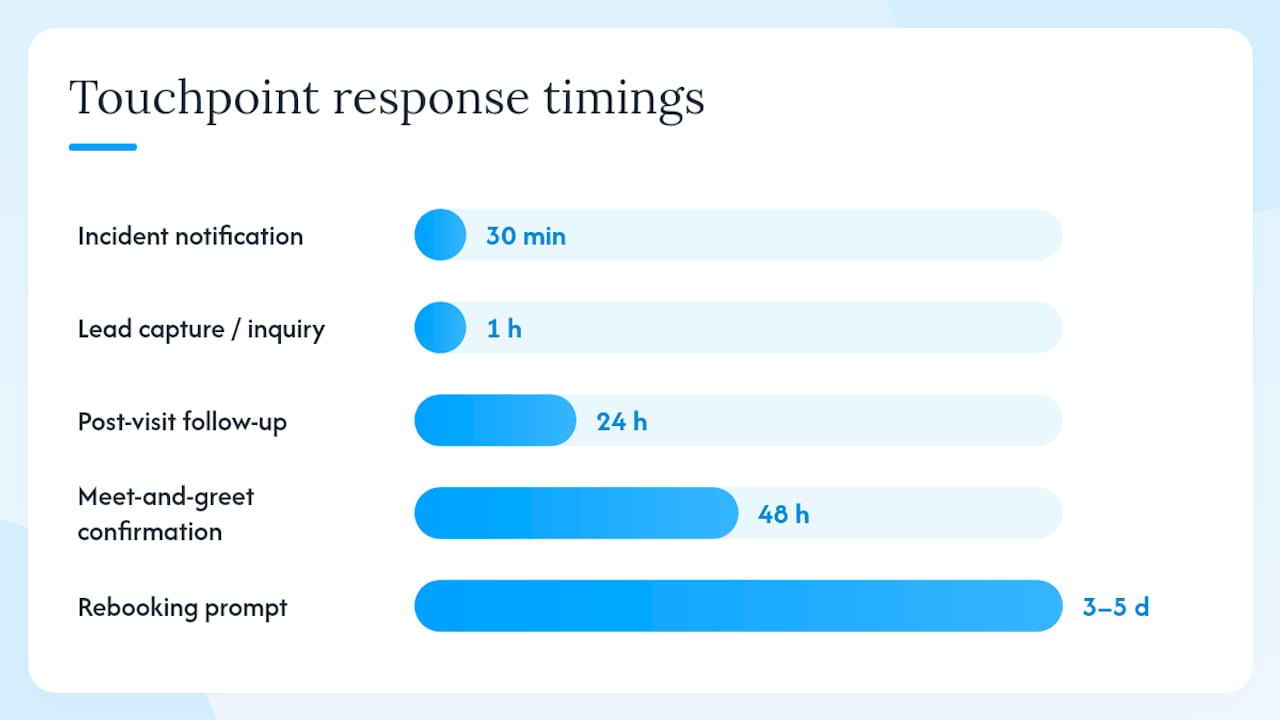
Having all of these in a single standard operating procedure (SOP) is what separates a professional operation from one that relies on whoever happens to be working that day. When your CX system lives in one document, any staff member can deliver it consistently.
How do you onboard new customers so they stay?
The promise of great onboarding is simple: make a new client feel so confident in your facility after their first 30 days that rebooking feels automatic. A structured 30-day onboarding sequence with targeted touchpoints materially improves early satisfaction and repeat bookings.
Every new client should receive these assets before or at their first visit:
- Digital welcome packet: — Your facility overview, policies, emergency contacts, and what to expect on day one.
Your 30-day onboarding sequence:
- Day 4–7 (evaluation day): Conduct the dog evaluation and send a same-day summary of results and playgroup placement.
Pro Tip: Build a “pawfile” for each dog during onboarding. Record their favorite playmates, preferred rest spots, food sensitivities, and quirks. Reference it in every report card. Clients notice immediately when you know their dog by name and personality, not just by kennel number.
What should your drop-off script cover?
A confident, warm drop-off experience sets the tone for the entire visit. Staff who know exactly what to say make parents feel safe leaving. Staff who improvise create anxiety.
Your drop-off script should cover:
- Greeting by name: “Good morning, [Parent Name]! And there’s [Dog’s Name]!”
- Quick health check: “Any changes since last time? Eating normally? Any medications today?”
- Behavior reminder: “We’ll keep an eye on [specific note from pawfile].”
- Update promise: “You’ll get a report card and photos by [time].”
- Handoff confirmation: “We’ve got it from here. Have a great day.”
Required paperwork and procedures at drop-off:
- Vaccination records current and on file
- Signed daycare agreement and emergency authorization
- Medication log completed if applicable
- Behavior notes flagged for floor staff
Pro Tip: During high-volume drop-off windows (7–9 AM), assign one staff member exclusively to parent-facing communication. The rest handle dogs. This prevents the bottleneck where parents wait while staff are managing playgroups, and it keeps your lobby calm.
Why do report cards keep pet parents coming back?
Rich, narrative report cards with photos outperform single-line updates every time. A parent who receives “Buddy had a great day!” learns nothing. A parent who receives a three-sentence story about Buddy’s morning zoomies, his new friend Max, and his afternoon nap in the sun feels connected to their dog’s day. That emotional connection is what drives five-star reviews and repeat bookings.
Eight key updates belong in every professional report card: identification details, behavioral observations, activity log, social interactions, health monitoring notes, food and water intake, rest periods, and staff recommendations. Together, these fields build trust, reduce follow-up questions, and create a documentation trail that protects your business.
Your report card template fields:
- Dog’s name, date, and attending staff member
- Arrival mood and energy level
- Playgroup participation and social interactions
- Activity highlights (specific games, enrichment, rest)
- Food and water intake
- Any behavioral observations or health flags
- Staff recommendation or note for next visit
- 2–5 photos (candid action shots preferred over posed)
| Report Card Type | Key Differences | Photo Count |
|---|---|---|
| Daycare (half day) | Activity log, 1–2 social notes, mood at arrival/departure | 2–3 photos |
| Daycare (full day) | Full activity log, enrichment notes, rest period | 3–5 photos |
| Boarding (overnight) | Morning and evening updates, sleep notes, appetite | 4–6 photos |
| Boarding (multi-night) | Daily updates, behavior trends, midstay health check | 5–8 photos per day |
Premium daycares like The Dawgs House use Pawfiles, live 1080p streaming, and detailed daily report cards as standard practice, not upsells. That approach sets a benchmark worth studying. Report cards also serve as legal documentation. If a parent later questions an incident, your daily records show exactly what was observed and when.
A standard template from the Panhandle Humane Society captures fields like car ride behavior, personality categories, and social interaction checkboxes. Adapt that structure for your daycare context and you have a solid starting point.
Structured report cards also function as early-warning systems. A dog who eats less, plays less, or rests more than usual may be showing early signs of illness or stress. Catching that pattern on day two of a boarding stay and communicating it proactively is the kind of service parents remember and talk about.
How should you handle incident reporting?
Report quickly, honestly, and with next steps. That is the only rule that matters when something goes wrong.
Incident message templates by severity:
Low severity (minor scrape, brief altercation, no injury):
“Hi [Name], quick heads-up: [Dog’s Name] had a minor [scrape/scuffle] during play today. We cleaned it up and he’s doing great. We’ll note it in his report card. No action needed on your end, but wanted you to know.”
Medium severity (injury requiring first aid, behavioral escalation):
“Hi [Name], I’m calling because [Dog’s Name] had an incident today that we want to walk you through. [Brief description]. We’ve [action taken]. Please call us at [Number] so we can talk through next steps together.”
High severity (veterinary care required, serious injury):
Call first. Always. Then follow up in writing within the hour.
Your internal incident log should capture:
- Date, time, and location of incident
- Dogs involved and staff present
- Exact sequence of events
- First aid or care provided
- Parent notification time and method
- Follow-up actions and outcome
Pro Tip: Keep your incident documentation in a consistent, timestamped format. Clear records protect your business and demonstrate professionalism if a dispute arises. This is general operational guidance, not legal advice. Consult an attorney familiar with pet care liability for your specific situation.
What post-visit follow-up actually drives rebooking?
A follow-up that includes value converts a single visit into a repeat customer. A follow-up that just says “thanks for coming” does not.
Your post-visit sequence:
- Within 24 hours: Send the final report card (if not already sent) with a short personal note from staff.
- Day 2–3: Send a follow-up SMS: “[Dog’s Name] was such a great addition to the group! We’d love to see them again. Book your next visit here: [Link].”
- Day 5: Send a short satisfaction survey (3–5 questions, under two minutes to complete).
Suggested survey questions:
- How would you rate your overall experience? (1–5 stars)
- Did your dog seem happy and comfortable when you picked them up?
- How clear and helpful was your daily report card?
- Is there anything we could have done better?
- How likely are you to recommend us to a friend? (1–10)
Low-friction rebooking offer: offer a 10% discount on the next booking when reserved within seven days of the last visit. Or offer a free enrichment session add-on for clients who book a monthly package. Keep the offer simple and time-limited.
What personalization tactics create “wow” moments?
Small, specific gestures create outsized loyalty. The key is making them feel personal without requiring hours of extra labor.
High-impact, low-cost personalization tactics:
- Enrichment matching: Use the Humane Society’s enrichment guidance to match puzzle feeders, sensory activities, or play styles to each dog’s profile. Reference it in the report card.
Your welcome kit should feel premium without being expensive. A branded folder (or digital PDF), a personalized welcome card, a facility map, and a small treat sample cost under $5 per client and signal professionalism immediately.
Pro Tip: At 50+ weekly visits, personalization only scales if it lives in your software. Build a notes field in your management system for each dog’s preferences, quirks, and milestones. Train staff to update it after every visit. The report card writer pulls from those notes, not from memory.
For a structured approach to enrichment scheduling that feeds directly into your personalization program, build a weekly activity rotation your team can reference without reinventing it each day.
What communication mistakes cost you the most?
The most damaging errors are not dramatic. They are quiet, repeated failures that erode trust over weeks.
- Inconsistent onboarding — Some clients get a tour and a welcome packet. Others get a verbal rundown. Corrective action: build a digital onboarding checklist and assign one staff member to own every new client’s first 30 days.
The mistakes that carry the highest retention risk are late incident disclosure and inconsistent onboarding. The one with the highest legal risk is poor incident documentation.
What tools and training make great CX repeatable?
The goal is one SOP per touchpoint and one training module per role. When CX depends on a specific person’s personality, it breaks the moment that person is out sick.
Your core template library:
- Onboarding welcome packet (digital PDF)
- Dog evaluation form and placement summary
- Daily report card template (daycare and boarding versions)
- Incident log and notification templates
- Reservation confirmation and reminder messages
- Post-visit follow-up email and SMS
- Post-visit satisfaction survey
Staff training outline (four modules):
- Client communication standards: What we say, when we say it, and how we say it.
- Report card writing: How to write a specific, warm, professional update in under five minutes.
- Incident response protocol: The 30-minute rule, escalation steps, and documentation.
- Personalization practices: How to use the pawfile system and deliver “wow” moments consistently.
For building a staff training program that covers these modules without requiring you to reinvent the curriculum, start with a clear role-by-role responsibility map before writing a single SOP.
Technology works best when it supports human workflows, not replaces them. A client app that sends automated report cards still needs a human to write the narrative. A booking system that fires reminders still needs a human to handle the exception when a parent replies with a question. Build your tech stack around your SOPs, not the other way around.
Which metrics tell you if your CX is actually improving?
Track four to six KPIs that tie directly to retention and revenue. Anything beyond that becomes noise.
| KPI | Definition | Target Benchmark |
|---|---|---|
| Repeat booking rate | Proportion of first-time clients who book a second visit within about two months | High rate of repeat visits |
| NPS / CSAT score | Measures of customer satisfaction from post-visit surveys | Strong positive scores indicating customer satisfaction |
| No-show rate | Proportion of confirmed bookings where the client does not show up | Low no-show rate |
| Incident response time | Average time taken to notify parents after an incident | Parents notified within 30 minutes of an incident |
| Report card completion rate | Proportion of daily visits that get a completed report card | High rate of report card completion |
| Rebooking conversion rate | Proportion of post-visit follow-ups that result in another booking | Significant conversion to repeat bookings |
Review these monthly. If your repeat booking rate drops below 60%, audit your onboarding and post-visit follow-up sequences first. If your no-show rate climbs, check whether your reminder cadence is running consistently.
For A/B testing: run two versions of your post-visit follow-up message for 30 days. One with a rebooking offer, one without. Compare rebooking conversion rates. That single test will tell you more than any industry benchmark.
Your 30–90 day implementation roadmap
Start with the highest-impact, lowest-effort wins. Do not try to build everything at once.
Days 1–7 (Quick wins, owner-led):
- Assign a CX owner (you or your manager).
- Build or adopt a report card template and send it to every client this week.
- Set up automated reservation confirmations and 48-hour reminders in your booking software.
- Create a one-page incident response protocol and share it with all staff.
- Audit your onboarding process: does every new client get the same experience?
Days 8–30 (Build the system, manager-led):
- Write SOPs for each communication touchpoint (use the table in Section 3 as your checklist).
- Build the digital welcome packet and dog evaluation summary template.
- Launch the post-visit survey and track your first NPS score.
- Train staff on report card writing and incident response using the four-module outline.
- Set up your KPI tracking table and record your baseline numbers.
Days 31–90 (Scale and refine, team-led):
- Review your first month of KPI data and identify the one metric furthest from target.
- Run your first A/B test on post-visit messaging.
- Add personalization features (pawfiles, birthday acknowledgments, enrichment matching).
- Conduct a facility audit against the checklist in Section 11.
- Schedule a quarterly CX review with your management team.
Owner handoff checklist for your manager:
- [ ] CX SOP document complete and accessible to all staff
- [ ] Report card template live and in use
- [ ] Reminder sequence automated
- [ ] Incident protocol trained and posted
- [ ] KPI dashboard set up and reviewed monthly
What most daycare owners get wrong about client communication
The conventional wisdom says that great customer experience in pet care is about the facility. Better play yards, nicer lobbies, more cameras. Those things matter, but they are not the lever most owners think they are.
The real driver of retention is not what parents see when they visit. It is what they feel when they are not there. A parent who drops off their dog and spends the next eight hours wondering if everything is okay is not a loyal client. They are a nervous one. And nervous clients do not rebook. They shop around.
The businesses that consistently outperform on retention are the ones that solve the anxiety of absence. They do it with specific, timely, personal communication. Not polished marketing. Not a beautiful website. A text at noon that says “Rosie just made a new friend and stole his tennis ball” does more for loyalty than any lobby renovation.
There is also a common mistake in how owners think about report cards. Most treat them as a nice-to-have, something to send when time allows. The operators who grow fastest treat them as a non-negotiable daily deliverable, the same way a restaurant treats food quality. When a report card is late or missing, it is not a minor operational slip. It is a broken promise to a parent who was counting on it.
The owners who build the most profitable daycares are not the ones with the fanciest facilities. They are the ones whose clients feel genuinely known and cared for, every single day.
Thedoggurus gives you the CX system, not just the advice
Reading this playbook is the easy part. Building the SOPs, writing the templates, training your staff, and tracking the KPIs is where most owners stall. That is exactly what Thedoggurus is built to solve.
Thedoggurus gives dog daycare and boarding owners the complete operational toolkit: ready-to-use report card templates, onboarding sequences, staff training modules, incident response protocols, and AI-powered tools that keep your team accountable without requiring you to be in the building 24/7. Every resource is built by people who have run pet care businesses, so the advice is grounded in what actually works at the floor level, not just in theory.
You get expert-led courses on client communication, staff training programs designed for pet care roles, and coaching that helps you move from reactive to proactive. The platform acts as your accountability partner so your CX system runs consistently whether you are on the floor or not.
Ready to build a client experience your clients talk about? Explore the owner platform or visit Thedoggurus to see how the full toolkit maps to your business.
Useful sources
- The value of keeping the right customers
- Easy enrichment ideas for pets
- How to “Wow” New Customers in 30 Days: Onboarding …
- The Dawgs House Experience
- Report Card
- 8 Key Updates Every Dog Day Care Report Card Must Include
- Dog Daycare Report Card: Your Pup’s Progress