

If you run a dog daycare, your target for labor costs should land within a realistic range around a third to just under half of daycare revenue, using fully loaded labor costs, according to PulseRevOps. Skip the industry-wide 30% number you’ve probably heard. It rarely reflects what a real payroll, taxed and benefited, actually costs. Your first move: calculate your own daycare labor percentage today by dividing fully loaded labor costs (wages, payroll taxes, and benefits) by daycare revenue alone, not your total business revenue.
- Target range: 35–45% of daycare revenue (adjust based on service mix and region)
- Immediate action: Pull last month’s daycare payroll and daycare revenue, then divide
- Watch for: Averaging daycare with boarding or grooming, which hides the real number
At Thedoggurus, we coach owners through this calculation constantly, and the biggest surprise is almost never the percentage itself. It’s how many owners have never isolated daycare as its own profit center before.
Key Takeaways
Daycare labor percentage only becomes a useful management tool when it’s calculated per profit center, using fully loaded labor costs, and benchmarked against your own facility’s history rather than a single industry-wide figure.
| Point | Details |
|---|---|
| Target range | Aim for 35% to 45% of daycare revenue using fully loaded labor costs. |
| Use the right formula | Divide total fully loaded daycare labor by daycare revenue, not company-wide revenue. |
| Separate profit centers | Calculate daycare, boarding, and grooming labor percentages independently to avoid masking problems. |
| Pair with SUR | Track service utilization rate alongside labor percentage; healthy SUR runs 65% to 75%. |
| Get structured support | Thedoggurus offers benchmarking analytics and coaching to calculate and improve your labor percentage. |
Table of Contents
- What Daycare Labor Percentage Measures and How to Calculate It
- Where Should Your Daycare Labor Percentage Land?
- A Worked Example You Can Copy Into Your Spreadsheet
- Translating Staffing Ratios Into a Labor Percentage
- Tactics That Lower Labor Percentage Without Cutting Corners
- KPIs, Review Cadence, and Red Flags to Watch
- The Coaching Lens on Daycare Labor Percentage
- Get Help Calculating and Improving Your Labor Percentage
- Frequently Asked Questions
- Sources
What Daycare Labor Percentage Measures and How to Calculate It
Daycare labor percentage is the share of your daycare revenue spent on the people who run it. The formula is simple:
(Total fully loaded daycare labor costs) ÷ (Daycare revenue) × 100
Your labor cost side needs to include more than hourly wages:
- Base wages for daycare attendants and supervisors
- Payroll taxes (FICA, unemployment insurance)
- Workers’ compensation premiums
- Benefits, PTO, and payroll processing fees
- A fair allocation of owner labor if you work the floor
- Decide whether owner labor gets a market-rate wage assigned to it, even if you don’t draw that pay yet.
- Apportion any shared staff (a front-desk person who also handles boarding check-ins) using time sheets or revenue share.
- Use net service revenue for daycare only. Not gift card breakage, not retail, not your grooming till.
Get this wrong at the definition stage and every benchmark comparison downstream becomes useless.
Where Should Your Daycare Labor Percentage Land?
Ranges vary more than most owners expect, and that’s the point. [Pet Boarding & Daycare](https://www.petboarding anddaycare.com/measuring-maintaining-a-healthy-labor-ratio/) reports many pet care companies run 30% to 50% of revenue on labor, with the right number depending on service mix, owner contribution, regional wages, and building layout. Meanwhile, PocketSuite found that once operators count fully loaded costs (not just base wages), many land closer to 45%, not the mythical 30% everyone quotes.
What actually drives the spread between facilities:
- Service mix. Pure daycare tends to run leaner than boarding or training, which need overnight or one-on-one staffing.
- Owner labor. Facilities where the owner still works the floor 30 hours a week often show artificially low percentages, until that labor gets priced in.
- Region. A daycare in a high-minimum-wage metro faces a structurally higher percentage than one in a lower-cost market, even at identical staffing efficiency.
- Building layout. Poor sightlines force more staff per dog than an open, well-designed daycare layout would require.
- Seasonality. Summer and holiday weeks change both attendance and staffing needs, sometimes in opposite directions.
A single company-wide number can hide a real problem. If your daycare runs a healthy 38% but your grooming department bleeds at 65%, an averaged 47% tells you nothing actionable. Calculate each profit center separately, or you’re managing blind.
A Worked Example You Can Copy Into Your Spreadsheet
Numbers make this concrete. Say you’re reviewing a two-week pay period for your daycare department.
Step 1: Total the labor dollars.
Three attendants work 240 combined hours at $16/hour, plus a supervisor at 40 hours at $20/hour. That’s $4,640 in base wages. Add 10% for payroll taxes and workers’ comp, and 5% for benefits and PTO. Total fully loaded labor: $5,336.

Step 2: Apportion shared staff.
Your front-desk employee splits time between daycare check-ins and boarding drop-offs. Her fully loaded cost for the period is $1,200, so $720 gets allocated to daycare.
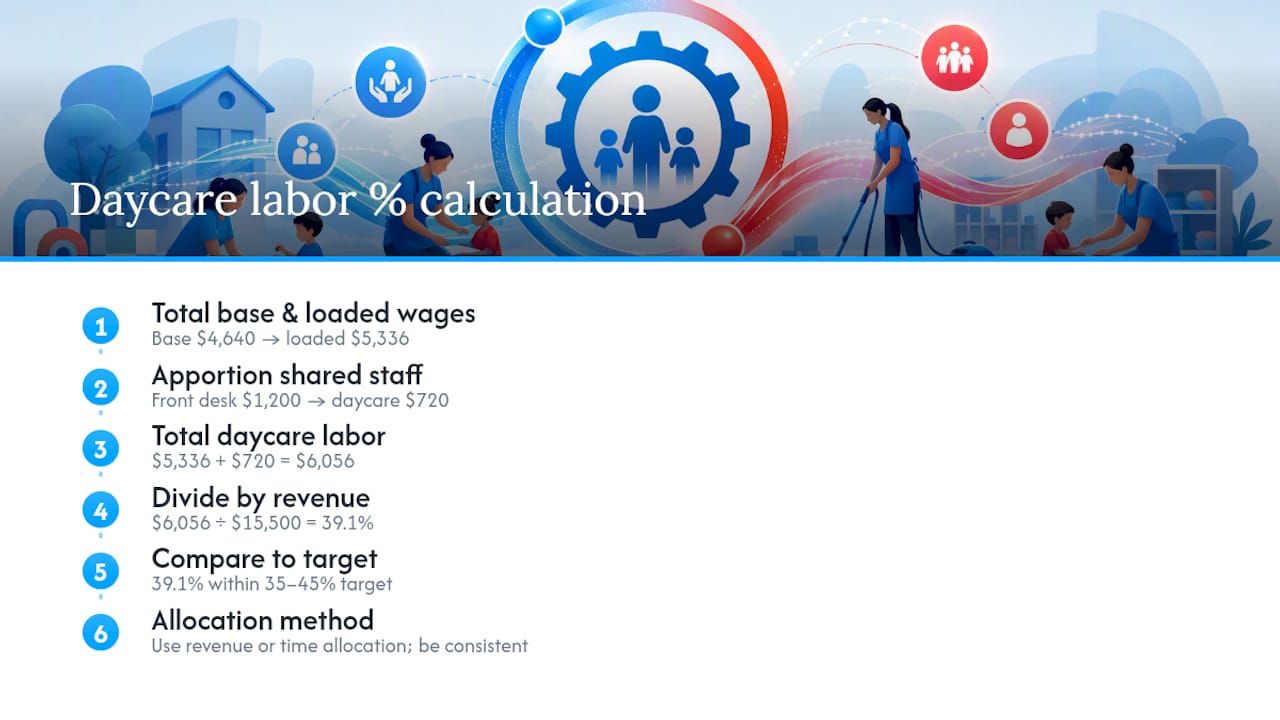
Step 3: Total daycare labor.
$5,336 + $720 = $6,056.
Step 4: Divide by daycare revenue for the same period.
Daycare revenue for those two weeks: $15,500.
That 39.1% sits comfortably inside the 35–45% target range. If your shared staff has a more variable role, revenue-proportion allocation (splitting their cost based on the percentage of total revenue each department generates) works better than time sheets. Pick one method and stick with it every pay period so your trend line means something over time.
Translating Staffing Ratios Into a Labor Percentage
Staffing decisions happen at the schedule level, not the spreadsheet level, so you need metrics that connect the two. Three numbers do the work:
- Staff-per-dog ratio: how many attendants you schedule per group of dogs on the floor
- Labor hours per dog-day: total paid staff hours divided by dogs attended that day
- Labor cost per dog-day: total daycare labor dollars divided by dogs attended
Run the math both ways. A facility averaging 45 dogs a day with 18 paid staff hours spends 0.4 labor hours per dog-day. Multiply that by a blended $18/hour fully loaded wage, and you get roughly $7.20 in labor cost per dog attended. Compare that to your average daycare revenue per dog to see your percentage before the month even closes.
PulseRevOps recommends pairing labor percentage with SUR, or service utilization rate, the share of paid staff hours that are directly billable to pet care tasks. Model attendance separately for weekdays, weekends, and peak seasons since paid hours rarely flex as fast as attendance does.
Tactics That Lower Labor Percentage Without Cutting Corners
You don’t need to slash headcount to move this number. Small, disciplined changes compound faster than most owners expect.
Scheduling levers:
- Flex shifts to match real attendance curves instead of a fixed daily template
- Limit drop-off and pickup windows to reduce front-desk overstaffing during slow midday hours
- Track scheduled hours against actual hours weekly, not monthly, so drift gets caught early
Revenue levers:
- Add departure grooming, nail trims, or enrichment add-ons to raise average revenue per pet
- Bundle daycare packages that improve attendance predictability, which makes scheduling far more accurate
Productivity levers:
- Cross-train attendants across daycare and boarding so labor flexes across profit centers during slow periods
- Build clear shift task lists so paid time converts to billable supervision, not idle floor time
Kennel Connection suggests aiming under 35% where feasible, largely through these two levers: tighter scheduled-versus-actual tracking and higher revenue per pet.
Pro Tip: Never staff below your facility’s minimum safe ratio to hit a percentage target. A lower labor percentage achieved by understaffing play groups isn’t optimization, it’s a liability waiting to happen.
KPIs, Review Cadence, and Red Flags to Watch
Set a rhythm and stick to it:
- Daily: attendance versus scheduled staff
- Weekly: schedule audit comparing planned hours to actual hours worked
- Monthly: full daycare labor percentage deep dive, calculated separately from other profit centers
- Biannually: benchmarking against your own historical trend and industry ranges
Watch for these red flags:
- Labor percentage climbing while daycare revenue stays flat, a sign of overstaffing or scheduling drift
- A blended company-wide average masking a struggling single profit center, which Wiss warns obscures site-level and department-level problems
- SUR dropping below 60% (overstaffed) or climbing above 80% (burnout risk)
- Holiday-season overstaffing that lingers into slower weeks after the rush ends
Configure your accounting system to tag labor and revenue by profit center from day one. Owners who skip this step almost never catch problems until the quarterly numbers force the conversation.
The Coaching Lens on Daycare Labor Percentage
Most owners chase a single number because it feels simpler than the truth. But labor percentage only tells you something useful when it’s tracked by profit center and compared against your own history, not against a vague industry average pulled from a blog post.
We’ve watched facilities improve their daycare labor percentage by five or more points in a single quarter just by switching from time-based to revenue-proportion allocation for shared staff. The number didn’t change because they cut hours. It changed because they finally measured accurately. If you want structured help running this analysis, The Dog Gurus coaching programs walk owners through the exact worksheets we use with clients.
Get Help Calculating and Improving Your Labor Percentage
Running these calculations by hand every pay period gets old fast, especially once you’re tracking daycare, boarding, and grooming separately. Thedoggurus built its benchmarking analytics and staff scheduling tools specifically so you’re not rebuilding this spreadsheet from scratch every month.

A trial or demo of the Thedoggurus platform gives you a working labor percentage calculation within your first session, built from your actual payroll and revenue data, plus a 90-day improvement plan tailored to where your numbers currently sit. You’ll also get access to staff training modules that support the cross-training tactics covered above, and coaching sessions if you want a second set of eyes on your apportionment method. If you’re still building out your operating budget or a profitable pricing structure, those tools live in the same platform. Start a demo with Thedoggurus and get your first labor percentage benchmark this week.
Frequently Asked Questions
What is a good daycare labor percentage?
A healthy target is 35% to 45% of daycare revenue using fully loaded labor costs, according to PulseRevOps. Your exact target depends on service mix, region, and owner involvement.
Once you add payroll taxes, workers’ comp, and benefits, PocketSuite found many operators actually run closer to 45%.
Should I calculate labor percentage separately for daycare and boarding?
Yes. Averaging profit centers hides underperforming departments. Wiss recommends tracking labor by site and by service category to catch problems early.
How often should I review my daycare labor percentage?
Do a weekly schedule audit and a full monthly deep dive, with a biannual benchmarking check against your own historical trend and industry ranges.
What’s the fastest way to lower daycare labor percentage without cutting quality?
Tighten scheduled-versus-actual hours tracking and raise average revenue per pet through add-ons and bundled packages, per Kennel Connection. Never drop below your facility’s minimum safe staffing ratio to hit a number.
Sources
- What are the most important KPIs every dog boarding… in 2027?
- Is Your Labor Percentage a Number or a Guess?
- How to Reduce Pet Care Labor Costs Without Sacrificing Quality | Kennel Connection
- Pet Care Business Accounting: Multi-Location Service Providers – Wiss