

Every safe, compliant dog daycare runs on the same seven policy pillars: intake and temperament screening, vaccination and parasite requirements, behavior and grouping rules, staffing and supervision ratios, sanitation protocols, emergency and veterinary agreements, and clear operations policies for reservations and fees. Each one needs to be written down, signed off by ownership, and matched to your state’s licensing and vet guidance. The best-run facilities back these up with documented temperament testing and posted supervision ratios that owners and inspectors can both see.
TL;DR:
- Staff must conduct structured trial days and proper scoring for behavior assessments, including specific criteria like social approach and resource guarding.
- Vaccination policies should require core vaccines and proof from veterinarians at least five to seven days before first attendance, along with year-round parasite prevention.
- Supervision ratios need to ensure one staff member per group of no more than 15 dogs, with mandatory training in canine body language and conflict de-escalation.
- Daily disinfection of surfaces, proper waste disposal, and immediate isolation of sick dogs are essential for preventing disease spread.
- Clear written policies on reservations, cancellations, emergencies, and vet agreements protect safety, schedule, and liability, backed by consistent staff enforcement.
Table of Contents
- What Should a Dog Daycare Intake and Temperament Screening Policy Include?
- What Vaccinations and Parasite Prevention Should Dog Daycare Require?
- How Do You Set Behavior Assessment and Playgroup Rules?
- What Staffing Ratios and Training Should Dog Daycare Policy Require?
- How Often Should a Dog Daycare Clean and Disinfect?
- What Reservation, Cancellation, and Fee Policies Work Best?
- What Should Your Emergency and Veterinary Care Policy Cover?
- Sample Policy Language and SOP Checklist for Operators
- Enforcing Daycare Policy Without Losing Clients
- How The Dog Gurus Helps You Put These Policies Into Practice
- Where to Verify Your Local Dog Daycare Requirements
- Sources
What Should a Dog Daycare Intake and Temperament Screening Policy Include?
Your intake policy is the front door to every other safety system you run. Skip a step here, and you’re building your playgroups on guesswork instead of evidence.
Here’s the enrollment sequence that holds up under both liability review and a busy Monday morning:
- Collect the paperwork first. Require a completed registration form, emergency contact information, a signed service agreement, current vaccine records, and a veterinarian release for any dog with a health history.
- Run a structured trial day. Have the dog arrive through a transition area away from the main pack, remove the leash only once staff can observe body language, and start with a short, supervised play session in a small group.
- Score the visit against written criteria. Document greeting behavior, response to correction, and any resource guarding, then decide pass, fail, or “retest in 30 days.”
- Apply puppy-specific rules. Most operators set a minimum age around 12 to 16 weeks, tied to vaccine timing, and keep puppies in separate, lower-stimulation groups until they’ve proven steady.
A written service agreement template makes this whole process faster to formalize.
What Vaccinations and Parasite Prevention Should Dog Daycare Require?
Health policy is where daycares either prevent an outbreak or cause one. The AVMA publishes vaccination guidance that most facility policies lean on directly, and your written policy should mirror it rather than improvise.
- Core vaccines: rabies, distemper/parvo combination, and Bordetella are standard requirements at nearly every facility; canine influenza is a common optional add depending on regional risk and your veterinarian’s recommendation.
- Acceptable proof: veterinarian-signed records or titer test results where your policy allows them. Home-administered vaccines generally should not count as proof.
- Waiting periods: a typical clause reads something like “dogs must be fully vaccinated at least 5 to 7 days before their first daycare visit” to allow immunity to build.
- Parasite prevention: year-round flea and heartworm prevention, plus a documented negative fecal test on a set schedule (many operators use annually or semiannually).
Facility examples like this requirements and rules policy show how specific this language can get, including spay/neuter age cutoffs many daycares tie to group eligibility.
How Do You Set Behavior Assessment and Playgroup Rules?
Grouping dogs correctly prevents more incidents than any single supervision tactic. State rules already spell out hard limits here. Iowa’s dog daycare regulations, for instance, cap playgroups at no more than 15 dogs and require written preentry temperament records.
Your assessment should score specific, observable behaviors rather than a vague “good with dogs” checkbox:
- Social approach: does the dog greet calmly, or does it barrel in stiff-bodied and fixated?
- Bite inhibition: how the dog responds during rough play, and whether it self-corrects.
- Resource guarding: reaction to toys, food, or handler attention near other dogs.
- Reactivity: response to sudden noise, new dogs entering, or crowding.
Group dogs by size, energy level, and play style, not just breed assumptions. Feed treats and meals only in separated spaces to avoid guarding triggers, and write an incident report for every bite or aggressive display, no matter how minor it looks in the moment. Reassess behavior every 90 days or after any incident, and refer dogs who need it to a trainer rather than quietly excluding them. Our guide on managing problem behaviors breaks down remediation scripts you can hand straight to staff.
Pro Tip: Keep a one-page “grouping key” at the front desk that maps each regular dog to compatible playmates by name. It turns a judgment call into a 10-second decision during a busy rush.
What Staffing Ratios and Training Should Dog Daycare Policy Require?
Supervision ratios are the single most cited safety measure in state kennel regulations, and for good reason. A staff member watching a very large group of dogs cannot catch a resource-guarding flare-up before it becomes a bite.
- Ratio benchmark: many regulators and operators use a supervision ratio that ensures adequate oversight, often around one supervisor per playgroup not exceeding 15 dogs, tightening that ratio for high-energy or mixed-size groups.
- Mandatory training: canine body language, pet first aid, and conflict de-escalation, each with a signed completion record kept in the staff file.
- Shift roles: define who holds continuous visual and auditory contact with each group, with no phone breaks that pull eyes off the floor.
- Incident ownership: name who files the report, who reviews it, and how long you retain it (most facilities keep records for at least three years).
Direct Animal’s list of core safety measures puts trained staff and active supervision at the top for a reason: everything else in your policy assumes someone is actually watching.
How Often Should a Dog Daycare Clean and Disinfect?
Sanitation policy prevents the diseases your vaccination policy doesn’t fully cover, like kennel cough and giardia, which spread through shared surfaces more than through the air.
- Daily: scrub and disinfect play area floors, wash food and water bowls after every use, and launder bedding between dogs.
- Weekly deep clean: pressure-wash turf or rubber flooring, sanitize toy bins, and inspect drains for buildup.
- Disinfectant choice: use a product labeled effective against parvovirus and rated safe for porous surfaces like turf; bleach solutions work but need proper dilution and rinse time.
- Isolation protocol: any sick or injured dog moves to an isolation space immediately, and that area gets a full disinfection cycle before another dog uses it.
- Pest control: document your pest-control schedule and waste disposal log, since both come up in most licensing inspections.
Our cleaning protocols guide walks through inspection-ready checklists you can post in the staff area.
What Reservation, Cancellation, and Fee Policies Work Best?
Clear operational rules protect your schedule and your revenue without turning every phone call into a negotiation.
- Reservation and cancellation windows: most facilities require 24 to 48 hours’ notice, with a no-show fee for unannounced absences.
- Late pickup: offer a short grace period, typically 10 to 15 minutes, then apply a flat late fee that escalates into overnight boarding charges if the client can’t be reached.
- Holiday surcharges: post peak-period pricing at least 30 days ahead and notify clients by email and in-app alert, not just a sign at the counter.
- Check-in protocol: require leash and collar on arrival, route every dog through the transition area, and state clearly what happens (denied entry, rescheduled visit) if paperwork or vaccine proof is missing that day.
What Should Your Emergency and Veterinary Care Policy Cover?
An emergency policy is worthless if it’s not signed before you need it. Set up a written emergency veterinary agreement with a local clinic that spells out response times and after-hours coverage.
- On-site first aid: train staff on basic wound care and when a situation requires transport versus on-site handling, and document every step taken.
- Owner notification: call immediately for any bite, limp, or unusual behavior, and get advance consent for emergency payment so treatment isn’t delayed by a billing conversation.
- Return-to-care timeline: require a vet release before a dog returns after injury or illness.
- Evacuation basics: assign specific staff roles for fire, weather, or facility emergencies, and drill the plan at least twice a year.
Pairing this with proper liability coverage closes the gap between what your policy promises and what your business can actually absorb if something goes wrong.
Sample Policy Language and SOP Checklist for Operators
You don’t need to write every clause from scratch. Adapt language like this:
- Intake: “All dogs must pass a supervised temperament evaluation before joining group play. Reassessment is required after any missed enrollment period longer than six months.”
- Vaccine proof: “Proof of rabies, distemper/parvo, and Bordetella vaccination from a licensed veterinarian is required prior to the first visit. Home records are not accepted.”
- Cancellation: “Reservations canceled with less than 24 hours’ notice are subject to a no-show fee equal to one day of daycare.”
- Emergency consent: “By signing, the owner authorizes emergency veterinary treatment and agrees to reimburse costs incurred on the pet’s behalf.”
Build your staff manual around a simple SOP checklist: intake flow, playgroup rotation cadence, cleaning schedule, and incident-report routing. Existing SOP templates give you a strong starting structure, and The Dog Gurus’ staff training modules and template library turn that structure into something your whole team can actually follow day to day.
Enforcing Daycare Policy Without Losing Clients
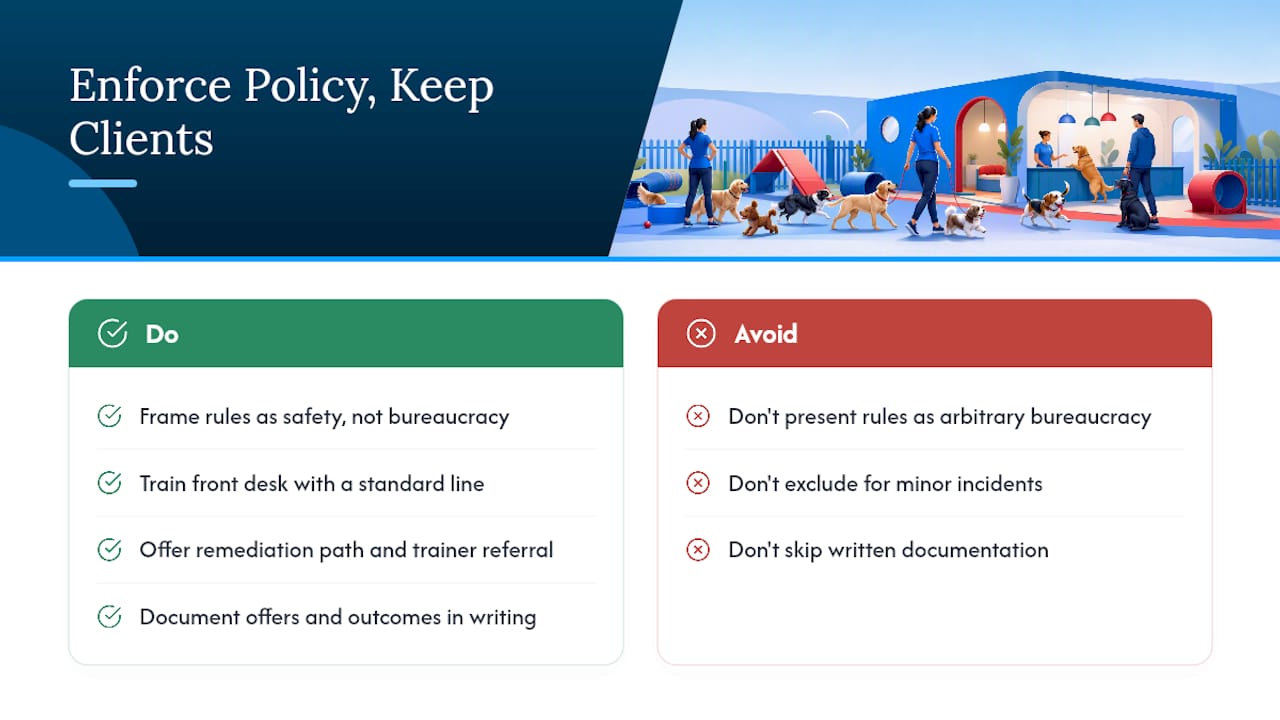
Strict rules read as cold until you frame them as safety, not bureaucracy. Train your front desk to say something like, “We hold every dog to the same vaccine and behavior standard, so your dog is always playing with dogs who’ve passed the same screening.” That line does more to keep a client than any refund policy.
Reserve permanent exclusion for documented aggression that puts other dogs or staff at risk. For everything short of that, offer a remediation path, a trainer referral, a smaller group, a reassessment date, and document the offer in writing either way. That paper trail protects your business and shows the client you’re not making an arbitrary call.
— Oliver
How The Dog Gurus Helps You Put These Policies Into Practice
Writing the policy is the easy part. Training every staff member to enforce it the same way, every shift, is where most daycares actually struggle.
Thedoggurus built its Staff Products around exactly that gap. Instead of retyping SOPs into a binder nobody reads, you get staff training modules covering canine body language and de-escalation, ready-to-adapt policy templates for intake and cancellations, and onboarding tools that get new hires up to your supervision standard faster. The Staff Products platform turns the policy checklist in this article into an actual training system your team completes and you can track. If you’re tired of policies that live in a drawer instead of on the floor, start a trial and see how quickly your team gets aligned.
Where to Verify Your Local Dog Daycare Requirements
Policy language only protects you if it matches your actual regulatory environment. Colorado’s kennel and daycare rules and Iowa’s dog daycare facility rules are two examples of how detailed state requirements get, covering everything from square footage per dog to playgroup caps.
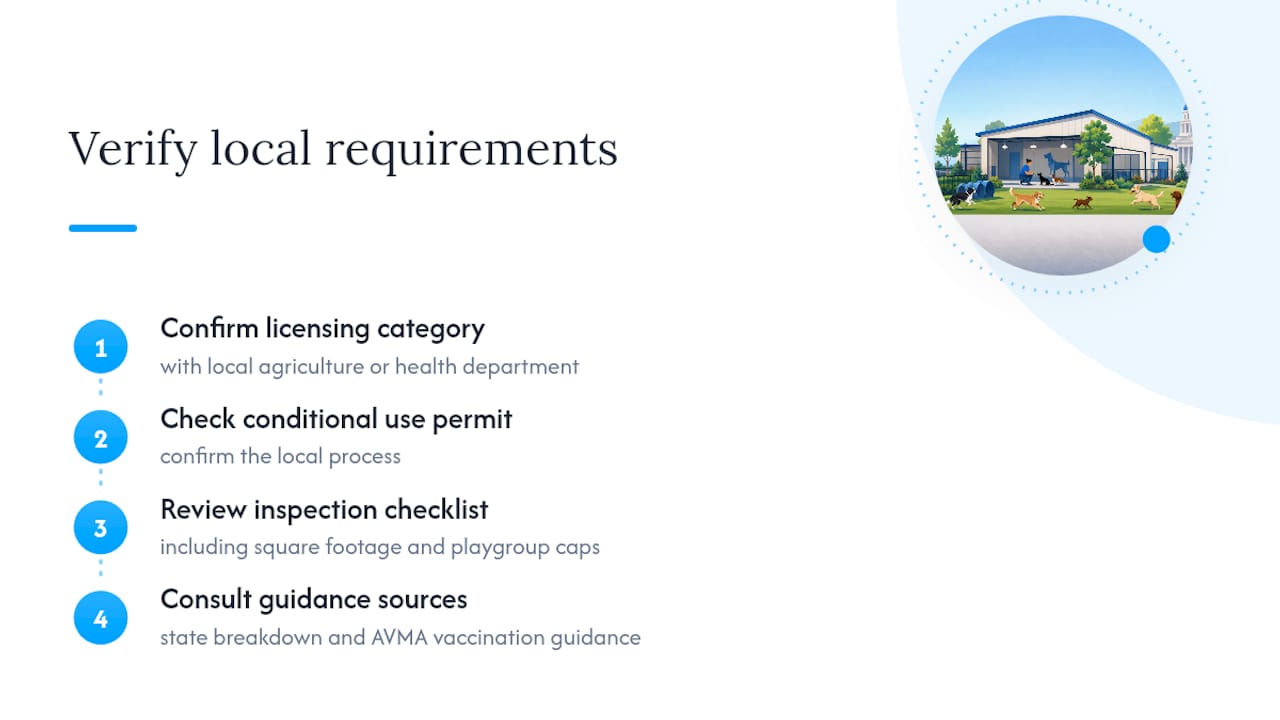
Before finalizing your own policy manual, confirm your state’s licensing category, conditional use permit process, and inspection checklist with your local agriculture or health department. Our breakdown of dog daycare regulations is a good next stop for the administrative side, and the AVMA remains the best source for vaccination and disease-prevention guidance as recommendations evolve.
Sources
- Colorado Department of Agriculture – Rule 8 CCR 1202-15 Part 14 (kennel/daycare rules)
- Iowa Administrative Code — Dog day care facility rules (21—67.11)
- AVMA — American Veterinary Medical Association
- 6 Safety Measures Every Dog Daycare Should Have — Direct Animal