

Run a predictable daycare day with a three-step workflow: plan the morning, run the floor, review performance. Every stage runs on a standard operating procedure (SOP) and a digital system that handles bookings, intake, playgroups, medications, billing, and reporting, so nothing depends on one staffer’s memory.
TL;DR:
- Manual record-keeping becomes error-prone beyond 25 to 30 dogs, making digital management essential for accurate bookings and payments.
- Staff must automatically log incident reports, medication doses, and behavior changes during shift handoffs to prevent silent failures.
- Grouping dogs by size, energy, and temperament improves safety and play quality more than matching by size alone.
- Daily metrics like attendance, incidents, and revenue should be tracked automatically to identify meaningful trends and guide staffing adjustments.
- Digital intake checklists and SOPs enhance onboarding, training, and consistency, reducing incidents caused by miscommunication or forgotten safety steps.
Table of Contents
- What Does a Daily Dog Daycare Workflow Actually Look Like?
- How Should Check-In and Intake Work?
- How Do You Structure Playgroups and Shift Blocks?
- Who Does What: Staff Roles, Ratios, and Handoffs
- How Do Bookings, Packages, and Billing Fit Into the Day?
- What Should Incident Reporting and Health Protocols Cover?
- What Cleaning and Facility-Prep Steps Keep You Inspection-Ready?
- What Metrics Should You Track Daily and Weekly?
- Where Thedoggurus Fits Into These Workflows
- How Should You Onboard and Train New Staff?
- How Do You Manage Inventory and Supplies?
- From Paper to SOPs: What Actually Changed
- How Thedoggurus Helps You Run These Workflows
- Sources
What Does a Daily Dog Daycare Workflow Actually Look Like?
A daycare day breaks into three repeatable stages, and each one needs its own short checklist.
- Plan. Check headcount against staff scheduled for the day, flag any dogs with new behavioral notes or medication needs, and confirm which handler owns which group before the doors open.
- Run. Sequence arrivals so check-in doesn’t bottleneck, assign dogs to groups based on temperament and energy, and adjust staffing in real time if a group runs hot or a handler calls out.
- Review. Reconcile actual attendance against bookings, read every incident log from the day, and hold a five-minute staff debrief before everyone leaves.
That third stage is the one most daycares skip, and it’s the one that prevents next week’s problems. A daycare running on paper can plan and run the floor fine. It’s the review step that quietly disappears when nobody owns it.
How Should Check-In and Intake Work?
Precheck removes the single biggest bottleneck in any daycare lobby: paperwork. Require digital consent forms, vaccination records, and behavior questionnaires before the dog ever walks in the door, not while a line forms behind them.
- Express intake for returning dogs with a current profile: scan the tag, confirm no new notes, walk them to their group.
- Walk-in intake for new dogs: verify vaccination records against your gating rules, complete a temperament check, and hold the dog in a low-stimulation area until cleared.
- Profile capture at first visit should include behavioral flags, medication schedule, emergency contact, and a signed list of people authorized for pickup.
Vaccination gating isn’t paperwork theater. The WSAVA Principles of Wellness point to routine preventive care and record-keeping as the backbone of a safe group setting, and a lapsed record is exactly the kind of thing a rushed front desk misses.
Pro Tip: Put the highest-risk items, like vaccine expiration and medication flags, at the top of every intake screen. Staff scan top to bottom under pressure, and burying a red flag at the bottom of a long form defeats the purpose of having one.
How Do You Structure Playgroups and Shift Blocks?
Grouping by size alone is the most common mistake newer daycares make. A calm 70-pound lab and a wound-up 15-pound terrier often play better together than two dogs of matched size but mismatched energy.
- Group by three axes: size, play style (wrestler, chaser, retriever, observer), and temperament, with new or reactive dogs assigned tighter supervision.
- Block the day: morning play (60 to 90 minutes), a rest and water window, midday play, a longer rest period tied to feeding and meds, then a lower-energy afternoon session.
- Flag automatically: any dog with two logged scuffles moves to a smaller group or a supervised one-on-one slot until reassessed, and a temperament evaluation determines when they can rejoin general play.
Rest windows aren’t downtime for staff. They’re when you clean, hydrate dogs, and catch problems before the next session starts.
Who Does What: Staff Roles, Ratios, and Handoffs
Industry guidance points to a general supervision ratio of one staffer per ten dogs, tightened to one per eight when the group includes new arrivals or reactive dogs, according to Animal Friends Pet Care’s operations guide. That ratio isn’t a ceiling to hit. It’s a floor you tighten the moment a group gets unpredictable.
- Greeter: owns intake, verification, and directing dogs to the right group.
- Floor supervisor: owns active play, group composition, and conflict intervention.
- Meds and feeds lead: owns the medication log, timing, and double-checks against consent forms.
- Floater: covers breaks, midday cleaning, and steps into any group running short-staffed.
Handoffs fail silently more often than any other part of the day. The outgoing shift needs to log every incident, every medication given, and any dog whose behavior shifted, and the incoming shift needs to actually read it before touching the floor. Building this into your staff accountability structure turns a verbal “everything’s fine” into a written record someone can act on.
Pro Tip: Make the incoming shift initial the handoff log before starting their shift. It takes ten seconds and it’s the difference between “someone told me” and “I confirmed it.”
How Do Bookings, Packages, and Billing Fit Into the Day?
Most daycares run three core service types: full day, half day, and multi-day packs sold as prepaid blocks. Packages should be priced at a discount to daily drop-in rates, enough to reward commitment without eroding margin on your busiest days.
- Capacity limits by group and time block, so a popular Monday doesn’t overbook your floor supervisor ratio.
- Blackout dates around holidays or short-staffed days, set in advance rather than discovered at check-in.
- Recurring bookings for regulars, confirmed automatically rather than re-booked weekly by phone.
- Daily reconciliation matching cards on file, deposits taken, and package deductions against actual attendance before you close the books.
A manual ledger works fine at a small scale. Past roughly 25 to 30 dogs a day, tracking packages and payments by hand starts producing errors that cost more staff time than the software would, according to K9Sky’s daycare management guide.
What Should Incident Reporting and Health Protocols Cover?
Triage first, document second. If a dog is bleeding, limping, or showing signs of distress, separate it from the group immediately and assess severity before deciding whether it needs a same-day vet visit or an emergency clinic.
- Assess and separate the dog from the group.
- Call the vet or emergency clinic if the injury involves puncture wounds, limping, or any change in consciousness.
- Document immediately: who was involved, what happened, when, and photos of any visible injury, filed in a permanent incident report record.
- Notify the owner before pickup, not at pickup.
Medication administration needs its own smaller checklist: confirm written consent is on file, have a second staffer verify dosage before giving it, and timestamp every dose in the dog’s profile. The Merck Veterinary Manual’s routine care guidance is a useful baseline for understanding why intake needs to capture current health status, not just vaccination dates, since dosing errors and missed conditions both trace back to incomplete records at check-in.
What Cleaning and Facility-Prep Steps Keep You Inspection-Ready?
Cleaning happens in three passes, timed to avoid interrupting supervised play.
- Opening: check supply stock (bags, cleaner, gloves, laundry), inspect flooring and fencing, and set out fresh water before the first dog arrives.
- Midday: clean during rest windows rather than around active play, so you’re never mopping next to a group of loose dogs.
- End-of-day: deep clean all play areas, restock consumables for tomorrow, and rotate laundry so bedding and towels are ready for the morning rush.
A written cleaning protocol turns this from “whoever has time” into a task someone owns every single day.
What Metrics Should You Track Daily and Weekly?
Track five numbers every day: attendance, utilization percentage, no-shows, incidents logged, and revenue per dog. None of them takes more than a glance to record if your system pulls it automatically.
- Weekly review: adjust staffing against actual utilization, check which packages are selling versus sitting unused, and look for behavioral trends across groups.
- Ten-minute post-mortem: pick one KPI, occupancy rate or incident rate works well, and ask what one change would move it next week.
Chasing a dozen metrics at once produces spreadsheets nobody reads. Picking one KPI a week and running a short post-mortem on it builds a habit of actually acting on the numbers, an approach Animal Friends Pet Care recommends over broad, unfocused tracking.
Where Thedoggurus Fits Into These Workflows
Every workflow above maps to a template: intake checklists mirror the AAHA canine life stage toolkit structure, incident reports follow a consistent field format, and cleaning SOPs break into opening, midday, and closing tasks. There are staff training modules and an AI accountability coach built around exactly this structure. A practical starting point: run a seven-day pilot. Add digital precheck, roll out one SOP, and track a single KPI. That’s enough to see whether the workflow actually holds up on a busy Saturday.
How Should You Onboard and Train New Staff?
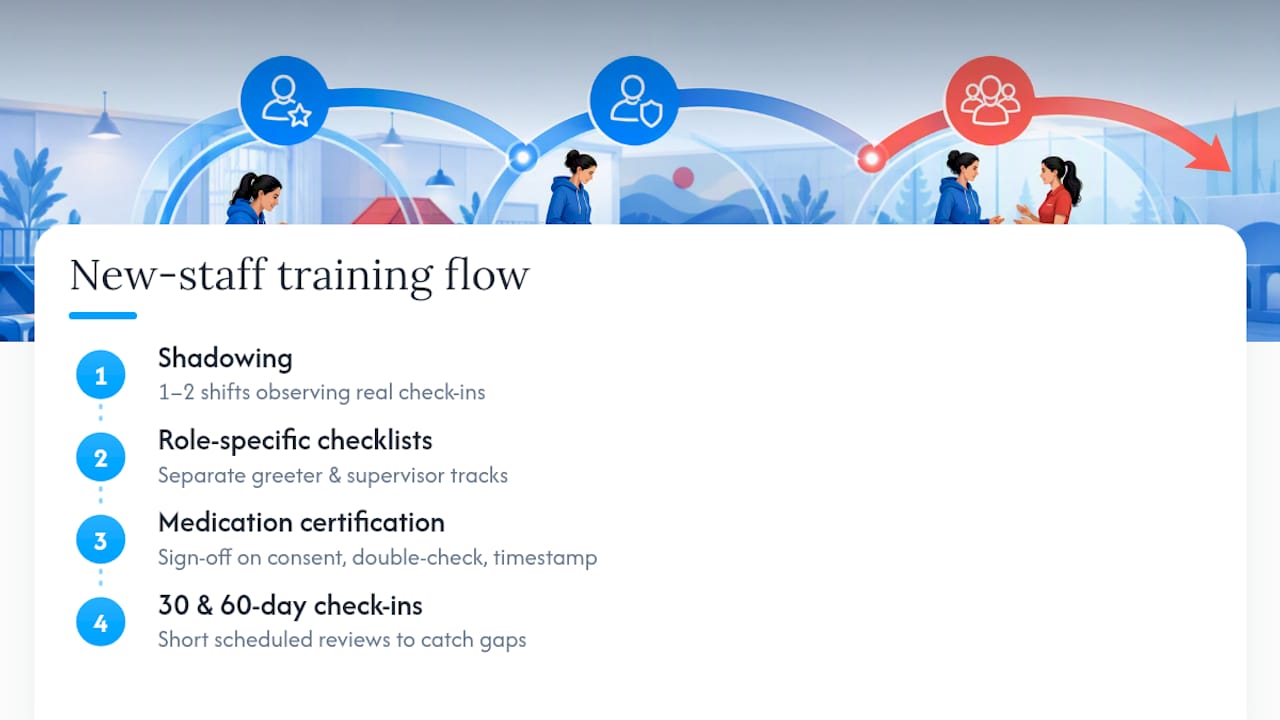
New hires learn faster when training follows the same three-stage structure as the daily workflow itself, rather than a generic orientation packet handed over on day one.
Start with shadowing. A new staffer spends their first shift or two following a greeter or floor supervisor, watching intake, group assignment, and handoffs in real time before touching any of it themselves. Written SOPs matter here, but they’re a reference, not a substitute for watching a live check-in go sideways and seeing how a trained handler fixes it.
Role-specific checklists come next. A new greeter needs a different training track than a new floor supervisor: intake verification and pickup authorization for one, group composition and conflict intervention for the other. Trying to train someone on everything at once slows the whole process down and produces staff who are mediocre at every role instead of solid at one.
Certification on medication administration should be a hard gate, not a soft suggestion. Nobody gives a dose until they’ve been checked off on the consent verification, double-check, and timestamp protocol by a supervisor, ideally more than once.
Build in a 30 and 60-day check-in. New staff forget details, cut corners under pressure, or develop workarounds that seem faster but skip a safety step. A short, scheduled review catches that early, before it becomes habit. Pairing this with your staff accountability structure keeps training reinforced instead of a one-time event that fades by week three.
How Do You Manage Inventory and Supplies?
Running out of cleaning solution mid-shift or discovering the medication cabinet is short on a critical dose is a preventable failure, not bad luck. Inventory management for a daycare covers three categories, and each needs its own tracking rhythm.
Food and treats need par levels set against your actual daily headcount, checked weekly, with a reorder trigger built in before you hit the last bag. Boarding dogs on owner-provided food need separate labeled storage to avoid mix-ups, which matters as much for allergy safety as for basic organization.
Cleaning supplies get consumed unevenly. A slow Tuesday burns through less disinfectant than a full Saturday, so tracking by usage pattern rather than a flat weekly order avoids both shortages and waste. Keep a running list on the opening checklist so whoever opens the building can flag low stock before it becomes an emergency.
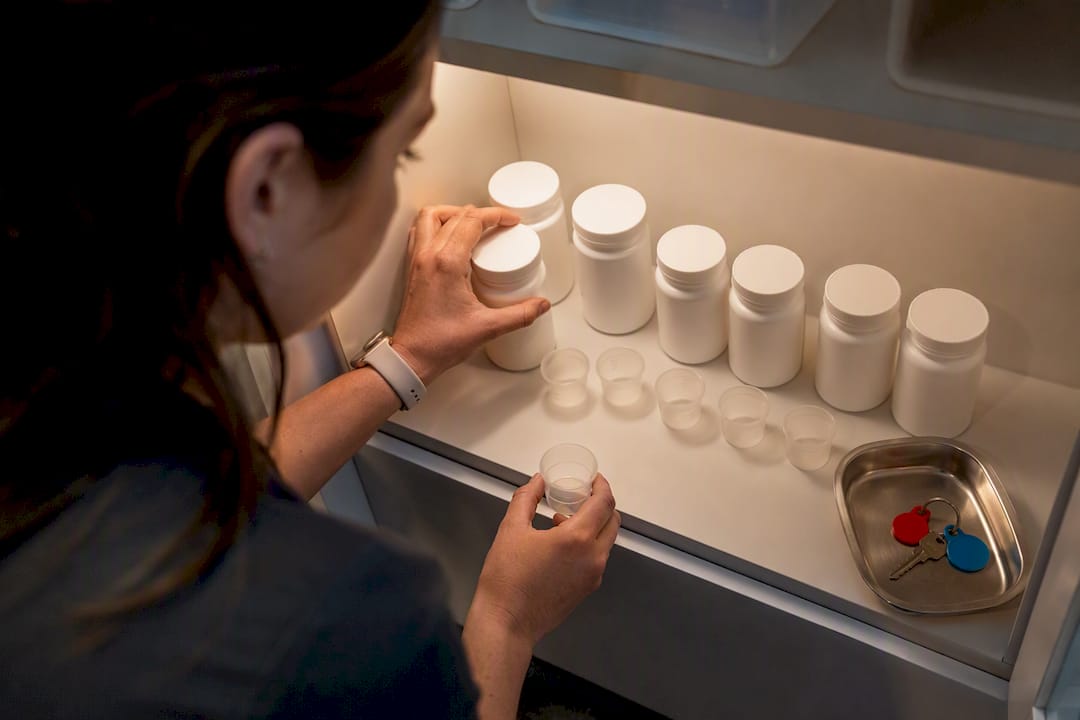
Medications need the tightest control of any inventory category. Store them separately from general supplies, log every dose given against the medication record, and reconcile the physical count against the log weekly. A mismatch between what’s logged and what’s left in the bottle is worth investigating immediately, not at the next audit.
A simple shared inventory sheet, digital or otherwise, that any staffer can update in real time beats a manager doing a weekly guess. The goal is catching a shortage on Tuesday, not discovering it Saturday morning with a full lobby waiting.
From Paper to SOPs: What Actually Changed
Switching from paper logs to a digital intake and a written SOP for playgroup assignment cut morning check-in time noticeably and reduced the confusion that used to send new staff hunting for a supervisor mid-rush. If you’re starting anywhere, start with digital intake this week. Track morning throughput before and after. The number will tell you if it worked.
— Oliver
How Thedoggurus Helps You Run These Workflows
There are SOP packs, role-specific staff training modules, and an AI coaching tool built around the workflows covered above, to plan the day, run intake, manage playgroups, and close out shifts.
The value here isn’t another dashboard to check. It’s less time spent rewriting checklists every time a new hire starts, and more consistency in how your team handles vaccination gating, medication administration, and incident documentation, the exact areas where inconsistency creates liability. If your current onboarding is “shadow someone for a week and figure it out,” that gap is where incidents happen.
Check the Staff Products page for pricing and start a trial to see whether the templates and training modules fit how your daycare actually runs.
Sources
- AAHA canine life stage guidelines toolkit
- WSAVA Principles of Wellness
- How to Run a Profitable Dog Daycare: Operations Guide | Animal Friends Pet Care
- Merck Veterinary Manual — Routine health care of dogs