

When an incident happens at your facility, the first thing you do in the next ten minutes determines everything that follows. Secure the animal, separate any involved dogs, triage injuries, preserve the scene, and start your incident report immediately. That single habit protects your animals, your clients, your staff, and your business.
Here are your first five actions:
- Secure the injured or involved animal in a safe, separate space away from the group.
- Separate all dogs involved and keep them calm and contained.
- Triage injuries and call your on-call vet or emergency clinic if needed.
- Photograph and video the scene, injuries, and any relevant equipment before anything is moved.
- Collect witness names and contact information from every staff member present.
Pro Tip: Download the Thedoggurus fillable incident-report template at Thedoggurus and keep a printed copy at your front desk and in every play area. Speed matters.
Key Takeaways
Completing a thorough incident report immediately, preserving photo and video evidence, and notifying your insurer within 24 hours are the three actions most likely to protect your facility from financial and legal harm.
| Point | Details |
|---|---|
| Document every incident | Log all events, including near-misses, using factual, blame-free language in every field. |
| Preserve evidence fast | Export video, photograph the scene, and label files with timestamps before anything is moved or overwritten. |
| Notify insurer within 24 hours | Delayed notice can slow or reduce claim payments; send the full documentation package with your first contact. |
| Waivers have limits | Courts may not enforce waivers for gross negligence; clean incident records are your strongest defense. |
| Thedoggurus | Provides fillable templates, staff training modules, and incident-tracking workflows built for U.S. pet care operators. |
Table of Contents
- What counts as an incident in dog daycare?
- What to do in the first 60 minutes after an incident
- How to fill out a dog daycare incident report
- Who to notify, when, and what to say
- What are your legal obligations as a daycare operator?
- How to file an insurance claim after a daycare incident
- How long should you keep incident records?
- Turn incidents into prevention with staff debriefs
- Your incident workflow: immediate through 7 days
- Where to get fillable incident-report templates
- The paperwork is the protection
- Thedoggurus gives you the templates and training to handle incidents with confidence
- Sources
What counts as an incident in dog daycare?
Not every rough moment is an incident, but your staff should err on the side of logging more, not less. Under-reporting is the mistake that costs you later.
Core incident types to always document:
- Bite or scratch causing injury to a dog, staff member, or visitor
- Dog-on-dog injury requiring first aid or vet care
- Escape from the facility or a play area
- Sudden illness, collapse, or seizure
- Death of an animal in your care
- Suspected cruelty, neglect, or abuse
- Unintended breeding
- Property damage caused by an animal in your care
Near-misses belong in your log too. A gate latch that failed but didn’t result in escape, a dog that snapped without making contact, or a dog that showed sudden aggression toward a handler are all worth recording. Managing problem behaviors in dog daycare starts with recognizing which behaviors cross the threshold into documented events.
A quick classification rule for staff: if it could have caused injury, illness, or property damage, log it.
What to do in the first 60 minutes after an incident
Follow these steps in order. Every minute counts for animal welfare and evidence preservation.
- Secure the animal. Move the injured or involved dog to a quiet, safe area immediately.
- Separate all involved dogs. Keep them apart and assign a staff member to each.
- Apply first aid if trained to do so, and assess whether emergency vet transport is needed.
- Designate a staff lead for the incident. One person manages the scene; others document.
- Photograph injuries and the scene from multiple angles before anything is cleaned or moved.
- Save video footage immediately. Pull and export the relevant clips right now.
- Collect witness information. Get the full name and contact info of every staff member present.
- Log the time of every action as you take it. Timestamps are critical for insurance and legal review.
- Call the pet owner. Use a calm, factual script (see the notification section below).
- Start the incident report. Fill in every field while details are fresh.
Pro Tip: Check your camera system’s overwrite settings today, before an incident. Many systems loop footage every 24–72 hours. Export clips immediately after any incident, label them with the date, time, and camera ID, and store them in a secure folder. Video and photo evidence is often decisive in insurance claims and legal disputes.
How to fill out a dog daycare incident report
A professionally defensible incident report uses facts only. No opinions, no blame, no emotional language. Train your staff to write what they observed, not what they think happened. Boring, consistent paperwork completed immediately saves businesses in disputes because emotional post-incident narratives are unreliable.
| Field | Example phrasing | Why it matters |
|---|---|---|
| Date and time | Date and time | Establishes timeline for insurer and legal review |
| Location in facility | “Large dog play yard, north gate area” | Identifies where supervision gaps may exist |
| Staff on shift | “Jane Smith, Mike Torres” | Documents who was present and responsible |
| Dogs involved (with ID) | Buddy and Rex | Links to intake records and vaccination files |
| Owner contact info | Sarah Lee, contact info | Required for immediate notification |
| Injuries observed | “Puncture wound, left rear leg, approximately 1 cm” | Factual description; avoid “severe” or “minor” |
| Actions taken | Applied pressure bandage; transported to Riverside Animal Hospital | Shows duty of care was exercised |
| Vet care authorization | Owner verbally authorized vet visit; confirmed by text | Protects you if costs are disputed |
| Witness statements | “Staff member Torres observed Rex lunge unprovoked” | Supports your account with corroboration |
| Photo/video references | IMG_date_time.jpg; Cam3_clip_time_range.mp4 | Preserves chain of evidence |
Avoid phrasing like: “Rex attacked Buddy” or “Staff failed to notice.” Write instead: “Rex made contact with Buddy’s rear leg. Staff separated dogs within approximately 30 seconds.”
For witness statements, use this short template: “I, [Name], observed [factual description of what was seen] at approximately [time] in [location]. Signed: ___ Date: ___”
Who to notify, when, and what to say
Speed and consistency in your notifications protect animal welfare and reduce your legal exposure. Gather intake forms, prior complaints, camera footage, and witness names quickly because evidence can disappear fast.
- Immediately: Call the pet owner. Be calm, factual, and brief.
- Within 1 hour: Contact your vet or emergency clinic if transport is needed.
- Within 24 hours: Notify your insurer. Most policies require prompt notice.
- When legally required: Contact animal control or public health authorities for bites involving humans, suspected cruelty, or animal death per your state’s rules.
Sample owner call script:
Keep the call factual. Don’t speculate about cause or assign blame. Document the call time, who spoke, and what was said.
Documents to send with your initial insurer notification: incident report, photos and video, intake and vaccination records, staff witness statements, and any vet invoices received so far.
What are your legal obligations as a daycare operator?
Your facility has a duty of care toward every animal in your custody. Courts require proof of four negligence elements: duty (you accepted responsibility for the animal), breach (you failed to meet the standard of care), causation (that failure caused the harm), and damages (actual harm resulted).
Waivers and liability agreements can limit recovery in many cases, but they are not bulletproof. Courts in many states will not enforce waivers for gross negligence or intentional harm. Your best defense is always a clean, contemporaneous incident report, not a waiver clause.
Consult an attorney when you see these red flags:
- An animal dies in your care
- A person is hospitalized from a bite or injury at your facility
- An owner alleges cruelty or neglect
- Your insurer denies or disputes the claim
- Evidence suggests a systemic policy failure
Even when waivers exist, preserve objective evidence to rebut waiver defenses. Documentation is your first line of protection.
How to file an insurance claim after a daycare incident
Insurers expect structured documentation: incident report, vaccine and intake records, witness statements, vet invoices, and a clear timeline. Missing elements can slow or reduce claim payments.
Your claims checklist:
- Completed incident report (all fields filled)
- Photos and video with timestamped file names
- Intake form and vaccination records for all involved animals
- Staff witness statements (signed and dated)
- Vet invoices and treatment notes
- Written record of owner communication (dates, times, what was said)
- Copy of your facility’s policies relevant to the incident
File your initial notice of claim as soon as possible, ideally the same day. Label every file clearly: IncidentDate_DogName_FileType (e.g., 20260314_Buddy_VetInvoice.pdf). This labeling system speeds insurer review and demonstrates that your team operates with discipline. For a deeper look at coverage gaps, dog daycare insurance guidance covers what policies typically include and where operators get caught short.
How long should you keep incident records?
Keep incident reports, photos, video, and related insurance files for a minimum of 3–7 years. The right number for your facility depends on your state’s statute of limitations for personal injury and property damage claims, plus any retention requirements in your insurance policy. Check both.
Protect client data with these steps:
- Store digital records in encrypted folders with role-based access (managers only, not all staff).
- Redact personal details (owner phone numbers, home addresses) before sharing reports with third parties who don’t need them.
- Use a named file structure so records are easy to retrieve under pressure.
- Maintain internal records beyond client waivers: bite reports, temperament notes, medication logs, and staff observations are vital for defense and quality control.
Check your state’s specific retention rules and your insurer’s contract terms. Some policies require you to maintain records for the life of the policy plus a set number of years.
Turn incidents into prevention with staff debriefs
Every incident is data. Run a debrief within 48 hours using this repeatable template:
- Facts: What happened, in sequence, with timestamps.
- Root-cause hypotheses: What conditions made this possible? (Supervision ratio, gate check missed, intake screening gap?)
- Corrective actions: Specific changes to prevent recurrence.
- Assigned owners: Who is responsible for each corrective action?
- Deadlines: When will each change be implemented and verified?
Common training fixes after incidents include reviewing supervision standards, tightening gate-check protocols, updating dog evaluation procedures, and refreshing behavior-recognition training. Strict incident logging, even for minor events, combined with transparent owner communication and daily logs, builds the internal record that protects you over time.
When a debrief reveals a systemic gap, update your written policy immediately and document the change with a date and the names of staff who were briefed.
Your incident workflow: immediate through 7 days
| Milestone | Key actions |
|---|---|
| Immediate (0–60 min) | Secure animal, triage, photograph scene, export video, notify owner, start incident report |
| Within 24 hours | File insurer notice, send owner written summary, complete all report fields, store evidence files |
| Within 72 hours | Follow up with owner on vet status, confirm insurer received documents, run staff debrief |
| At 7 days | Vet follow-up check, owner satisfaction check, review corrective actions, update policies if needed, escalate to legal counsel if unresolved |
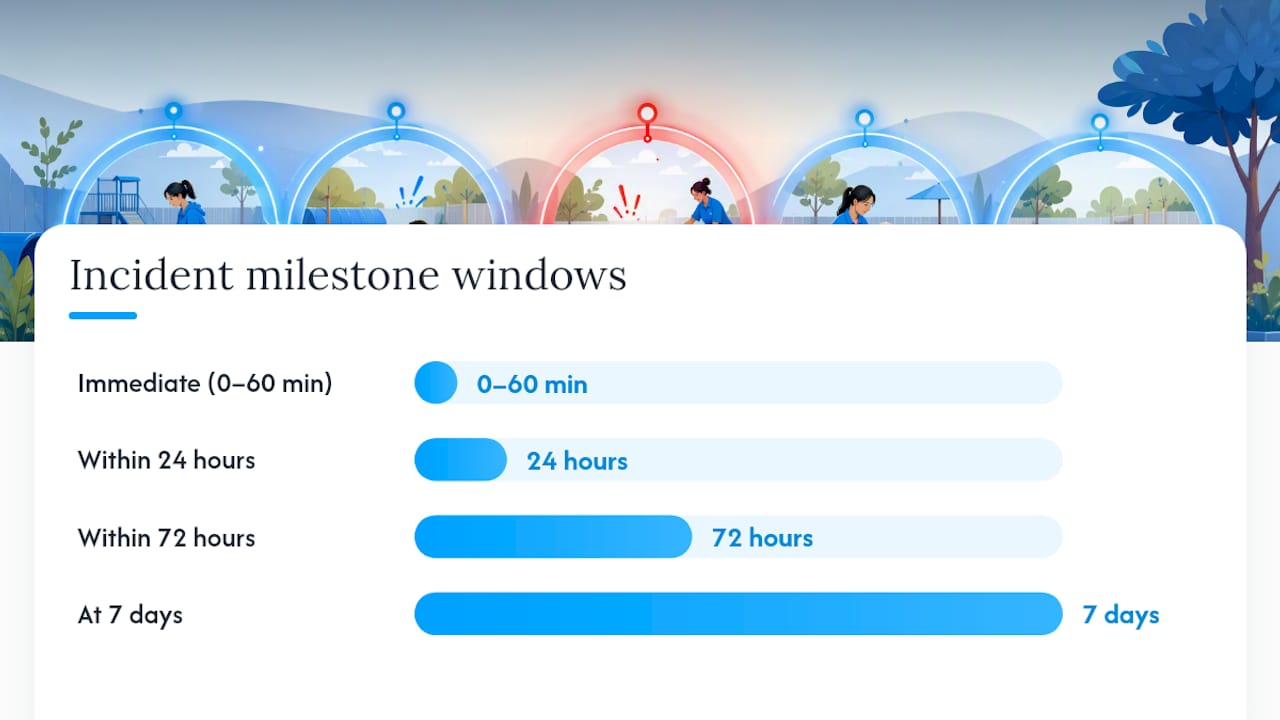
Assign a named staff member to track each milestone. Unresolved issues at the 7-day mark should go to management or legal counsel immediately.
Where to get fillable incident-report templates
The fastest way to get a ready-to-use template is through Thedoggurus. The fillable incident-report template covers every field listed in this article and is designed for dog daycare and pet care operations in the U.S.
Before you deploy any template, make these customizations:
- Add your facility name, address, and license number.
- Include your state-specific reporting requirements (animal bites, human injuries, deaths).
- Have an attorney review your waiver language and any arbitration clauses.
- Add fields for your specific services (boarding, grooming, training) if applicable.
Store the template in two formats: a PDF fillable version for immediate use and a digital form (Google Forms, JotForm, or similar) for cloud-based access. Limit editing access to managers. Staff should be able to fill and submit, not modify the template structure. Operators should maintain internal records beyond client waivers, including bite reports, temperament notes, medication logs, and staff observations.
The paperwork is the protection
Most operators know they should document incidents. Fewer treat that documentation as the single most important thing they can do in the first hour. Here’s what experience running pet care operations makes clear: the facilities that come through serious incidents with their reputation and finances intact are almost always the ones with boring, consistent paperwork.
A daily staff handoff that includes a verbal near-miss report is one of the most underused tools in this industry. When your closing shift tells your opening shift about the dog that almost got through the gate, and someone writes it down, you catch the pattern before it becomes an incident. That habit costs nothing and changes everything.
The operators who wait until something goes wrong to build their documentation system are the ones who end up scrambling. Build the system now, train your staff on it, and run it every day.
Thedoggurus gives you the templates and training to handle incidents with confidence
Running a dog daycare means being ready for the unexpected. Thedoggurus gives you fillable incident-report templates, step-by-step staff training modules, and AI-powered tools that help your team document incidents consistently, every time.

Your staff gets role-specific training on incident response, evidence preservation, and owner communication. You get the operational playbook, the forms, and the workflows built by people who have actually run pet care businesses. No guessing, no scrambling, no gaps.
Ready to protect your facility with proven systems? Start with Thedoggurus and get your incident-report template today.
Sources
These U.S.-focused resources support the legal, insurance, and documentation guidance in this article:
- Can I sue a dog kennel, pet boarding facility, or dog day care? | FindLaw
- Boarding and Daycare Disasters: What to Do If Your Pet Is Injured or Killed in Someone Else’s Care — Litigation for Animal Welfare
- Dog Daycare Insurance: Liability, Care/Custody Coverage, Claims, and Coverage Gaps | PAWS
- Dog Bite Injuries At Groomers, Pet Stores, And Daycares: Who’s Liable When An Animal Professional Fails To Protect You? | State Law Firm
- Animal Bailee Insurance: A Comprehensive Guide for Dog Daycare and Boarding Operators – PetEditorial
This article is general information, not a substitute for advice from a qualified lawyer. Consult a qualified legal professional about your own circumstances before acting on anything here.