

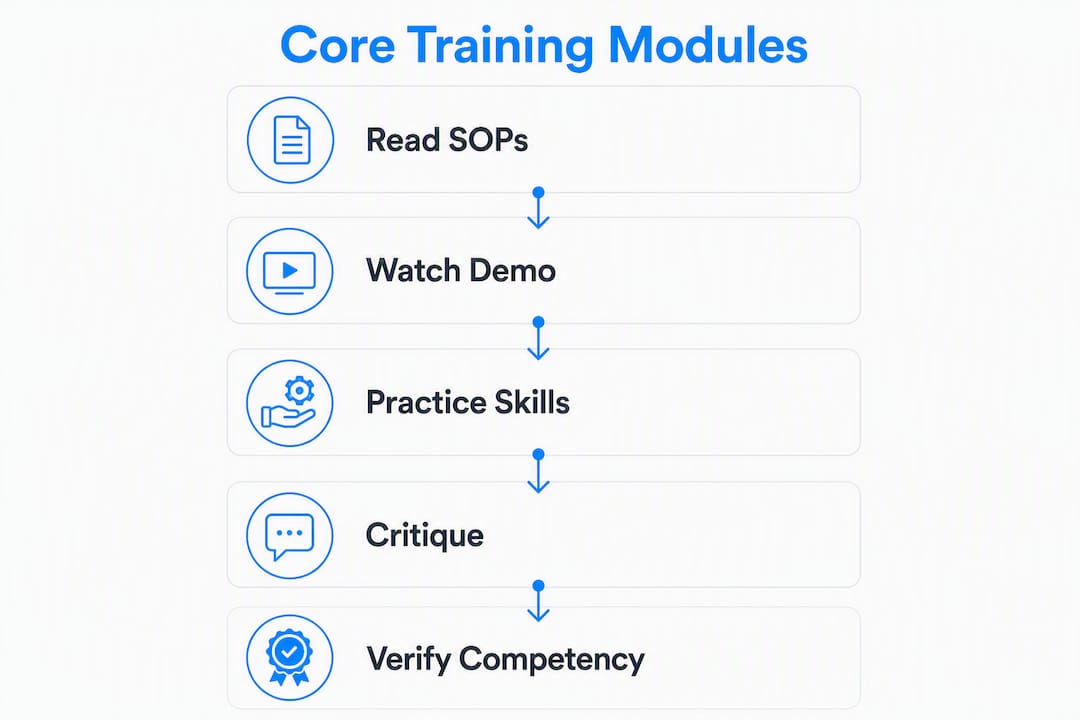
The best pet sitter training for your business is not a certification course. It is an SOP-driven, competency-based onboarding program built around a Read→Watch→Practice→Critique→Verify progression with measurable KPIs at every stage. Every business-grade staff training program needs these core elements:
- SOP library covering intake, feeding, medication, sanitation, and emergency response
- Demonstration-first modules so staff observe correct performance before they attempt it independently
- Role-based shadowing with a designated mentor for each new hire
- Emergency response protocols and basic first aid scope for each role
- Client communication standards including intake notes, service logs, and privacy boundaries
- Built-in assessment with pass/fail criteria and a signed competency sign-off
Your immediate next step: Download or build a 30/60/90-day onboarding template for your pet business and assign one internal trainer before your next hire starts.
Table of Contents
- What core modules does the best pet sitter training program include?
- How do you design and roll out a business-grade onboarding program?
- How do you measure whether your training program is actually working?
- What legal and safety protections do SOPs and training records provide?
- Your 30/60/90-day onboarding template and sample checklists
- Who should deliver training, and how do you build internal trainers?
- Common training mistakes that undermine your program
- Key Takeaways
- Why the “certification” framing misses the point for business owners
- Thedoggurus: a platform built for this exact program
- Sources and further reading
What core modules does the best pet sitter training program include?
Generic onboarding templates are common, but they fall short. Employer-facing training must cover species-specific behavior, emergency response, and client communication to protect your reputation and your clients’ pets.
Safety and restraint protocols are the foundation. For grooming roles, that means grooming-specific hazards such as dryer safety, restraint equipment use, and when to refuse service. Written SOPs here are not optional. Because the US pet care industry is largely unregulated at the state level, your internal documentation becomes your primary legal protection.
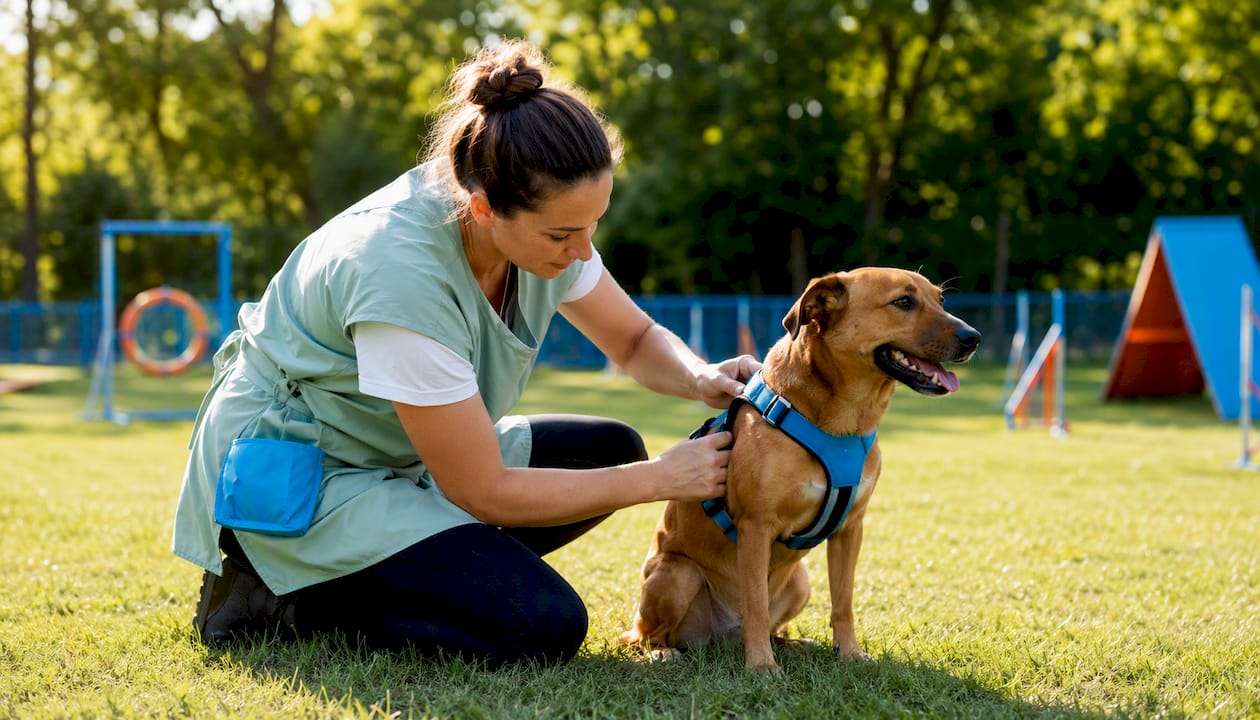
Species- and role-specific handling covers canine body language, feline stress signals, and small-mammal handling as applicable to your service mix. Staff who can read a dog’s stress signals before a bite happens are worth far more than staff who react after one.
Emergency response and first aid training should define what staff handle on-site versus when they call the vet or owner immediately. Scope this by role. A kennel tech needs a different response checklist than a solo pet sitter. First aid and CPR training is a practical starting point for this module.
Client communication, documentation, and privacy round out the operational core. Intake notes, service logs, and accurate handoff records protect you when a client disputes a service or a pet arrives with an undisclosed condition.
Soft skills belong in the program too. Empathy, time management, and conflict resolution are not extras. A staff member who handles a worried pet parent with confidence keeps clients. One who goes silent under pressure loses them.
Each module should follow the same delivery sequence: read the SOP, watch a demonstration, practice in a controlled setting, receive feedback, and pass a verified assessment.
How do you design and roll out a business-grade onboarding program?
A well-designed rollout produces trained, assessable staff within 90 days. Here is the sequence:
- Map your roles. List every position and the specific tasks each one owns. A pet sitter’s SOP set differs from a kennel tech’s.
- Build or audit your SOP library. Every core task needs a written procedure before training begins.
- Define pass/fail criteria. Decide what “competent” looks like for each skill and write an assessment rubric.
- Run a pilot with a small cohort. Use demonstration-first sessions, assign a mentor, and test your timeline before scaling.
- Schedule cohorts and set up your learning platform. Video-based training paired with on-floor verification reduces time-to-competence and makes auditing records simpler.
- Verify and document. Every role gets a skills sign-off sheet stored in the employee file.
Before rollout, confirm you have:
- Written SOPs for every core task
- A designated trainer or mentor per role
- A training calendar with scheduled demo sessions
- An assessment rubric with clear pass thresholds
- A platform or folder system for tracking completion
For part-time staff, compress the timeline but never skip the verification step. A part-time sitter who skips the competency sign-off is the same liability risk as a full-time one.
How do you measure whether your training program is actually working?
Retention, incident rate, client satisfaction, and competency pass rates are your four core KPIs. Structured onboarding increases retention over multiple years, making it one of the highest-return investments a pet care business can make.
| KPI | How to measure | Frequency | Retraining trigger |
|---|---|---|---|
| Employee retention over time | Track headcount vs. turnover in your scheduling system | Quarterly | Turnover above your baseline |
| Incident/near-miss rate | Incident log reviewed monthly | Monthly | Any increase over prior period |
| Client satisfaction (NPS or CSAT) | Short post-service survey (3–5 questions) | Monthly | Score drop of several points |
| Competency pass rate | Skills sign-off completion rate | Per cohort | Below a set pass threshold |
| Time-to-competence | Time from hire to first solo shift | Per hire | Exceeds your expected target |
Collect this data with tools you already use. Your scheduling software exports headcount. Your CRM or booking platform can trigger a short client survey automatically. Incident logs take five minutes per event. The goal is a monthly review that takes 30 minutes, not a new reporting system.
Pro Tip: Monthly department checklists help you “inspect what is expected” and surface which specific processes need retraining, rather than applying broad performance fixes that miss the real gap.
What legal and safety protections do SOPs and training records provide?
Because pet grooming and pet sitting are largely unregulated at the state level, your written SOPs are the primary evidence of reasonable care if a pet is injured and litigation follows. Businesses that rely on tribal knowledge face significantly higher legal risk than those with documented, consistently trained procedures.
Maintain these records for every employee:
- Signed SOP acknowledgment forms
- Training completion logs with dates
- Skills competency sign-offs per role
- Incident reports with timestamps
- Vaccination and medical records for pets in your care (where permitted)
Pro Tip: Store time-stamped training sign-offs and short video demonstrations of key skills alongside the employee record. A 60-second phone video of a staff member correctly performing a restraint procedure is concrete evidence of training.
Consult your insurance carrier about policy-specific documentation requirements. Some liability policies require documented training records to honor a claim. This is general information, not legal advice; confirm current requirements with your carrier or a qualified attorney.
Your 30/60/90-day onboarding template and sample checklists
A 30/60/90 split keeps new hires moving toward competence without overwhelming them. Days 1–30 cover orientation and core skills. Days 31–60 build supervised independence. Days 61–90 focus on assessment and productivity targets.
| Phase | Focus | Key deliverables | Sign-off required |
|---|---|---|---|
| Days 1–30 | Orientation, SOP review, demo sessions | SOP acknowledgment, day-1 checklist, week-1 shadowing log | Trainer initials on each module |
| Days 31–60 | Supervised solo shifts, client communication practice | Shift observation notes, incident log review, client survey results | Mentor sign-off on 3 observed shifts |
| Days 61–90 | Independent performance, assessment, productivity targets | Competency rubric score, skills sign-off sheet, 90-day review form | Manager final sign-off |
Day 1 checklist items: facility tour, emergency exit locations, emergency contact protocol, pet handling SOP review, client privacy policy acknowledgment.
Week 1 checklist items: shadowed feeding and medication administration, leash-handling observation, client intake note practice, first incident log walkthrough.
Monthly review items: SOP quiz or verbal review, incident log summary, client feedback review, mentor observation note.
For grooming roles, add restraint equipment sign-off and dryer safety verification. For solo pet sitters, add key-handling protocol and lockout/emergency access procedures. Part-time staff follow the same phases on a compressed schedule, typically six weeks rather than 90 days, but the sign-off requirements stay identical.
Who should deliver training, and how do you build internal trainers?
The strongest programs combine platform-led content for baseline knowledge with internal mentors who verify competency on the floor. Neither alone is enough.
- Owner/operator: sets standards, approves SOPs, and reviews KPIs. Not the default day-to-day trainer.
- Training manager: schedules cohorts, tracks completion, and manages the assessment process. This can be a senior staff member with a formal trainer designation.
- On-floor mentors: observe practice, give real-time feedback, and sign off on skills. Select mentors based on SOP consistency, not just tenure.
- External subject-matter instructors: useful for first aid/CPR, species-specific behavior, or grooming safety where internal expertise is limited.
To prepare a staff member as a mentor, confirm they can:
- Perform every SOP in their role without prompting
- Explain the why behind each step, not just the sequence
- Observe a new hire and give specific, constructive feedback
- Complete a trainer shadow assessment with a manager present
Selecting the right training leader is one of the highest-leverage decisions you make in building a sustainable program.
Common training mistakes that undermine your program
The most common errors are skipping demonstration and practice, relying on generic templates, and failing to track competency. Here is what to watch for:
- Staff saying “this is how I do it” signals SOP drift. When you hear individualistic language, it means procedures are being treated as personal preference rather than team standard. That requires SOP revision and targeted retraining, not a general reminder.
- Increasing incident or rework rates after the first 30 days indicate the verification step was skipped or the assessment threshold was too low.
- Low pass rates on skills checks often mean the demonstration phase was too short, not that the staff member is unqualified.
- Inconsistent client notes across the team point to a client communication module that was read but never practiced.
When a red flag appears, the fix is targeted: identify the specific SOP or skill, run a focused remediation session with demonstration and observed practice, and re-verify before the staff member returns to that task independently. Broad retraining rarely solves a specific gap.
Avoid the opposite error too: overloading staff with theory modules before they have touched a single animal. Practical skills need floor time, not more reading.
Key Takeaways
A competency-based, SOP-driven onboarding program is the single most effective investment a pet care business can make in staff quality, retention, and legal protection.
| Point | Details |
|---|---|
| Use the 5-step progression | Read→Watch→Practice→Critique→Verify builds real competency; SOPs alone do not. |
| Track four core KPIs | Retention, incident rate, client satisfaction, and competency pass rate tell you whether training is working. |
| SOPs are your legal protection | In a largely unregulated industry, documented and consistently trained procedures are your primary evidence of reasonable care. |
| Build internal trainers | Designate a training manager and on-floor mentors before scaling; platform content alone cannot verify on-floor skills. |
| Thedoggurus delivers this system | The platform provides SOP libraries, video modules, mentor workflows, assessment rubrics, and LMS tracking built for pet care businesses. |
Why the “certification” framing misses the point for business owners
Most of what ranks online for pet sitter training is aimed at individuals seeking personal credentials. That is a different product for a different buyer. What you need as a business owner is a system that produces consistent, assessable staff performance across your whole team, not a certificate any one person earns and takes with them.
The businesses that struggle with staff quality are almost never short on willing employees. They are short on a repeatable process for turning those employees into competent, confident team members. A certification does not give you that. A structured onboarding program with clear SOPs, demonstration-first delivery, and monthly inspections does.
The other thing most guides underestimate is the maintenance cost of training. Building the program is the easy part. The harder work is the monthly review cycle, the SOP revision when a process changes, and the retraining when a red flag surfaces. Owners who treat onboarding as a one-time event consistently see performance drift within six months. Treating it as an ongoing operational system is what separates the businesses that scale from the ones that stay stuck.
Thedoggurus: a platform built for this exact program
Your staff training program needs more than a folder of PDFs. Thedoggurus gives pet care business owners a complete, ready-to-deploy training system, so you spend less time building from scratch and more time running a great business.
The platform delivers exactly what this guide describes:
- SOP libraries and playbook templates you can customize for your roles and service mix
- Expert-led video modules covering safety, behavior, client communication, and operations
- Mentor workflows and assessment rubrics so on-floor verification is built into the process
- LMS tracking and benchmarking analytics that make your KPI reviews a 30-minute monthly task
- AI-powered tools that act as a 24/7 accountability partner for owners and staff
It runs on a subscription model with tiered plans for business owners and staff, including options for growing teams and enterprise-level operations. Start with a demo at Thedoggurus to see how the platform maps to your current onboarding gaps and get your first cohort moving within the week.
Sources and further reading
These are the core resources behind this guide. Use them as references when building your own SOPs, training rubrics, and measurement systems.
- Best Practices for Onboarding New Employees in Pet Sitting — Scout: Practical onboarding checklist and retention research for pet sitting businesses.
- March 2026 Webinar: How to Train Staff for Real Competency Through SOPs and Muscle Memory — Pet Industry Network: Source for the Read→Watch→Practice→Critique→Verify progression and demonstration-first principles.
- Implementing Written Systems and Operations — Pet Boarding and Daycare Magazine: Monthly inspection and SOP maintenance guidance for pet care operators.
- Pet Grooming Salon SOPs: Safety, Sanitation & Operations — WorkProcedures: Grooming-specific SOP templates covering restraint, dryer safety, and injury response.
- 8 Key Topics that Elevate Your Animal Care Employee Onboarding Process — Tiffani Hill LLC: Role-specific onboarding topics including emergency protocols and client communication.
- Standard Operating Procedures — Journal of the American Veterinary Medical Association, Vol. 258 Issue 5 (2021): Authoritative framework for SOP design, purpose, and documentation standards in animal care settings.
Recommended
- Finding the Best Staff Training for Your Pet Business – The Dog Gurus
- Selecting the Best Staff Training Leader for Your Pet Care Business – The Dog Gurus
- 5 Tips for Creating a Staff Training Program for Your Pet Business – The Dog Gurus
- Adding Dog Training Revenue To Your Pet Care Business – The Dog Gurus