

Yes, you can launch a professional dog walker business this week. Startup costs are generally modest, and building a sustainable income often takes several months of consistent effort. Here are your first three moves:
- Choose your business name and structure, get a free EIN at IRS.gov, and open a dedicated business bank account.
- Buy pet-sitter liability insurance and bonding (typically $150–$400/year) before you walk a single dog.
- Sign your first client contract and secure your first paying client using a written service agreement that covers vaccinations, emergency contacts, and payment terms.
That’s your week-one plan. Everything else builds from those three actions.
Table of Contents
- Is dog walking the right business for you?
- Step-by-step startup checklist for your first 6 months
- What does it actually cost to start, and what should you charge?
- What legal and insurance steps protect your business?
- How do you run daily operations efficiently?
- How do you get your first 50 clients and keep them?
- When should you hire, and how do you do it right?
- What actually separates high-retention dog walking businesses?
- Key Takeaways
- What experienced owners wish they’d known before launching
- Thedoggurus gives pet care owners a faster path to a profitable business
- Useful sources and next-step resources
Is dog walking the right business for you?
Dog walking works as a side hustle, a full-time owner-operator career, or the foundation of a scalable pet care company. The path you choose shapes everything: your pricing, your schedule, and how fast you need to grow.
As a side hustle, you can realistically earn $500–$1,500/month working mornings and weekends with 8–15 regular clients. As a full-time solo operator, independent walkers charge $30–$80 per hour versus $15–$30 on platform apps, which means your pricing strategy directly determines whether you can replace a salary. As a company founder, you’re building a team-based operation with recurring revenue, and the ceiling is much higher — but so is the complexity.

ZipRecruiter data shows annual wages for dog walkers spread widely, with many solo operators earning in the lower to mid five-figure range and higher earners pulling significantly more by going independent and adding services. The honest reality: most new owners don’t hit full income in month one. Plan for a ramp period and bridge that gap with platform bookings, pet sitting, or part-time work.
You’re a strong fit if you:
- Are physically active and comfortable handling dogs of all sizes and temperaments
- Can commit to a reliable daily schedule (dogs and their owners depend on consistency)
- Have basic canine handling skills or are willing to get certified
- Enjoy building local relationships and don’t mind marketing yourself
You may want to reconsider if you expect fast profits, dislike outdoor work in all weather, or aren’t prepared to handle a dog emergency calmly.
| Pros | Cons |
|---|---|
| Low startup cost | 6–18 month income ramp |
| Recurring, loyal clients | Physical demands in all weather |
| Flexible schedule | Income ceiling without hiring |
| High perceived value when done professionally | Liability exposure without proper insurance |
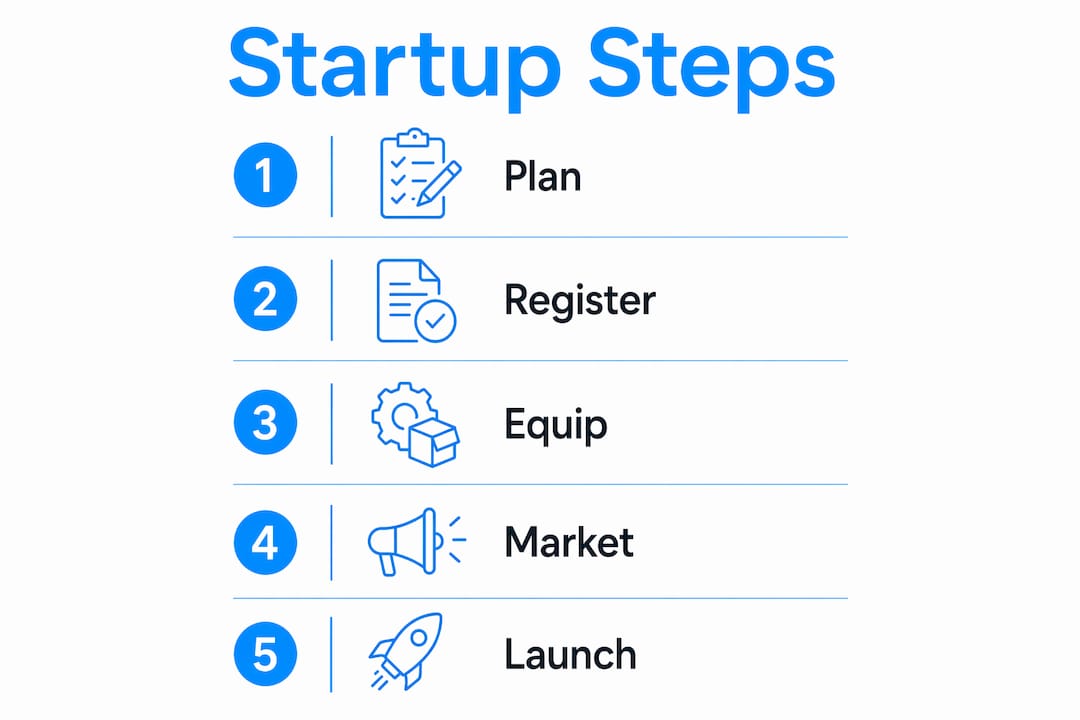
Step-by-step startup checklist for your first 6 months
Week 0–1: Legal foundation and first gear
- Choose a business name and check availability with your state’s secretary of state website.
- Select a business structure (most new walkers start as sole proprietors, then form an LLC once revenue grows).
- Get your EIN for free at IRS.gov — takes 10 minutes online.
- Open a business bank account to separate personal and business finances from day one. The SBA’s guidance on business banking walks you through what to look for.
- Buy liability insurance and bonding before your first walk.
- Purchase basic gear: leashes, waste bags, a first-aid kit, and a treat pouch.
- Build a simple one-page website with your services, service area, pricing, and a contact form.
Month 1: Operations and first clients
- Draft your client intake form (vaccination records, emergency contacts, vet info, behavioral notes).
- Write a service contract covering scope of service, cancellation policy, and payment terms.
- Set your pricing grid for 30-minute walks, 60-minute walks, and any add-ons.
- Establish a daily scheduling routine using a calendar or scheduling app.
- Secure your first 3–5 clients through personal outreach, neighborhood Facebook groups, or Nextdoor.
Months 2–6: Growth and direct client acquisition
- Shift from platform-dependent bookings to direct client relationships to protect your margins.
- Launch a referral program (a free walk or discount for every new client referred).
- Partner with local vets, groomers, and trainers for cross-referrals.
- Mix platform bookings with private clients as a bridge strategy while your reputation builds.
- Add a second service (pet sitting, pack walks, or a training add-on) to increase revenue per client.
Pro Tip: Your one-page website needs five things: a clear headline stating what you do and where, a services list with prices, a photo of you with dogs, a short bio, and a contact form. That’s it. Launch it before you spend a dollar on ads.
What does it actually cost to start, and what should you charge?
One-time startup costs include business registration fees, basic equipment such as leashes and bags, a simple website, branded materials like cards or flyers, and software trials or setup. These costs are generally low enough to allow launching without a business loan.
One-time costs are genuinely low compared to most small businesses. The typical range is $300–$700, which means you can launch without a business loan.
Monthly recurring expenses typically include liability insurance and bonding, scheduling software, fuel and mileage, phone plans, and bookkeeping tools. Total monthly costs generally remain affordable depending on your software choices and mileage.
Pricing benchmarks by market tier
| Market Type | 30-Minute Walk | 60-Minute Walk | Pack Walk (per dog) |
|---|---|---|---|
| Tier 1 (NYC, LA, SF, Chicago) | $30–$40 | $45–$80 | $20–$35 |
| Mid-size cities (Denver, Austin, Nashville) | $15–$30 | $30–$80 | $15–$30 |
| Smaller markets and suburbs | $15–$22 | $22 for a 30-minute walk | $12–$20 |
Simple profit model example: Say you’re in a mid-size market charging $22 for a 30-minute walk. You complete 6 walks per day, 5 days a week. That’s $660/week gross, or roughly $2,640/month before expenses. Subtract $250 in monthly costs and you net approximately $2,390. Add a second walker and double the volume — that’s when the business model gets interesting.
What legal and insurance steps protect your business?
Choosing a business structure
Most walkers start as sole proprietors because there’s no filing cost and setup is instant. The downside is personal liability: if a dog bites someone, your personal assets are exposed. Forming an LLC (typically $50–$150 in state filing fees) creates a legal separation between you and the business. Once you’re earning consistently and considering hiring, talk to an accountant about whether an S-corp election makes sense for tax savings on self-employment income.

Check your state’s licensing requirements at SBA.gov — some cities require a general business license even for solo service providers.
Tax basics for independent dog walkers
- EIN: Get one free from the IRS even as a sole proprietor — it keeps your Social Security number off client paperwork.
- Quarterly estimated taxes: The IRS expects self-employed owners to pay estimated taxes four times per year. Missing these triggers penalties.
- Mileage deduction: Track every business mile. The IRS standard mileage rate changes annually, and this deduction adds up fast for walkers covering multiple neighborhoods.
- Home office and phone: Proportional deductions are available if you use your home or phone for business.
Insurance and bonding
Pet-sitter liability insurance covers property damage, dog bites, and injuries that happen in your care. Bonding protects clients against theft by you or your employees — it’s a trust signal that serious operators carry. The Pet Sitters International directory and similar professional associations can point you toward vetted insurance providers. Budget $150–$400/year for a solid policy.
Local leash laws and waste-disposal ordinances vary by municipality, and failure to comply can trigger fines and even loss of business privileges. Build sanitation and leash protocols into your service agreement from day one.
Client contract and intake checklist
Every client relationship should start with a signed contract. At minimum, your intake process should collect:
- Proof of current vaccinations (rabies, distemper, bordetella)
- Emergency contact and vet contact with authorization to seek care
- Behavioral history (dog-reactive, resource-guarding, bite history)
- Owner-supplied equipment requirements (collar, harness, leash, muzzle if needed)
- Payment terms and cancellation policy
Contracts that require vaccination proof and emergency contacts reduce disputes and protect you legally if something goes wrong. Don’t skip this step even for friends and family.
Pro Tip: Add a “photo and social media consent” clause to your contract. Clients love seeing their dogs on your Instagram, and it doubles as free marketing — but you need written permission first.
How do you run daily operations efficiently?
A professional dog walking operation runs on systems, not memory. Here’s the daily workflow that keeps things tight:
Client intake → scheduling → routing → GPS check-in → walk notes and photo → invoice
That sequence should be non-negotiable from your first week. When it’s consistent, clients trust you. When it breaks down, you lose them.
What to look for in scheduling and routing software
Scheduling software with GPS check-ins and photo updates is now a standard client expectation, not a luxury. When evaluating tools, prioritize:
- Recurring booking support so clients don’t have to re-book every week
- Automated route optimization to reduce drive time between walks
- Staff assignment for when you hire additional walkers
- GPS check-in and check-out with timestamps clients can see
- Client-facing updates (photo, notes, map) sent automatically after each walk
- Integrated invoicing so payment collection is frictionless
Popular options in the pet care space include Time To Pet, Leashtime, and PetPocketbook. Compare features against your volume before committing to a paid plan.
Payment and bookkeeping
- Use a dedicated payment processor (Stripe, Square, or your scheduling software’s built-in payments) to keep records clean.
- Track every expense in a bookkeeping tool like QuickBooks Self-Employed or Wave from day one — not at tax time.
- Log mileage with MileIQ or a similar app every day. This is one of the most overlooked deductions for service-area businesses.
Safety and documentation
- Keep a dog medical info card for each client in your bag or phone, covering allergies, medications, and vet contact.
- Document any incident (dog altercation, injury, escape attempt) in writing within 24 hours and notify the client immediately.
- Take a photo at pickup and drop-off for every walk. This protects you if a client claims the dog was returned in poor condition.
Pro Tip: Set up a simple shared folder (Google Drive works fine) for each client with their intake form, contract, and vaccination records. When you hire your first walker, you can hand off a complete client file in minutes.
How do you get your first 50 clients and keep them?
Referral and neighborhood outreach
Referrals are the highest-converting channel in pet care. A client who was referred by a friend converts faster, complains less, and stays longer. Build a referral program from month one:
- Offer a free walk or $20 credit for every new paying client a current client refers.
- Ask for referrals explicitly after the first two weeks of service — that’s when clients are most satisfied.
- Door hangers and targeted yard signs in your service area work better than most paid ads for local dog walkers. Effective sign placement near dog parks, pet supply stores, and busy walking paths puts your name in front of the right people.
- Post in neighborhood Facebook groups and Nextdoor with a genuine introduction, not a sales pitch.
Online presence checklist
- Google Business Profile: Claim and complete it. This is where most local clients find you.
- Yelp listing: Add photos, respond to every review, and keep your hours accurate.
- Website with local SEO basics: Your city and neighborhood name should appear in your page title, meta description, and first paragraph.
- Instagram or Facebook: Post one photo or short video per day. Dogs are inherently shareable content.
For social media marketing tactics specific to pet businesses, the Thedoggurus blog has practical templates you can adapt immediately.
Local partnerships that generate steady referrals
- Veterinary clinics: Leave cards, offer to be their “trusted walker” recommendation for post-surgery recovery clients.
- Groomers and trainers: Cross-refer clients. A groomer who trusts you will send you business for years.
- Pet supply stores: Ask about bulletin board space or co-hosted events.
The power of networking in pet care is well documented — local reputation compounds faster than any paid channel.
Retention tactics that keep clients for years
- Subscription billing (monthly auto-pay for a set number of walks) reduces churn and smooths your cash flow.
- Walk packs (buy 10, get 1 free) reward loyalty and lock in future bookings.
- Consistent scheduling matters more than most owners realize. Clients who get the same walker at the same time every week cancel far less often.
- Proven customer retention strategies for small businesses — like personalized follow-ups and loyalty incentives — translate directly to pet care.
When should you hire, and how do you do it right?
Signs it’s time to bring someone on
You’re ready to hire when you’re turning away clients, working more than 35–40 walks per week solo, or when a single sick day means lost revenue. The break-even math is straightforward: if a new walker generates more revenue than their cost (wages, insurance, training time), hiring pays.
1099 contractors vs. W-2 employees
This is one of the most consequential decisions you’ll make. Here’s the honest trade-off:
1099 contractors cost less upfront — no payroll taxes, no benefits. But you have less control over how they work, and misclassifying an employee as a contractor carries IRS penalties.
W-2 employees give you more control over quality, scheduling, and brand standards. Employee-based teams tend to build stronger client retention and higher long-term business value, even though payroll overhead is real. If you want to build something sellable, the employee model is worth the cost.
Consult an employment attorney or HR professional before classifying anyone — the rules vary by state.
Hiring checklist
- Post a clear job description with physical requirements, schedule expectations, and pay range.
- Run a background check on every candidate (services like Checkr make this fast and affordable).
- Check references with a specific question: “Would you trust this person alone with your dog?”
- Conduct a trial walk with you present before assigning solo clients.
- Review your insurance policy to confirm it covers additional walkers.
Training curriculum basics
- Your walk SOP: leash protocols, pickup/drop-off procedure, photo requirements, and what to do if a dog escapes or is injured
- Client communication standards: what to say, what not to say, and how to handle complaints
- Emergency protocols: nearest emergency vet, how to reach you, and when to call 911
For a deeper look at building a support team in pet care, Thedoggurus has resources built specifically for this transition.
What actually separates high-retention dog walking businesses?
The operators who build durable, profitable businesses share a few habits that most guides don’t emphasize enough.
Integrating training into walks
Positive reinforcement integrated into daily walks — not sold as a separate training package — raises perceived value and keeps clients longer. Dogs that come home calmer and better-behaved generate word-of-mouth that no ad budget can match. A simple pilot: spend the first 5 minutes of each walk on a leash-manners exercise. Track client feedback over 60 days. If retention improves, build it into your standard service description and price accordingly.
For a practical framework on adding training revenue to your existing services, Thedoggurus covers the pricing and positioning in detail.
The employee vs. gig model decision
Operators who build employee-based teams consistently report stronger client relationships and higher business valuations than those who rely on gig contractors — the payroll overhead is real, but so is the compounding advantage of consistent, accountable walkers who clients know by name.
This isn’t a knock on the gig model for early-stage operators. It’s a warning that if you want to build something with enterprise value, the model you choose in year two shapes what you can sell or scale in year five.
Three KPIs to track from day one
- Client retention rate: What percentage of clients are still with you after 90 days? After 12 months? This is your single most important number.
- Average walks per client per month: Low numbers signal scheduling friction or dissatisfaction. High numbers signal loyalty.
- Cost per booked walk: Add up your monthly fixed costs plus mileage and divide by total walks completed. This tells you whether your pricing is actually sustainable.
Measuring these three metrics from the start gives you data to make pricing and routing decisions instead of guessing.
Key Takeaways
A professional dog walker business is genuinely launchable in week one for $300–$700, but sustainable income typically requires 6–18 months of consistent client-building and smart operational choices from the start.
| Point | Details |
|---|---|
| Startup cost is low | One-time costs run $300–$700; annual recurring expenses typically land at $700–$1,200. |
| Income ramp takes time | Plan for 6–18 months to reach stable income; bridge with platform bookings or pet sitting. |
| Legal and insurance basics are non-negotiable | Get your EIN free, form an LLC when revenue grows, and carry liability insurance before walk one. |
| Operations need systems, not memory | GPS check-ins, photo logs, and recurring billing are now standard client expectations. |
| Thedoggurus accelerates the learning curve | Thedoggurus provides courses, coaching, contract templates, and AI-powered tools built specifically for pet care business owners. |
What experienced owners wish they’d known before launching
The first 90 days of a dog walking business feel exciting. Days 91 through 180 are where most new owners hit their first real test: the referral pipeline slows, a key client cancels, or the physical grind of daily walks in bad weather starts to wear. That’s not failure — that’s the normal curve.
The owners who make it past month six share a few habits worth noting:
- They stopped relying on a single platform early. Gig platforms are a useful bridge, but building your business on someone else’s algorithm is a fragile foundation. Every month you delay moving clients to direct relationships is a month of margin you’re leaving behind.
- They set payment terms and enforced them. Chasing unpaid invoices from clients you like is demoralizing. Auto-pay or prepaid walk packs solve this before it becomes a problem.
- They kept their service area tight. Driving 45 minutes between walks destroys your hourly rate. The most profitable solo operators work a radius of 3–5 miles and fill it densely.
- They documented everything from day one. Incident reports, client notes, walk photos — operators who build this habit early have far fewer disputes and a much easier time training new hires later.
The realistic expectation: if you follow the checklist in this guide, stay consistent, and treat client relationships as your primary asset, you can build a sustainable dog walking business. It won’t happen in 30 days. It will happen in 12–18 months if you don’t quit at month four.
Thedoggurus gives pet care owners a faster path to a profitable business
Running a professional dog walking operation means managing clients, contracts, scheduling, marketing, and eventually a team — all at once. Thedoggurus is the platform built specifically for pet care business owners who want to do that without reinventing every system from scratch.
With Thedoggurus, you get expert-led courses covering operations, marketing, and profitability; ready-to-use contract templates and onboarding playbooks; AI-powered tools that act as a 24/7 business accountability partner; and staff training modules designed for multi-walker teams. The founders have built and run pet care businesses themselves, so the guidance is grounded in what actually works — not theory.
If you’re ready to cut your ramp time and build on proven systems, explore Thedoggurus plans and pricing to find the right fit for where you are right now.
Useful sources and next-step resources
Use these to go deeper on the legal, insurance, operational, and marketing topics covered above.
| Resource | Why It’s Useful |
|---|---|
| IRS EIN Application | Free, 10-minute online application for your Employer Identification Number |
| SBA Business Bank Account Guide | Explains what to look for when opening a dedicated business account |
| SBA State Licenses and Permits | Find your state’s specific licensing requirements for service businesses |
| Next Insurance: Dog Walking Legal Requirements | Covers leash laws, ordinances, and contract clauses specific to dog walkers |
| Pet Sitters International | Professional association with insurance referrals, certification, and industry standards |
| ZipRecruiter Dog Walker Salary Data | Current wage benchmarks by market to validate your pricing |
| Thedoggurus: Marketing for Pet Businesses | Tactical low-cost marketing templates built for pet care operators |
| Thedoggurus: Starting or Expanding Your Pet Business | Checklist for business setup and scaling decisions |
| Thedoggurus: Adding Enrichment Services | How to add value-add services that increase retention and per-client revenue |
| Thedoggurus Pricing and Plans | Primary resource for courses, coaching, and AI-powered tools for pet care owners |
Templates and checklists mentioned in this guide — including the client intake form, service contract outline, and walk SOP template — are available through Thedoggurus. Start with the pricing page to find the plan that fits your stage.