

Doggy daycare training is the process of teaching your dog the obedience, impulse control, and social skills needed to thrive in a supervised group environment. Without this preparation, even friendly dogs can struggle with the noise, excitement, and unpredictability of a daycare setting. The good news is that a focused training plan, built around proven canine behavior training techniques, makes a real difference. This guide covers the foundational skills your dog needs, what quality facilities do to keep dogs safe, and how you can prepare your dog step by step for a positive daycare experience.
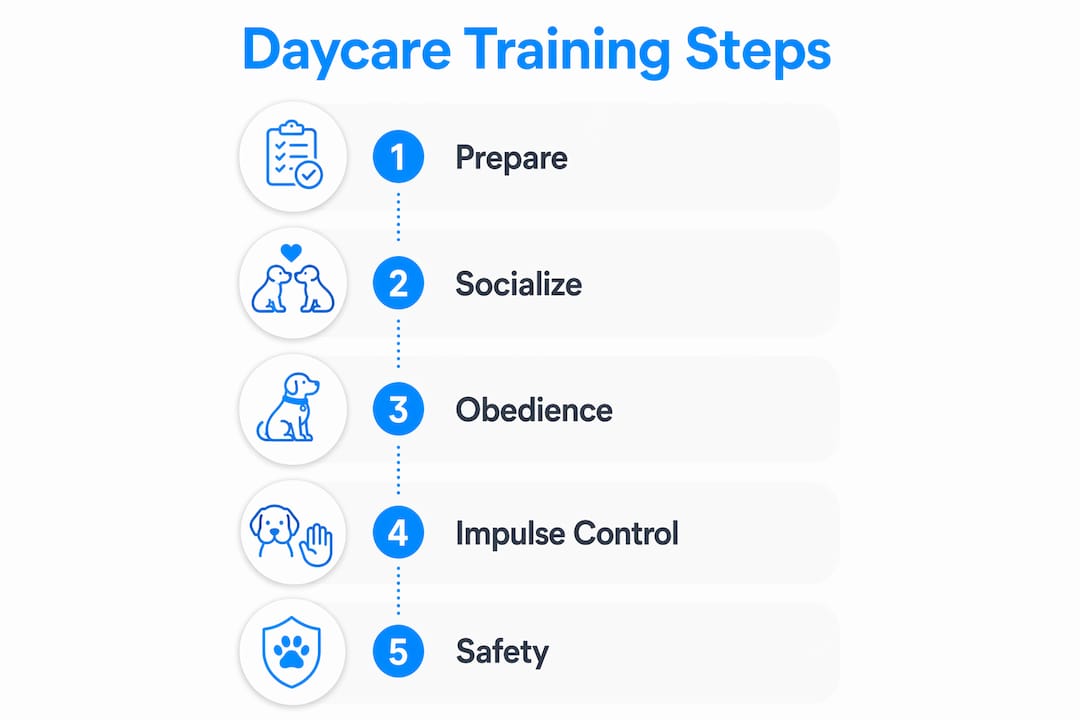
What doggy daycare training actually requires
Doggy daycare training, known in professional circles as canine behavior training for group environments, is not just about teaching your dog to sit. It is about building the self-control and social awareness your dog needs to function calmly around other dogs and unfamiliar people for hours at a time. Dogs that arrive at daycare without these skills often become overstimulated, reactive, or develop bad habits that are hard to reverse. The goal is a dog that can engage, disengage, and settle on cue.
The three core pillars are obedience, impulse control, and appropriate social behavior. Obedience gives staff the tools to manage your dog safely. Impulse control prevents the frantic energy that leads to rude play or conflict. Social skills teach your dog how to read and respond to other dogs without escalating tension.
What foundational skills should dogs learn before daycare?
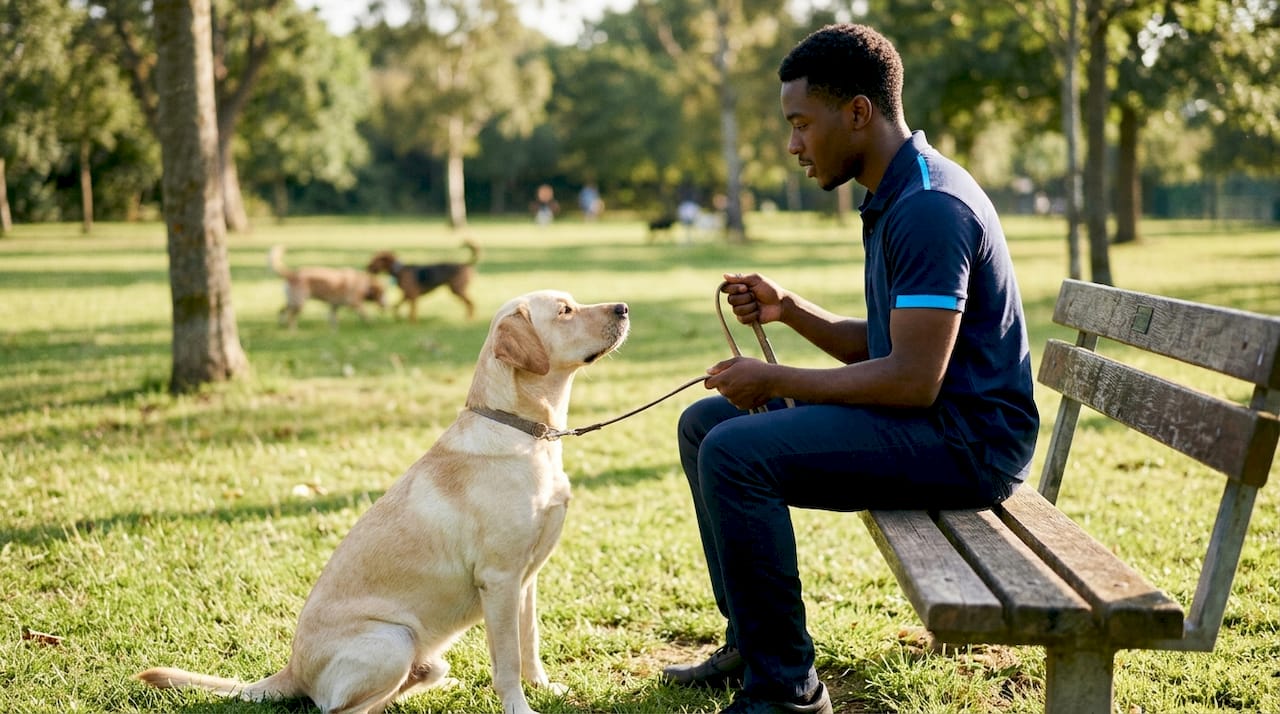
The skills your dog needs before daycare entry are specific and measurable. Pre-daycare training should include holding a “sit” or “down” for 10–30 seconds amid distractions, calm leash walking, and a reliable “place” command for settling. These are not optional extras. They are the baseline that allows daycare staff to manage your dog safely during transitions, drop-offs, and group play breaks.
Here are the foundational skills to build before your dog’s first day:
- Sit and down with duration. Your dog should hold either position for 10–30 seconds while other dogs or people move nearby. This builds the impulse control that prevents chaotic greetings at drop-off.
- Calm leash walking. The walk to and from the facility sets the tone for your dog’s entire day. A dog that arrives already amped up from pulling on leash is harder to settle into a group.
- The “place” command. This is the most underused skill in daycare prep. Teaching your dog to go to a mat or bed and stay there gives staff an off-switch for high-energy moments. Without this kind of “off-switch” skill, daycare can make high-energy dogs harder to manage at home.
- Recall and disengagement. Your dog needs to come when called, even mid-play. A solid recall lets staff interrupt play before it escalates.
- Appropriate play behaviors. Dogs should know how to take breaks, respond to calming signals from other dogs, and avoid mounting, body-slamming, or pinning.
Pro Tip: Practice the “place” command in busy environments like a park or pet store before daycare starts. If your dog can settle on a mat with distractions around them, they are ready for the daycare floor.
Puppy socialization classes are a proven starting point for younger dogs. Structured puppy programs like the AKC S.T.A.R. Puppy program run 6–8 weeks with weekly 60-minute classes for dogs from 8 weeks to 12–16 months old. That structure builds exactly the social confidence and basic obedience daycare requires.
How do professional daycare facilities train staff and maintain safety?
The quality of a daycare facility depends far more on its staff than on its square footage or amenities. Safety depends on staff-to-dog ratios and staff skill in reading dog behavior, not on facility size. A beautiful facility with undertrained staff is a liability. A modest facility with expert, certified staff is where your dog is actually safe.
Staff-to-dog ratios by facility type
| Facility Type | Recommended Ratio |
|---|---|
| Indoor facilities | 1:6 to 1:8 |
| Mixed indoor/outdoor | 1:8 to 1:10 |
| Outdoor facilities | 1:10 to 1:15 |
| Puppies and special needs | 1:4 to 1:8 |
Staff-to-dog ratios vary by facility type, generally ranging from 1:6 to 1:15. Puppies and special needs dogs require tighter supervision, typically 1:4 to 1:8, because their play is more unpredictable and their vulnerability to injury is higher.
Certified staff should hold credentials in canine first aid, CPR, and behavior assessment. Reading canine body language in real time is the single most critical skill for preventing incidents. Staff who can spot a dog shifting from play to stress, or recognize a freeze before a snap, stop problems before they start. Thedoggurus covers this in depth through its group play safety standards resources for facility professionals.
Pro Tip: Before enrolling your dog, ask the facility three questions: What is your staff-to-dog ratio? What certifications do your staff hold? What is your emergency protocol? Transparency on these points is a reliable indicator of facility quality.
Continuing education and facility accreditation separate good daycares from great ones. Staff should receive ongoing training, not just a one-time orientation. Ask whether the facility has a written operations manual and whether staff are trained on behavior assessment protocols, not just feeding schedules.
Step-by-step guide: preparing your dog for daycare
Preparation works best when it follows a clear sequence. Rushing your dog into daycare before they are ready creates stress for your dog, the staff, and the other dogs in the group. Here is a practical sequence that works.
Build basic obedience at home first. Spend two to four weeks on sit, down, stay, and recall before you even visit a facility. Use short, five-minute sessions twice a day. Consistency at home creates the foundation that transfers to new environments.
Practice calm transitions on leash. Walk your dog past busy places, like a shopping center or a dog-friendly store, and reward calm behavior. The goal is a dog that can walk into a new building without losing their mind at the door.
Introduce the “place” command with duration. Start with your dog’s mat at home, then move the mat to different rooms, then to different locations outside. Build up to 10–30 seconds of calm settling with mild distractions present.
Enroll in puppy socialization classes or a group obedience class. Group classes teach your dog to focus on you even when other dogs are nearby. That focus is exactly what daycare staff need from your dog during transitions and play breaks.
Schedule a trial visit at the facility. Most quality daycares offer a temperament assessment or a short trial day. Use this to observe how your dog responds and to ask staff what they noticed about your dog’s behavior.
Align your home training with the facility’s methods. Ask the daycare what cues they use and what their daily routine looks like. Consistency across home and daycare settings, including routines like scheduled naps and structured breaks, builds a calm, well-behaved companion. When your dog hears the same cues and follows the same structure in both places, behavior improves faster.
Pro Tip: Some facilities offer “transfer sessions” where a trainer teaches you how to maintain the behaviors your dog is learning at daycare. Ask about this option. It is one of the most effective ways to get lasting results from daycare training programs.
Common challenges during daycare training and how to fix them
Even well-prepared dogs hit bumps. Knowing what to expect helps you respond quickly instead of assuming the worst.
- Over-arousal at drop-off. Your dog barks, lunges, or spins when you arrive at the facility. The fix is practicing calm arrivals at home. Walk up to the door, ask for a sit, reward calm behavior, then enter. Repeat this pattern until arrival becomes a cue for calm, not excitement.
- Excessive barking during play. Unstructured daycare settings can reinforce barking as a way to get attention or invite play. Rewards-based training integrated into daycare prevents this habit from forming. Ask whether the facility uses structured play breaks and redirection, not just free-for-all play.
- Post-daycare nipping or hyperactivity at home. This is a sign of overstimulation, not bad character. Your dog spent hours in a high-stimulus environment and has not yet learned to self-regulate. Build a quiet decompression routine at home after pickup: a calm walk, a chew, or time on their mat.
- Inconsistent behavior between home and daycare. Your dog listens at daycare but ignores you at home, or vice versa. This happens when the cues, rules, and expectations differ between the two environments. Reinforcing behavior across both settings closes that gap.
“Daycare should be viewed as a supervised learning environment, not just a place to burn energy. When play is combined with structured training, dogs build better habits and owners see real, lasting behavior change at home.”
When challenges persist despite consistent effort, a certified professional trainer is the right next step. Look for trainers who use positive reinforcement methods and who have experience with group environments specifically. Thedoggurus offers leadership resources for playgroups that help both owners and facility staff understand how to guide dog behavior in group settings.
Key Takeaways
Effective doggy daycare training requires foundational obedience, consistent routines across home and facility, and certified staff who can read canine behavior in real time.
| Point | Details |
|---|---|
| Build skills before enrollment | Teach sit, down, place, and recall at home before your dog’s first daycare day. |
| Match home and facility training | Use the same cues and routines the daycare uses to speed up lasting behavior change. |
| Verify staff credentials | Ask about certifications, ratios, and emergency protocols before choosing a facility. |
| Manage post-daycare energy | Build a calm decompression routine at home to prevent overstimulation behaviors. |
| Use structured programs | Puppy socialization classes and group obedience training build the social focus daycare requires. |
What I have learned from watching dogs succeed and struggle at daycare
Most owners I talk to think daycare is a solution to a training problem. They figure that if their dog plays with other dogs all day, the energy and the bad behavior will sort themselves out. That is not how it works. Daycare without training is just supervised chaos. The dogs that thrive are the ones whose owners did the work first.
The single biggest predictor of daycare success is not breed, age, or energy level. It is whether the dog has a reliable “off-switch.” Dogs that can settle on cue, even briefly, give staff the control they need to manage a group safely. Dogs without that skill become the ones staff are constantly managing, which is stressful for everyone.
The other thing I have seen consistently is that owners underestimate how much the facility’s staff quality matters. A dog can be perfectly trained and still have a bad experience if the staff cannot read the room. Certified staff who understand canine body language catch problems at the warning sign stage, not after a fight has already started. That skill is worth more than any amenity a facility can offer.
My honest advice: treat daycare prep the same way you would treat any new social situation for your dog. Build the skills, visit the facility first, ask hard questions about staff training, and stay consistent at home. The dogs that do best at daycare are the ones whose owners stayed engaged, not the ones who dropped off and hoped for the best.
— Oliver
How Thedoggurus helps you build a better daycare experience
Running a dog daycare or preparing your dog for one takes more than good intentions. It takes proven systems, trained staff, and the right guidance at every stage.

Thedoggurus is built for exactly this. Whether you are a dog owner looking for expert-backed training guidance or a daycare professional building a safer, more effective program, Thedoggurus brings together expert-led content, coaching, and practical tools in one place. From group play safety standards to staff accountability systems, the resources are grounded in real experience from people who have built and run pet care businesses. Visit Thedoggurus to find the training support that fits your situation.
FAQ
What is doggy daycare training?
Doggy daycare training is the process of teaching a dog obedience, impulse control, and social skills so they can function calmly and safely in a supervised group daycare environment.
What skills does my dog need before starting daycare?
Your dog should reliably hold a sit or down for 10–30 seconds amid distractions, walk calmly on leash, respond to a recall, and settle on a “place” cue before their first daycare day.
How do I know if a daycare facility is safe?
Ask about staff-to-dog ratios, staff certifications in canine first aid and behavior assessment, and the facility’s emergency protocol. Quality facilities are transparent about all three.
Why does my dog misbehave at home after daycare?
Post-daycare hyperactivity or nipping is usually a sign of overstimulation. Build a calm decompression routine after pickup, such as a quiet walk or time on a mat, to help your dog regulate.
How long does it take to prepare a dog for daycare?
Most dogs benefit from two to four weeks of focused home training before their first daycare visit. Puppies enrolled in structured programs like the AKC S.T.A.R. Puppy class typically complete a 6–8 week foundation course before group daycare is appropriate.
Recommended
- Crafting an Effective Enrichment Schedule for Your Doggie Daycare – The Dog Gurus
- Ensuring Safe and Joyful Play: Dog Daycare Group Play Safety Standards – The Dog Gurus
- How Does Your Dog Daycare Compare to the Others in the Industry? – The Dog Gurus
- Enhancing Staff Accountability in Pet Boarding and Daycare: The Operations Manual Advantage – The Dog Gurus