

Your dog daycare service agreement is the single document that protects your facility, your staff, and every pet in your care. Copy the template below, customize the bracketed fields, and you have a legally defensible contract ready to deploy today.
Before you scroll to the full text, here are the must-have items every US dog daycare and boarding contract needs:
- Vaccination proof: Rabies, Distemper/Parvo (DA2PP), and Bordetella required before the first visit, with a vet-signed certificate or clinic printout on file
- Owner duty to disclose: An explicit warranty covering prior bites, aggression incidents, and known health conditions, with owner initials required on this clause
- Emergency veterinary authorization: Written permission for your facility to arrange emergency care when the owner is unreachable, with all costs the owner’s responsibility
- Payment, deposits, and cancellation terms: Clear fee schedules, deposit forfeiture rules, and notice windows (24 hours for daycare, 72 hours for overnight boarding)
- Liability waiver and indemnification: Assumption-of-risk language paired with a separate initialing requirement to strengthen enforceability
- Right to refuse and termination: Your facility’s right to decline or end service for health, behavior, or safety reasons, with a documented reason on file
- Dispute resolution: Mediation first, then binding arbitration, with a named state jurisdiction
Pro Tip: Save your agreement in both Word (.docx) and PDF formats. Use an e-sign platform such as DocuSign, PandaDoc, or HelloSign to collect signatures digitally and link the signed document directly to your booking or POS system.
Table of Contents
- What should your dog daycare service agreement include?
- What does each clause actually do for your business?
- What legal issues should you expect an attorney to flag?
- How do you roll out a new contract to your clients?
- What should you collect before a dog’s first visit?
- Key Takeaways
- Why most daycare contracts fail before they are ever tested
- Thedoggurus gives you the templates and training to back them up
- Useful sources for building your dog daycare contracts
What should your dog daycare service agreement include?
A solid dog daycare contract covers every scenario that creates liability: a dog that bites, an owner who never picks up, a missed cancellation, and an emergency vet visit at midnight. The template below is organized into numbered sections so you can paste it directly into Word or upload it to your e-sign platform. Replace every bracketed field with your facility’s specifics.

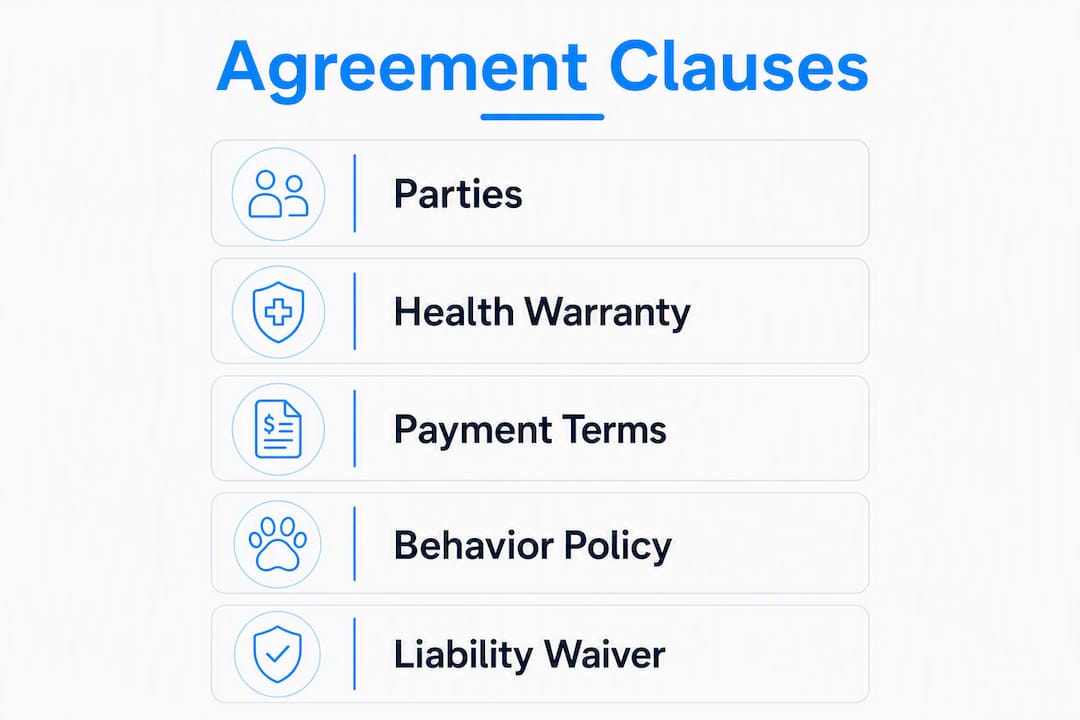
Full fill-in-the-blank service agreement
DOG DAYCARE AND BOARDING SERVICE AGREEMENT
Effective Date:
SECTION 1 — PARTIES AND SCOPE
This Dog Daycare and Boarding Service Agreement (“Agreement”) is entered into by and between:
Facility: [Facility Legal Name], located at [Street Address, City, State, ZIP] (“Facility”)
Owner: [Owner Full Legal Name], residing at [Street Address, City, State, ZIP] (“Owner”)
Pet(s) Covered: [Pet Name(s), Breed(s), Age(s), Weight(s)]
This Agreement governs all services provided by the Facility to the Owner, including but not limited to dog daycare, overnight boarding, grooming, enrichment sessions, and any ancillary services selected at intake.
SECTION 2 — SERVICES PROVIDED
The Facility will provide the following services as selected and paid for by the Owner:
- Dog Daycare: Supervised group or semi-group play during standard business hours ([Opening Time] to [Closing Time])
- Overnight Boarding: Supervised care from [Check-In Time] to [Check-Out Time] the following day
- Grooming: [Describe grooming services offered, if applicable]
- Enrichment / Quick Train Sessions: Treat-based group enrichment activities led by staff during daycare; Owner consent is required and is granted by signing this Agreement unless Owner opts out in writing at intake
For enrichment sessions, the Facility uses. If your pet has a known food allergy, note it in Section 2a below and the Facility will exclude your pet from treat-based activities.
Section 2a — Allergy / Dietary Notes: _______________________________________________
SECTION 3 — ADMISSION CRITERIA AND VACCINATION REQUIREMENTS
Admittance to the Facility is conditioned on the following, without exception:
- Rabies: Current vaccination, verified by a vet-signed certificate
- Distemper/Parvo (DA2PP): Current vaccination, verified by a vet-signed certificate
- Bordetella: Current vaccination administered no fewer than [5–7] days prior to the first visit, verified by a vet-signed certificate
Owner warrants that all vaccination records provided are accurate and current. Expired or unverifiable records are grounds for immediate refusal of admittance. The Facility reserves the right to request updated records at any time.
Owner Initials (Vaccination Warranty): _______
SECTION 4 — OWNER REPRESENTATIONS AND DUTY TO DISCLOSE
Owner represents and warrants that, to the best of Owner’s knowledge:
- Owner is the legal owner or authorized agent of the pet(s) listed above.
- The pet(s) have no known history of biting, unprovoked aggression, or attacks on people or other animals, except as disclosed here: _______________________________________________
- The pet(s) are in good general health and free from any contagious illness or condition.
- All information provided on this Agreement and any intake form is accurate and complete.
Owner acknowledges that providing false or incomplete information is a material breach of this Agreement and may result in immediate termination of services and Owner’s liability for any resulting damages.
Owner Initials (Duty to Disclose): _______
SECTION 5 — PAYMENT, DEPOSITS, CANCELLATION, AND FEES
5.1 Rates: Current service rates are posted at the Facility and on the Facility’s website. Rates are subject to change with [30] days’ written notice.
5.2 Deposit: A deposit of [$X or X% of total estimated charges] is required to confirm overnight boarding reservations. Deposits are non-refundable if the reservation is cancelled outside the notice window in Section 5.3.
5.3 Cancellation Notice:
- Daycare: [24] hours’ notice required. Cancellations with less notice forfeit any prepaid session fee.
- Overnight Boarding: [72] hours’ notice required. Late cancellations forfeit the deposit.
- Holiday Periods: [Specify holiday windows, e.g., Thanksgiving week, Christmas week]. A minimum stay of [X nights] is required; full payment is due at booking and is non-refundable.
5.4 No-Show: Failure to arrive without notice forfeits the full session or deposit.
5.5 Late Pickup / Overstay: Dogs not collected by [Closing Time] will be charged a late fee of [$X per 15 minutes or $X flat fee per hour]. If a dog remains past [X minutes after closing], the Facility will automatically convert the stay to overnight boarding at the standard boarding rate, and Owner authorizes this conversion by signing this Agreement.
Owner Initials (Late Pickup / Automatic Boarding Conversion): _______
SECTION 6 — BEHAVIOR POLICY AND REFUSAL OF SERVICE
6.1 Behavior Standards: All pets must demonstrate behavior compatible with group care. The Facility uses a graduated response:
- Warning: Owner is notified of a behavior incident; pet may be separated from the group.
- Probation: Repeated incidents result in a probationary period with restricted group access.
- Dismissal: A bite that breaks skin, an unprovoked attack, or repeated aggression after probation results in permanent termination of services.
6.2 Bite Incidents: Any bite that breaks skin requires the pet to be quarantined per applicable state law, and Owner must provide proof of a veterinary examination within [48] hours. Owner is responsible for all costs associated with the incident, including medical care for any injured party.
6.3 Right to Refuse: The Facility reserves the right to refuse admittance or terminate services at any time, for any reason related to the health, safety, or well-being of any pet, staff member, or other client. The Facility will document the reason for refusal in writing.
Owner Initials (Behavior Policy and Right to Refuse): _______
SECTION 7 — EMERGENCY VETERINARY CARE AUTHORIZATION
If the Owner is unreachable and the Facility determines that a pet requires emergency veterinary care, Owner hereby authorizes the Facility to:
- Transport the pet to [Owner’s Veterinarian of Record: Name, Address, Phone] or, if unavailable, to the nearest emergency veterinary clinic.
- Authorize triage, stabilization, and necessary treatment on Owner’s behalf.
- Incur reasonable veterinary expenses on Owner’s behalf.
Owner is solely responsible for all veterinary costs incurred under this authorization. The Facility will make reasonable efforts to reach Owner before authorizing non-emergency procedures. The Facility is not liable for the outcome of any emergency treatment.
Emergency Contact: [Name, Relationship, Phone Number]
Veterinarian of Record: [Clinic Name, Address, Phone]
Owner Initials (Emergency Vet Authorization and Payment Responsibility): _______
SECTION 8 — LIABILITY WAIVER, ASSUMPTION OF RISK, AND INDEMNIFICATION
Owner acknowledges that group dog care involves inherent risks, including but not limited to injury from other animals, illness, escape, and property damage. Owner voluntarily assumes all such risks.
To the fullest extent permitted by applicable law, Owner releases, waives, and discharges the Facility, its owners, officers, employees, and agents from any and all claims, demands, damages, losses, or liabilities arising out of or related to the care of Owner’s pet(s), except in cases of gross negligence or willful misconduct.
Owner agrees to indemnify and hold harmless the Facility from any third-party claims arising from the actions of Owner’s pet(s) while in the Facility’s care.
Owner Initials (Liability Waiver and Indemnification): _______
SECTION 9 — ABANDONMENT
If Owner fails to collect the pet(s) and makes no contact with the Facility for [7] consecutive days after the scheduled pickup date, the Facility may declare the pet(s) abandoned. The Facility will make reasonable attempts to contact Owner and the emergency contact on file.
Following a declaration of abandonment, the Facility may:
- Continue to board the pet(s) and charge Owner for all accrued costs.
- Transfer the pet(s) to a licensed rescue organization or animal control authority.
- Pursue legal remedies to recover outstanding fees.
All abandonment procedures will comply with applicable state law. Owner is responsible for all costs incurred from the scheduled pickup date through disposition.
Owner Initials (Abandonment Clause): _______
SECTION 10 — CONFIDENTIALITY AND DATA HANDLING
The Facility collects Owner’s personal information (name, address, phone, email, payment method) and pet health records solely for the purpose of providing services. The Facility will not sell or share this information with third parties except as required by law or as necessary to provide emergency veterinary care.
By signing this Agreement, Owner consents to receive service-related communications via email and SMS. Owner may opt out of marketing communications at any time by notifying the Facility in writing.
SECTION 11 — DISPUTE RESOLUTION AND GOVERNING LAW
The parties agree to resolve any dispute arising under this Agreement first through good-faith mediation. If mediation does not resolve the dispute within [30] days, the parties agree to binding arbitration administered by in [City, State]. This Agreement is governed by the laws of the State of [State].
SECTION 12 — ENTIRE AGREEMENT AND AMENDMENTS
This Agreement constitutes the entire agreement between the parties and supersedes all prior understandings. Amendments must be in writing and signed by both parties. The Facility will notify Owner of material policy changes with [30] days’ written notice, and continued use of services constitutes acceptance.
SECTION 13 — SIGNATURES
By signing below, Owner confirms they have read, understood, and agreed to all terms of this Agreement.
High-Risk Clause Initials Summary (Owner must initial each line):
Pro Tip: Print a two-sided version with the initials summary on page one and the full agreement on page two. Clients who see the initials block first read the contract more carefully.
What does each clause actually do for your business?
Understanding the purpose behind each section helps you adapt the language without accidentally weakening your protection. Here is a clause-by-clause breakdown.
Parties and scope
Naming the facility’s legal entity (not just a trade name) and the exact services covered prevents disputes about what was and was not agreed to. If you operate daycare, boarding, and grooming under one roof, list all three. Ambiguity here is the most common reason contracts fail in small-claims court.
Vaccination and health warranty
Standard practice across operator templates is to require vet-signed vaccination records for Rabies, Distemper/Parvo, and Bordetella before admittance. The warranty language puts the legal burden on the owner if records turn out to be false. Requiring initials on this clause signals active acknowledgement, not just passive signature.
Owner duty to disclose
This is the single most important clause in your contract. An explicit warranty about prior bites and aggression history protects your facility because it shifts liability when an owner conceals a known risk. Practitioner templates consistently require owners to initial this section separately. A dog with an undisclosed bite history that injures another pet or a staff member creates a very different legal situation when the owner has signed a warranty of accuracy.
Admission, refusal, and termination
Industry templates consistently give facilities the right to decline service for any safety-related reason and require documentation of the refusal. Your staff should log the date, the reason (expired vaccines, observed aggression, incomplete records), and the staff member’s name. That paper trail matters if an owner disputes the refusal.
Payment, deposits, cancellation, and late pickup
Sample templates show 24-hour notice for daycare and 72-hour notice for overnight boarding, with deposit forfeiture for late cancellations. The automatic boarding conversion clause is especially worth including: if a dog is still at your facility at 7:30 PM and your closing time is 7:00 PM, the conversion clause prevents a staff member from being held hostage waiting for an owner who is not responding.
Emergency veterinary authorization
Operator forms authorize transport, triage, and treatment when the owner is unreachable, and place all costs on the owner. Name the owner’s vet of record in the clause. If that clinic is closed, the facility is authorized to use the nearest emergency clinic. The key phrase is “Owner is solely responsible for all veterinary costs” — make it a standalone sentence, not buried in a paragraph.
Liability waiver and indemnification
A waiver is only as strong as its presentation. Best-practice templates separate the waiver from the general contract body and require a separate initials line. No waiver eliminates liability for gross negligence, so pair yours with adequate facility insurance and documented staff training. The waiver reduces exposure; it does not replace operational safety.
Behavior policy and consequences
A graduated response (warning, probation, dismissal) gives you a defensible process. The bite protocol is the most critical piece: specify that a bite breaking skin triggers quarantine per state law and requires a vet exam within 48 hours at the owner’s expense. Vague language like “we may take action” creates room for argument. Specific language closes it.
Abandonment clause
Abandonment clauses must match your state’s animal abandonment statutes and set a clear threshold, such as 7 days of no contact, before the facility can act. Include the disposition options your state permits: transfer to a licensed rescue, surrender to animal control, or legal sale to recover costs. Never draft this clause without checking your state’s specific statute.
Data protection and confidentiality
Collect only what you need: name, address, phone, email, payment method, and pet health records. State clearly that you will not sell this data. SMS and email opt-in consent language protects you under the Telephone Consumer Protection Act (TCPA) if you send appointment reminders or promotional messages. Structurally similar confidentiality clauses from service contract templates provide a useful model for this section.
Dispute resolution and jurisdiction
Mediation first, then binding arbitration, is the standard approach. Specify the arbitration body (the American Arbitration Association is widely recognized) and the venue city and state. Avoid forum-selection language that requires an owner in your city to arbitrate in another state — courts in many states will void it as unconscionable.
Comparison: clause risk levels and recommended owner initials
| Clause | Risk Level | Owner Initials Required? |
|---|---|---|
| Vaccination warranty | High | Yes |
| Duty to disclose | High | Yes |
| Late pickup / auto boarding conversion | Medium | Yes |
| Behavior policy and right to refuse | High | Yes |
| Emergency vet authorization | High | Yes |
| Liability waiver and indemnification | High | Yes |
| Abandonment | High | Yes |
| Payment and cancellation | Medium | Optional |
| Data handling | Low | No |
Pro Tip: Write every clause in plain, short sentences. Courts are more likely to enforce language that a reasonable person can understand on a first read. If a clause takes more than three sentences to explain, break it into numbered sub-points.
What legal issues should you expect an attorney to flag?
This template is a strong operational starting point, not a substitute for legal review. Here are the issues attorneys most commonly revise in pet care service agreements.
Overly broad waivers. A waiver that attempts to release the facility from all liability, including its own negligence, is unenforceable in most states. Limit the waiver to inherent risks of group dog care and exclude gross negligence and willful misconduct. That language is already in the template above.
Ambiguous abandonment clauses. State abandonment statutes vary significantly. Some states require specific written notices before a facility can transfer or sell an animal. Your attorney will check whether your threshold (7 days) and disposition options comply with your state’s law.
Unconscionable cancellation penalties. A cancellation fee that equals the full cost of a multi-week boarding stay may be challenged as a penalty rather than a legitimate liquidated damages clause. Your attorney will assess whether your fee formula is proportionate.
Jurisdiction and choice-of-law clauses. A clause requiring arbitration in a distant city or applying another state’s law may be unenforceable against a local consumer. Keep jurisdiction in your facility’s home state and city.
Insurance alignment. Your contract should ask owners to disclose any pet insurance their dog carries. Include your facility’s insurance policy number in the agreement so owners and their insurers can coordinate claims efficiently. For a deeper look at what coverage your facility needs, dog daycare insurance guidance covers the key policy types.
Pro Tip: Maintain a dated version history of your contract. When you update terms, save the old version with a version number and date. Require clients to re-sign only when material terms change, such as fee schedules, cancellation windows, or behavior policy. A signed version history protects you if a client claims they were not notified of a change.
This article provides general operational information, not legal advice. Have your final contract reviewed by a licensed attorney in your state before deploying it to clients.
How do you roll out a new contract to your clients?
Customizing the template is the easy part. Getting every current and future client signed is where most operators stall. Here is a practical rollout sequence.
Set your jurisdiction and fee variables first. Fill in your state, city, cancellation windows, deposit amounts, late fees, and holiday minimum-stay rules before sharing the document with anyone. A contract with blank fields looks unprofessional and creates enforceability questions.
Choose your emergency vet protocol. Decide whether you will always use the owner’s vet of record first or default to a specific emergency clinic. Name that clinic in your template so staff do not have to make that decision at 11 PM.
Select your e-sign workflow. Platforms like DocuSign, PandaDoc, and HelloSign all support fillable fields and signature blocks. Link the signed PDF to your client record in your booking or POS system. If you use paper, scan and store the signed copy in a dedicated folder organized by client last name.
Update your intake form to match. Your intake form and your contract should ask for the same information: vaccination dates, microchip number, bite history, emergency contact, and vet of record. Mismatches between the two create confusion at the front desk.
Train your intake staff on three things: how to verify vaccination certificates (vet signature, date, and pet name must match), how to flag an undisclosed aggression history, and how to document a refusal. Staff accountability practices that connect contract acceptance to daily operations make enforcement consistent.
Communicate the change to existing clients. Send a brief email explaining that you have updated your service agreement, what changed, and the deadline to re-sign. Offer a 30-day grace period for existing clients. Require re-signing only for material changes.
Pilot with new clients for 30 days. Before rolling out to your full existing client base, run the new contract with every new client for one month. You will catch friction points (a confusing clause, a missing field, a step your staff skips) before they affect long-term relationships.
Pro Tip: Add a short one-paragraph plain-language summary at the top of your contract, above Section 1. Something like: “This agreement covers our vaccination requirements, payment terms, behavior policy, and what happens in an emergency. Please read it carefully and initial each highlighted section.” Clients who understand what they are signing are far less likely to dispute it later.
What should you collect before a dog’s first visit?
Your contract is only as strong as your intake process. Here is the checklist your front-desk staff should run through before any dog’s first day.
- Owner contact information: Full legal name, address, phone (primary and secondary), and email
- Proof of identity: Driver’s license or government-issued ID on file
- Emergency contact: Name, relationship, and phone number (someone other than the owner)
- Veterinarian of record: Clinic name, address, and direct phone number
- Vaccination certificates: Vet-signed records for Rabies, Distemper/Parvo (DA2PP), and Bordetella, with dates confirming current status
- Signed service agreement: All sections completed, all high-risk clauses initialed
- Signed emergency care authorization: Confirmed in the agreement and verbally acknowledged at intake
- Medication instructions: Any current medications, dosage, and administration schedule
- Feeding and allergy notes: Feeding schedule, food brand, and any known allergies (especially relevant for enrichment sessions using treats)
- Temperament and behavior history: Prior bites, aggression incidents, fear triggers, and socialization history
- Payment method on file: Credit card, ACH, or account credit confirmed before the first visit
Operational red flags to act on immediately:
- Expired or photocopied vaccination records without a vet signature
- Owner discloses a bite history not noted on the agreement
- Emergency contact number is the same as the owner’s (no backup)
- Incomplete allergy information when the dog is enrolled in enrichment sessions
When you refuse first-day admittance, document the reason in writing, note the staff member’s name and the date, and give the owner a written explanation. That record protects you if the owner disputes the refusal.
Intake field to required evidence
| Intake Field | Required Evidence |
|---|---|
| Rabies vaccination | Vet-signed certificate with date and pet name |
| Distemper/Parvo (DA2PP) | Vet-signed certificate with date and pet name |
| Bordetella | Vet-signed certificate, administered 5–7 days before first visit |
| Bite/aggression history | Owner written disclosure in Section 4 of the agreement |
| Emergency contact | Name, relationship, and phone number distinct from owner |
| Veterinarian of record | Clinic name, address, and direct phone |
| Microchip number | Owner-provided or confirmed at intake scan |
| Allergy information | Written note in Section 2a of the agreement |
| Payment method | Card on file or confirmed account credit |
Store scanned vaccination certificates in your client management system alongside the signed agreement. Most state veterinary boards recommend retaining pet health records for a minimum of three years; check your state’s specific guidance for the exact retention period.
Key Takeaways
A legally defensible dog daycare service agreement requires vaccination proof, owner duty-to-disclose initials, emergency vet authorization, and clear payment terms before a dog’s first visit.
| Point | Details |
|---|---|
| Require initials on high-risk clauses | Owner initials on the waiver, abandonment, emergency care, and duty-to-disclose sections strengthen enforceability. |
| Three vaccines before admittance | Rabies, Distemper/Parvo (DA2PP), and Bordetella must be current and vet-signed before any dog enters your facility. |
| Cancellation windows by service type | Use 24-hour notice for daycare and 72-hour notice for overnight boarding, with deposit forfeiture for late cancellations. |
| Match abandonment language to state law | Set a clear threshold (7 days of no contact) and confirm disposition options comply with your state’s animal abandonment statute. |
| Thedoggurus supports full implementation | Thedoggurus provides contract templates, staff training modules, and operational tools to help you deploy and enforce your agreement consistently. |
Why most daycare contracts fail before they are ever tested
The contract itself is rarely the problem. The problem is how it gets used, or more accurately, how it does not.
Most operators write a solid agreement, get it signed at intake, and then file it somewhere it is never seen again. The first time a dog bites another dog, or an owner disputes a late-pickup charge, or a pet is left uncollected for two weeks, the contract gets pulled out and everyone discovers that the staff member who handled intake skipped the initials block, or the emergency contact number is disconnected, or the abandonment clause references a state statute that was amended two years ago.
The clauses that protect you most, the duty-to-disclose warranty, the emergency authorization, the abandonment threshold, are also the ones owners are most likely to skim past if your intake process does not require active engagement. Requiring initials on each high-risk clause is not bureaucratic overhead. It is the difference between a clause that holds up and one that an owner’s attorney argues was buried in fine print.
There is also a common mistake around enforcement consistency. A cancellation policy that gets waived for a favorite client three times in a row is no longer a policy. It is a suggestion. When you enforce it against a different client, you have a problem. Your contract is only as strong as your willingness to apply it the same way every time, and that requires staff who understand why each clause exists, not just that it exists.
Managing play behaviors and safety protocols is the operational complement to a strong contract. The agreement documents what happens when things go wrong. Your daily safety practices are what prevent things from going wrong in the first place.
Thedoggurus gives you the templates and training to back them up
Running a dog daycare means you need more than a good contract. You need staff who know how to enforce it, intake workflows that catch problems before a dog walks through the door, and operational systems that hold up when you are not standing at the front desk.
Thedoggurus is the all-in-one platform built specifically for pet care business owners. You get downloadable contract templates, staff training modules covering intake, behavior screening, and incident response, and operational playbooks you can put into practice immediately. The platform’s AI-powered tools act as a 24/7 resource so your team always knows the right next step, whether that is handling a refusal, documenting an aggression incident, or rolling out updated terms to existing clients.
If you are starting a dog daycare and boarding business or tightening up an existing operation, the right time to get your agreements and training aligned is before the next incident, not after. Visit Thedoggurus to explore the platform, request a demo, or start a trial today.
Useful sources for building your dog daycare contracts
These are the primary references and practitioner templates that informed this article. Each one supports specific clauses in the template above.
| Source | What It Supports |
|---|---|
| SF Dog Days Services Agreement | Vaccination requirements, right-to-refuse language, late pickup and automatic boarding conversion, liability waiver with separate initials |
| Totally Woof Service Contract | Owner duty-to-disclose warranty, emergency vet authorization and payment responsibility, initialing best practices |
| Wags & Wiggles Service Contract | Cancellation notice windows (24-hour daycare / 72-hour boarding), holiday minimum-stay rules, enrichment consent and treat allergy opt-out |
| Ocoee River Dog Daycare and Resort Contract | Abandonment clause structure, state-statute alignment, duty-to-disclose as highest-priority clause |
| LawDepot Child Care Contract | Structural model for compensation, termination, and confidentiality clauses adaptable to pet care |
Additional practitioner resources to review:
- Rocket Lawyer Day Care Contract — state-specific clause requirements and general service contract structure
- eForms Daycare Contract Template — fillable PDF and Word format examples with state-by-state notes
- Legal Templates Daycare Contract — payment, scheduling, and cancellation clause models