

Selective, essentials-first spending plus healthcare and subscription services will determine who wins in 2026. The U.S. pet industry hit $158 billion in 2025, and Morgan Stanley projects the sector’s growth pace slowing from roughly 9% annually to about 4% through 2030. That is not bad news. It is a sorting mechanism, separating operators who add real value from those coasting on pandemic-era demand.
Here is what to prioritize immediately:
- Make pricing and value crystal clear at every touchpoint, not just at checkout
- Build at least one subscription or recurring-revenue offer into your service mix
- Deepen or create a referral relationship with local veterinary practices
- Add or expand cat-specific services and retail, even in a dog-dominated business
- Audit your “middle of the road” offerings, since undifferentiated pricing is the riskiest position in 2026
Bottom line: if your business cannot show a customer exactly what they get for their money, you’re vulnerable this year.
Key Takeaways
Winning in 2026 means proving value fast, adding at least one health or subscription revenue line, and picking a clear pricing lane instead of sitting in the eroding middle.
| Point | Details |
|---|---|
| Growth is slowing, not stopping | Expect roughly 4% annual growth through 2030, down from about 9% through 2025. |
| Health services lead growth | Vet care and product sales are outpacing other categories inside the $158 billion market. |
| Cats are the underserved opportunity | Cat-owning households grew 5% year-over-year while dog acquisition moderated. |
| Pick premium or value, not both | Undifferentiated mid-tier pricing is the most vulnerable position in 2026. |
| Build systems, not guesswork | Thedoggurus provides retention playbooks, staff training, and pricing tools built specifically for pet care operators navigating these shifts. |
Table of Contents
- Pet Industry Trends 2026: The Market Snapshot
- Six Trends Reshaping Pet Business Strategy in 2026
- Channels, Pricing, and the Squeeze on Margins
- Staffing, Consolidation, and Operational Pressure
- Where to Place Your Bets: Opportunities and Risks in 2026
- Your 90-Day and 12-Month Action Plan
- How These 2026 Forecasts Were Built
- What We’re Actually Seeing With Pet Business Owners
- Turn These 2026 Trends Into a Real Growth Plan
- Useful Reading on Pet Industry Trends 2026
- Frequently Asked Questions
- Sources
Pet Industry Trends 2026: The Market Snapshot
The pet industry isn’t shrinking. It’s maturing, and maturing markets reward precision over volume. APPA’s $158 billion 2025 total sets the baseline for 2026 projections, and roughly 95 million U.S. households still own at least one pet, so the demand floor remains wide even as growth cools.
Category performance tells the real story. Food and treats remain the largest line item, but vet care and product sales are climbing fastest as a share of the pie, a pattern APPA’s industry data confirms. Packaged Facts projects the broader market growing near 3.9% annually between 2025 and 2030, a more conservative number than the double-digit years many operators built their business plans around.
| Category | Approximate 2025 Value | 2026 Outlook |
|---|---|---|
| Pet food & treats | ~$69.7 billion | Steady growth, private-label pressure |
| Vet care & product sales | ~$42.4 billion | Fastest-growing segment |
| Supplies, live animals, other | Remainder of $158B total | Flat to moderate |
| Overall market | $158 billion | ~4% annual growth through 2030 |
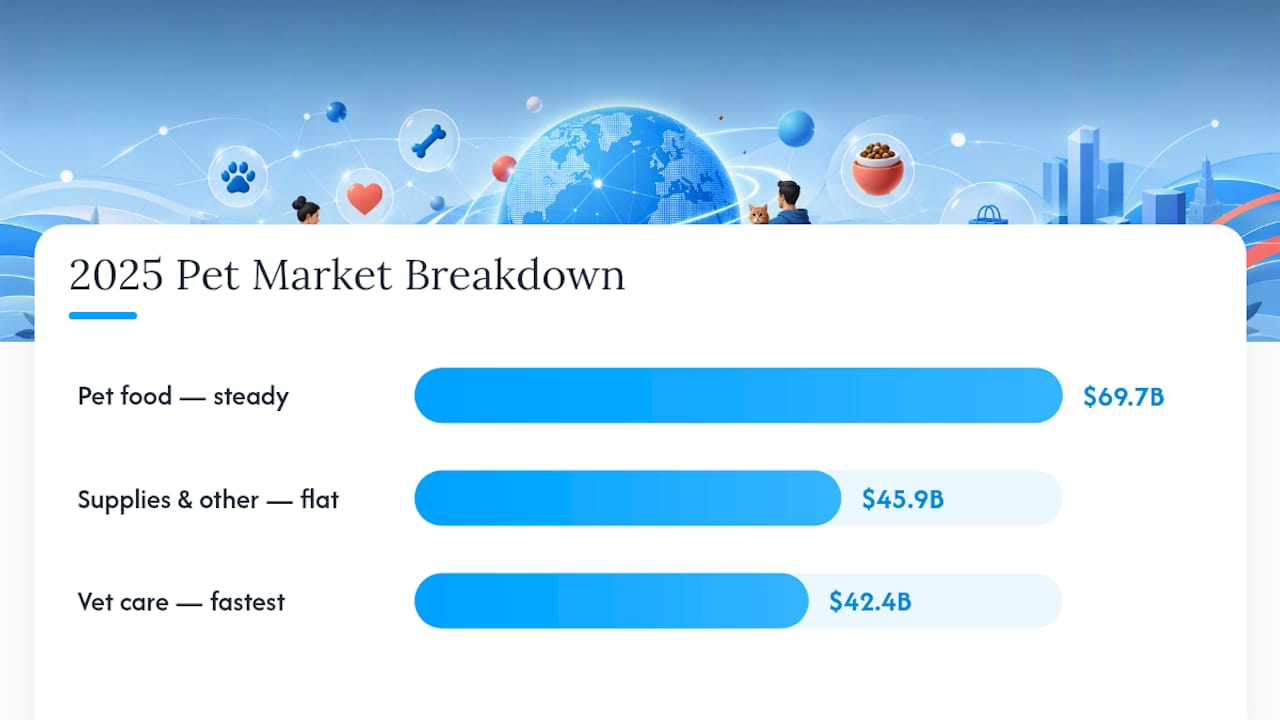
The number that should reshape your 2026 budget: vet care and product sales are outpacing every other category, which means operators who bolt health services onto their existing customer base have the clearest growth lane available.
Six Trends Reshaping Pet Business Strategy in 2026
Selective spending is now the default, not the exception
About 22% of pet owners cut spending in 2025, while roughly half held spending flat. Morgan Stanley frames this as a genuine selective spending market: owners still buy, but they demand proof of value first. That shifts your job from generating awareness to demonstrating outcomes. A boarding facility that documents enrichment activities, or a groomer that photographs before-and-after coat health, gives owners the evidence they now expect before they’ll pay a premium.
Business implication: stop marketing on convenience alone. Lead with demonstrable results, health outcomes, and expert credibility.
Veterinary and health-adjacent services are the clearest growth engine
Vet care and product sales already represent one of the largest and fastest-growing categories inside the $158 billion total. Daycare, boarding, and training businesses that once treated health as someone else’s department are now adding wellness checks, supplement retail, and vet referral partnerships as core revenue lines, not afterthoughts.

Business implication: every non-clinical pet business should have at least one formal relationship with a local veterinary practice by the end of 2026.
Cats are quietly outgrowing dogs in growth rate
Cat-owning households grew 5% year-over-year in 2025, while dog acquisition has moderated in several segments. Packaged Facts specifically calls out cat-focused offerings as an area with real runway left. Most daycare and boarding operators built their entire service menu around dogs. That’s an opening, not a threat.
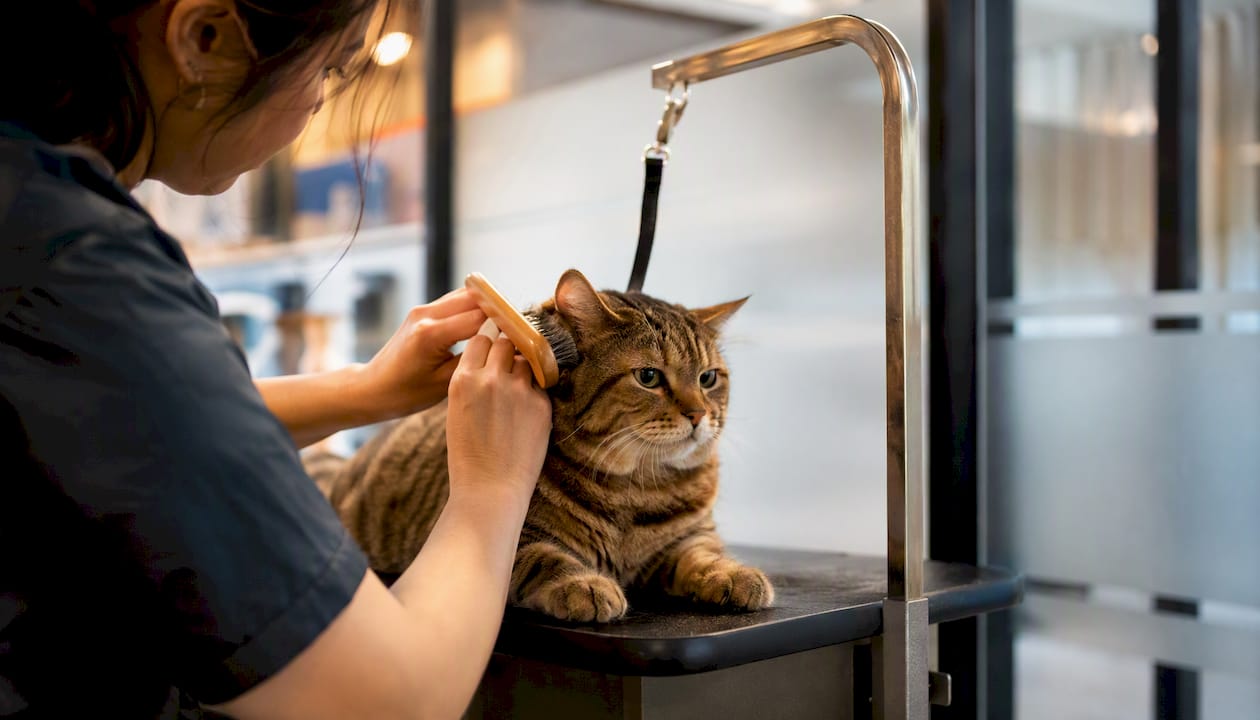
Business implication: even a modest cat boarding wing, feline-specific grooming slot, or cat sitting add-on can capture demand your dog-focused competitors are ignoring.
Digital and subscription channels keep gaining share
Morgan Stanley expects online purchases to reach roughly 39% of pet spending in coming months, with subscriptions and direct-to-consumer pharmacies pulling recurring-supply spend away from physical retail. Local, service-based businesses can’t out-ship Amazon, but they can out-relate it.
Business implication: use subscription and retention playbooks for recurring services like grooming packages or training memberships, where digital giants have no local presence advantage.
The middle of the market is disappearing
Clarkston Consulting argues the mid-tier is eroding fast: businesses without a clear identity as either premium/specialized or high-efficiency/value are losing ground to private label and discount competitors on one side, and boutique specialists on the other.
Business implication: pick a lane this year. A business trying to be “pretty good at everything, moderately priced” is the most exposed position in the entire industry right now.
Technology and sustainability move from novelty to expectation
Wearables, AI-assisted diagnostics, and eco-friendly packaging have shifted from marketing gimmicks to baseline customer expectations. NielsenIQ describes the industry moving toward an integrated “omni-market” model where product sales, clinical care, and personalized services converge into one experience.
Pro Tip: Don’t chase every gadget. Pick one tech investment (scheduling AI, health tracking, or a subscription platform) that removes friction for your specific customer base, and master it before adding another.
Business implication: operators who present themselves as one integrated hub for pet health, wellness, and care will out-position those selling disconnected services.
Channels, Pricing, and the Squeeze on Margins
Where the money moves in 2026 matters as much as how much moves. E-commerce and subscription models keep taking share, with online purchases projected near 39% of spending. Private-label brands are also undercutting mid-tier pricing at retail, which puts pressure on any operator selling commodity products without a service wrapped around them.
The businesses holding margin best in 2026 share a pattern:
- They bundle products with services (retail supplements sold alongside daycare or training)
- They build subscription logistics for recurring needs like food, grooming packages, or wellness plans
- They price transparently, so value-seeking customers don’t feel nickel-and-dimed
- They partner with local vets rather than competing against online pharmacies on price
Consider a small boarding operator adding a monthly “wellness membership” that bundles nail trims, a weight check, and a discounted retail supplement. It’s a low-cost pilot that builds recurring revenue and mirrors NielsenIQ’s omni-market model at a fraction of the investment.
Pro Tip: Review your pricing strategy before you touch your marketing budget. Most margin problems in 2026 start with pricing that never accounted for rising costs, not with insufficient demand.
Staffing, Consolidation, and Operational Pressure
Budget-conscious customers change more than your marketing. They change your staffing math. As owners scrutinize every purchase, businesses need tighter scheduling and less idle labor cost, even as wage pressure continues across the service sector.
Consolidation is accelerating too. Larger groomers, boarding chains, and franchise groups are acquiring independent operators at a steady clip, betting that scale wins on procurement and marketing spend. Independent operators can still compete, but only by leaning into the local relationships and flexibility that chains struggle to replicate.
Run this operational audit before mid-2026:
- Review staff scheduling against actual demand patterns, not last year’s assumptions
- Renegotiate vendor and supply contracts now, before contracts auto-renew at higher rates
- Identify which services can bundle together to raise average ticket without raising headcount
- Confirm your local licensing and safety compliance is current, since municipal pet-business regulation continues to tighten in many markets
- Consider AI-assisted scheduling to reduce idle labor without cutting service quality
- Track staff turnover as a leading indicator, not just a lagging complaint
Where to Place Your Bets: Opportunities and Risks in 2026
Not every trend deserves equal investment. Here’s how the major 2026 bets stack up on upside, cost, and time to results:
| Opportunity | Revenue Upside | Capital Required | Time to Value |
|---|---|---|---|
| Subscription/membership offer | Moderate to high | Low | 1 to 3 months |
| Vet referral partnership | High | Low | 3 to 6 months |
| Cat-focused SKUs or services | Moderate | Low to moderate | 2 to 4 months |
| Private-label retail | Low to moderate | Moderate | 6 to 12 months |
Three pilots worth testing this year:
- Product pilot: add a small cat-specific retail line or boarding slot and track sign-ups over 60 days
- Service pilot: launch a wellness membership bundling one retail item with one recurring service
- Channel pilot: test a local vet co-referral program and measure new-client volume it generates
Scale whichever pilot hits its target fastest, and kill the ones that don’t move the needle within a full quarter. Cheap, fast pilots beat big bets you can’t unwind.
Your 90-Day and 12-Month Action Plan
Turning 2026 forecasts into results means sequencing your moves. Start here:
First 90 days:
- Survey your current customers on what they’d pay more for (health tracking, convenience, expertise)
- Launch one small SKU or service trial tied to cat care or wellness
- Pilot a subscription or membership offer with your most loyal customers
- Reach out to one local vet practice about a referral partnership
Months 4 to 12:
- Set a measurable retention improvement target, not just a revenue target
- Roll out the pilot that performed best to your full customer base
- Revisit pricing using profitable pricing tactics as costs shift
Track these metrics monthly: customer lifetime value versus acquisition cost, retention rate, average order value, and subscription conversion rate. Budget pilots modestly using a seasonal planning approach so no single test threatens cash flow.
How These 2026 Forecasts Were Built
This outlook combines APPA’s national spending and ownership data, Morgan Stanley’s growth and channel analysis, Packaged Facts’ category forecasts, and NielsenIQ’s channel research into a single directional view, not a guaranteed forecast.
The pattern across every source points the same direction: total spending keeps rising, but growth concentrates in health services, subscriptions, and cat-focused categories, while undifferentiated middle-tier products lose ground.
Primary sources: APPA’s State of the Industry data, Morgan Stanley’s 2026 outlook, Packaged Facts’ market outlook, and NielsenIQ’s channel analysis.
Limitations: these projections assume no major shock to consumer inflation or pet adoption rates.
What We’re Actually Seeing With Pet Business Owners
Working alongside daycare, boarding, grooming, and training operators, the pattern in the data matches what shows up in real businesses: owners who added one clear health or subscription offering in 2025 grew faster than those who simply held their prices steady and hoped. One boarding operator we’ve seen replicate this pattern added a modest wellness check add-on tied to boarding stays, turning a one-time service into a recurring touchpoint. The trend data confirms what’s already visible on the ground: clarity and health-adjacent value win in 2026.
Turn These 2026 Trends Into a Real Growth Plan
Reading the trends is the easy part. Building the pricing model, staff training, and subscription systems to act on them is where most pet businesses stall out. Thedoggurus exists specifically for that gap: an all-in-one platform combining expert-led courses, coaching, and AI-powered tools built by people who’ve run pet care businesses themselves, not generic business consultants guessing at your margins.
Inside the platform, you’ll find retention playbooks built for exactly the subscription and membership models this article covers, staff training modules to handle the operational pressure of 2026’s tighter labor market, and budgeting tools to fund your pilots without guesswork. Operators using structured retention and pricing playbooks consistently see stronger repeat-visit rates than those improvising month to month. Visit Thedoggurus to start a trial and build your 2026 plan on a system, not a hunch.
Useful Reading on Pet Industry Trends 2026
These are the primary sources behind this outlook, worth bookmarking for ongoing research rather than a one-time read:
- APPA’s State of the Industry data: the definitive source for U.S. pet ownership and spending figures, updated regularly
- Morgan Stanley’s 2026 pet industry outlook: analyst commentary on growth rates, channel shifts, and cost pressures
- Packaged Facts’ pet market outlook: category-level forecasts including the cat-focused growth opportunity
- NielsenIQ’s pet care analysis: consumer behavior and omni-market channel research
- Clarkston Consulting’s industry trends report: analysis of premiumization versus value competition
Frequently Asked Questions
What is driving pet industry growth in 2026?
Vet care, health services, and subscription-based recurring revenue are the primary growth drivers, even as overall category growth moderates to roughly 4% annually through 2030.
Is the pet industry still growing in 2026?
Yes. The market reached $158 billion in 2025 with continued growth projected into 2026, though the pace has slowed from prior years.
Should pet businesses focus more on cats in 2026?
Cat-owning households grew 5% year-over-year in 2025 while dog acquisition moderated in several segments, making cat-focused services and retail a genuine, underserved opportunity for most dog-centric operators.
How should pet businesses adjust pricing for 2026?
Choose a clear position, either premium and specialized or efficient and value-driven, since undifferentiated mid-tier pricing is losing ground to both private label and boutique competitors.
What role do subscriptions play in pet industry trends for 2026?
Sources
- Pet Industry Growth Slows Amid Rising Costs in 2026 | Morgan Stanley
- U.S. Pet Industry Reaches $158 Billion in 2025, Poised for Continued Growth in 2026
- Pet Market Outlook 2026-2027 | Packaged Facts
- 2026 pet care industry trends | Clarkston Consulting