

If you’re deciding which dog daycare training program to invest in, here’s the short answer:
- Thedoggurus — Staff Products: Best for owners who want more than a certificate. You get integrated business systems, role-specific staff learning paths, AI-powered accountability, and coaching in one subscription. It’s the pick when you need training that translates directly into operations.
- IAP College — Dog Daycare Owner Certificate: Best for aspiring owners who want a business-focused certificate at a low entry cost. Self-directed, completable in as little as 2 weeks, with lifetime access and downloadable credentials.
- Good Dog Academy — Daycare & Boarding Certificate: Best for learners who want a curriculum-driven certificate covering both daycare and boarding operations. Lifetime access and solid operational coverage make it a practical standalone option.
- Dog Handler Academy — Training for Daycare Employees: Best for daycare staff and managers who need role-specific, on-the-floor handler skills. Built for employee upskilling, not owner business planning.
Table of Contents
- How do the top dog daycare courses compare at a glance?
- How do you choose the right dog daycare training program?
- What do credible dog daycare courses actually teach?
- What skills and U.S. standards separate safe daycares from the rest?
- What should you budget and how long will it take?
- What do past students say about these programs?
- Does certification help you find a job or grow your business?
- What continuing education and advanced options exist?
- Key Takeaways
- What actually matters when you’re running a daycare every day
- Thedoggurus: integrated training and business tools for daycare owners
- Useful sources and further reading
How do the top dog daycare courses compare at a glance?
| Course | Best For | Format | Price Band | Duration | Certificate / Credits | Core Topics | Support |
|---|---|---|---|---|---|---|---|
| Thedoggurus — Staff Products | Owners + staff teams | Self-paced + live coaching | Subscription (tiered) | Ongoing / role-based | Certificate + business tools | Behavior, operations, safety, business, leadership | Coaching, AI tools, templates, community |
| IAP College — Dog Daycare Owner Certificate | Aspiring owners | Self-paced | Low ($) | 2–12 weeks (rec. 6 wks) | Downloadable certificate | Business startup, operations, dog care basics | Lifetime access, self-directed |
| Good Dog Academy — Daycare & Boarding Certificate | Curriculum-focused learners | Self-paced | Mid ($) | Flexible, lifetime access | Certificate | Daycare + boarding operations, safety | Lifetime access, course materials |
| Dog Handler Academy — Training for Daycare Employees | Daycare staff / handlers | Self-paced | Mid ($) | Flexible | Certificate | Group play, handling, supervision | Staff-focused modules |

The single biggest practical difference: Thedoggurus combines training with live coaching, AI accountability, and ready-to-use business templates, while the standalone certificate programs give you knowledge and credentials without the operational infrastructure to act on them immediately.
How do you choose the right dog daycare training program?
The right course depends on your role, your timeline, and what you plan to do with the credential. Here’s how to think through it.

Match the course to your role first
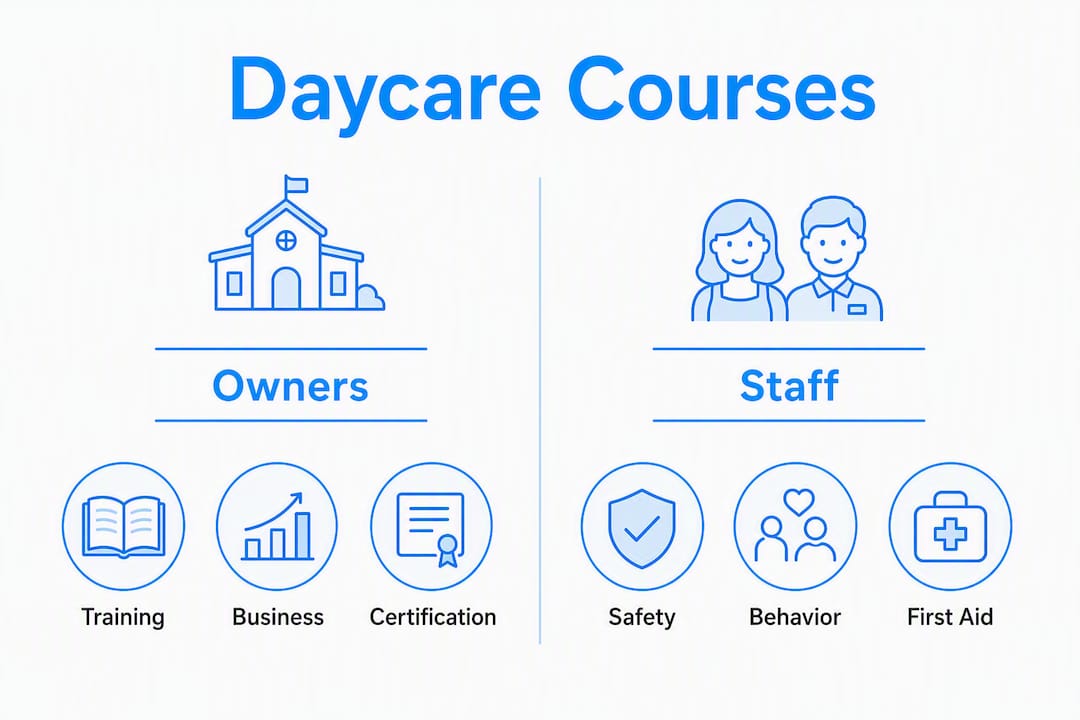
Owner launching a facility and a handler upskilling for group play supervision need fundamentally different programs. Owner-focused courses should cover business operations, pricing, staffing, and intake policy. Staff-focused courses should go deep on canine body language, handling techniques, and real-time supervision. Buying the wrong type wastes both money and time.
Questions worth asking any provider
- Does the instructor currently run or have they run an actual daycare facility?
- Does the curriculum include on-the-job templates, not just theory?
- Is there a staff training pathway, or is it a single-user course?
- Can you access a sample lesson or demo before purchasing?
- What is the refund or satisfaction policy?
Pro Tip: Ask the provider for a recent graduate outcome or case study. A credible program can point to owners who opened facilities or staff who moved into supervisory roles. If they can’t, that tells you something.
Red flags to watch for
- No first-aid or CPR coverage anywhere in the curriculum (the American Red Cross lists pet first aid and CPR as a baseline for professional handlers)
- Missing behavior assessment or temperament testing modules
- No demo access, no refund window, and no sample syllabus available
- Completion timelines that sound unrealistically fast for the depth of content claimed
- Credentials that carry no continuing education (CE) credit recognition or employer-facing value
What do credible dog daycare courses actually teach?
Across both owner- and staff-focused programs, the strongest curricula share a recognizable module map. Knowing what to expect helps you spot gaps in any program you’re evaluating.
Core modules in reputable programs:
- Canine behavior and body language: stress signals, arousal thresholds, play styles, and early warning signs before escalation
- Intake and temperament testing: evaluation protocols, safe dog assessment procedures, and criteria for group suitability
- Group play management: supervision techniques, group play safety standards, and handler rotation
- Health, vaccination, and sanitation: vaccination verification (rabies, distemper, parvo; Bordetella and canine influenza are commonly recommended), cleaning protocols, and disease prevention
- Facility operations: scheduling, capacity management, and emergency preparedness
- Emergency response and first aid/CPR: a non-negotiable for any staff member working with dogs
- Client communication and service: intake forms, owner updates, and complaint handling
- Business operations (owner-focused): pricing, marketing, staffing plans, and financial basics
Business modules are often optional or absent in staff-focused programs. If you’re an owner, confirm they’re included before enrolling. Safe daycare operations require vaccination checks, intake policies, cleaning protocols, and trained emergency responders — a course that skips any of these is incomplete for professional use.
What skills and U.S. standards separate safe daycares from the rest?
Most courses cover the basics. The programs that actually produce safer facilities go further on three specific competencies.
Active scanning is a trained skill, not a personality trait
The highest-impact, most under-taught competency in daycare work is proactive scanning for stress and arousal signals. High-performing facilities train staff to systematically scan the entire group at regular intervals and rotate handler focus so no dog goes unmonitored. This is a repeatable routine, not an instinct. Programs that build this habit produce fewer incidents than those that only teach emergency response after something goes wrong.
Staff-to-dog ratios matter operationally
Industry guidance recommends ratio ranges that shift by environment and group composition:
| Environment | Recommended Ratio |
|---|---|
| Small indoor groups | 1:6–1:8 |
| Mixed indoor/outdoor | 1:8–1:10 |
| Large outdoor yards | 1:10–1:15 |
| Puppies / special needs | 1:4–1:8 |
A course that never mentions ratios is leaving out one of the most practical operational metrics you’ll use every day. When evaluating a program, ask whether ratio guidance appears in the curriculum.
First aid and CPR certification is non-negotiable
Pet first aid and CPR should be a baseline requirement for every handler on your floor, not an optional add-on. Recognized certifications include American Red Cross, Pet Tech, and ProPetHero. Any course positioning itself as professional-grade should either include this content or explicitly direct students to complete it alongside the program.
Pro Tip: When reviewing a course syllabus, check whether behavior management and first aid appear in the same program. Courses that separate them force you to buy twice to get complete coverage.
What should you budget and how long will it take?
Completion timelines and prices vary more than most people expect. Here’s a realistic breakdown.
Price bands:
- Entry-level ($99–$199): Self-paced, certificate-only programs. QC Pet Studies starts at $99 with lifetime access, tutor feedback, and four content modules covering behavior, activities, service, and business basics. Good for getting started.
- Mid-range ($200–$499): More comprehensive standalone certificates, often with broader curriculum coverage and some form of student support.
- Premium / integrated (subscription or multi-module): Platforms like Thedoggurus that combine courses with coaching, templates, AI tools, and staff learning paths. Priced as a subscription with tiered plans.
Completion timelines:
- Self-paced short course: 1–2 weeks (possible minimum for programs like IAP College)
- Recommended part-time pace: 6 weeks (IAP College’s suggested timeline)
- Extended programs: up to 12 months for deep business-plus-coaching tracks
- Short CE-focused courses: UniversalClass’s “How to Run a Dog Day Care” runs approximately 7 hours with 0.7 CEUs across 15 lessons — useful for continuing education credit, not a standalone credential
What premium pricing typically includes: live or async coaching, business templates, community access, staff module libraries, and AI accountability tools. Payment plans are available on several platforms. Lifetime access is a common feature at the entry and mid-range levels. Confirm refund windows before purchasing — a reputable provider will offer at least a short satisfaction window or demo access.
What do past students say about these programs?
Verified student feedback on dog daycare training programs tends to cluster around a few consistent themes. Owners who complete business-focused courses most often cite the operational frameworks — intake policies, pricing structures, and staffing templates — as the content they put to work fastest. Staff-focused learners highlight body language modules and group play supervision techniques as the skills that changed how they work on the floor.
Programs without any publicly available testimonials, case studies, or graduate outcomes deserve extra scrutiny. A course that can’t point to real people who used the training to open a facility or advance their career is harder to evaluate. Look for providers who share specific outcomes, not just generic praise. Thedoggurus publishes practitioner-led content and coaching grounded in running actual pet care businesses, which gives its training a verifiable real-world foundation.
Does certification help you find a job or grow your business?
For staff, a certificate from a recognized program signals baseline competence to employers. Dog Handler Academy’s employee-focused credential is specifically designed to be employer-facing, making it a practical credential for handlers applying to daycare facilities. Facilities increasingly ask for documented training as part of their hiring process, particularly for roles involving unsupervised group play supervision.
For owners, the career support question is different. A certificate alone won’t open a facility. The practical requirements — permits, insurance, zoning, staffing plans, and intake policies — sit outside most course curricula. Starting a dog daycare requires a permitted location, business registration, local licenses, and immunization policies before you see your first client. Courses that include business modules and operational templates get you closer to launch-ready than certificate-only programs.
Thedoggurus addresses this gap directly: its platform combines training with the business systems, templates, and coaching that turn course knowledge into an operating facility.
What continuing education and advanced options exist?
Continuing education in dog daycare falls into two categories: formal CE credits and advanced specialization.
On the formal CE side, the Professional Animal Care Certification Council (PACCC) is the primary U.S. credentialing body for pet care facility professionals. Courses that carry PACCC-recognized continuing education credits hold more weight with employers and facility accreditation bodies than those that don’t. UniversalClass’s short course offers 0.7 CEUs, which counts toward CE requirements but isn’t a substitute for a full credential.
Advanced specialization options include behavior consulting add-ons, canine first aid instructor training, and facility management tracks. Thedoggurus supports ongoing learning through its subscription model, meaning your access to new content, updated templates, and coaching doesn’t expire after a single course completion. For owners who want to keep growing after launch, that ongoing access matters more than a one-time certificate.
Key Takeaways
Thedoggurus is the strongest choice for owners who need training and business systems together — standalone certificates work for learners who need credentials without the operational infrastructure.
| Point | Details |
|---|---|
| Owner launching a daycare | Thedoggurus combines courses, coaching, templates, and AI tools in one subscription for launch-ready owners. |
| Staff or handler upskilling | Dog Handler Academy delivers role-specific, on-the-floor handler training built for employee competence. |
| Cost-conscious starter | IAP College’s certificate starts at a low price point, completes in 2–12 weeks, and includes business modules. |
| Curriculum non-negotiables | Any credible program must cover behavior signals, first aid/CPR, intake protocols, and supervision ratios. |
| Thedoggurus platform | Integrated training + business systems + AI accountability makes it the recommended option for owners scaling a facility. |
What actually matters when you’re running a daycare every day
Most course comparisons focus on price and completion time. Those matter, but they’re not what separates facilities that run well from those that don’t.
The gap shows up in the first month of operations. You can know every body language signal in the textbook and still struggle when you’re short-staffed on a Tuesday with 30 dogs in the yard and a new handler who’s never managed a group transition. The skills that hold under pressure — scanning routines, ratio management, de-escalation before a fight starts — are built through repetition and feedback, not a single watch-through of a video module.
What I’d tell any owner evaluating programs: look for training that gives you something to use on Monday morning. Templates for intake policies, staff onboarding checklists, ratio guidelines you can post in the break room. A certificate is a credential. A system is what keeps dogs safe and staff confident when things get complicated.
The courses that produce the best outcomes are the ones built by people who have stood in a playroom and made those calls in real time. That’s the standard worth holding every program to.
Thedoggurus: integrated training and business tools for daycare owners
Standalone certificates give you knowledge. Thedoggurus gives you the infrastructure to act on it. For owners who need both course content and the operational systems to run a real facility, it’s a different category of resource entirely.
The platform combines expert-led courses, role-specific staff learning paths, AI-powered accountability, ready-to-use business templates, and live coaching in one subscription. You’re not just learning what a safe daycare looks like — you’re building the playbooks, onboarding systems, and team training that make it work day to day. Staff modules mean your whole team trains together, not just the owner.
Plans are tiered with monthly and annual options. If you’re ready to move from certificate to operational confidence, explore the Staff Products plans and see which tier fits your facility’s stage.
Useful sources and further reading
These U.S.-focused resources informed the standards and course details covered above. Each is worth bookmarking as you evaluate programs and build your facility.
- PACCC — Pet Care Facility Certification: The primary U.S. credentialing body for pet care professionals. Check whether a course you’re considering carries PACCC-recognized CE credits.
- American Red Cross — Pet Certifications: The baseline standard for pet first aid and CPR certification for handlers and staff.
- TrustMyPets — Dog Daycare Staff Training Standards: Practical ratio guidance and staff training benchmarks for facility operators.
- IAP College — Dog Daycare Owner Certificate — Full course details, syllabus, and pricing for the self-directed owner certificate.
- NJ Vet — Safety Standards for Dog Daycares: Operational safety standards covering vaccination, sanitation, and emergency preparedness.