

Every dog-related business, whether daycare, grooming, training, boarding, pet sitting, dog walking, or retail, is built on the same foundation: earning the trust of pet parents and delivering consistent, safe care. The fastest path forward is simple. Pick the model that matches your skills, your available space, and your cash runway, then validate local demand before you spend a dollar on build-out.
Before you go further, do these three things today:
- Market scan: Search your ZIP code on Google Maps for existing dog daycare, grooming, and boarding providers. Note their pricing, reviews, and gaps.
- Legal/insurance check: Confirm your city or county zoning allows the business type you’re considering, and get a general liability insurance quote.
- Pricing scan: Call or book a competitor as a mystery shopper to understand local rate benchmarks.
Table of Contents
- Which dog-related business model fits your situation?
- How do you choose the right dog business for your skills and market?
- What U.S. legal and insurance steps must you complete before opening?
- What does a solid operations playbook look like?
- What are the real startup costs and key financial benchmarks?
- How do you scale without losing what makes you good?
- How do you build total brand trust with modern pet parents?
- Your 90-day checklist to launch or professionalize your operation
- Key Takeaways
- What actually matters most when building a pet care business
- Thedoggurus gives you the tools to build it right
- Useful sources and references
Which dog-related business model fits your situation?
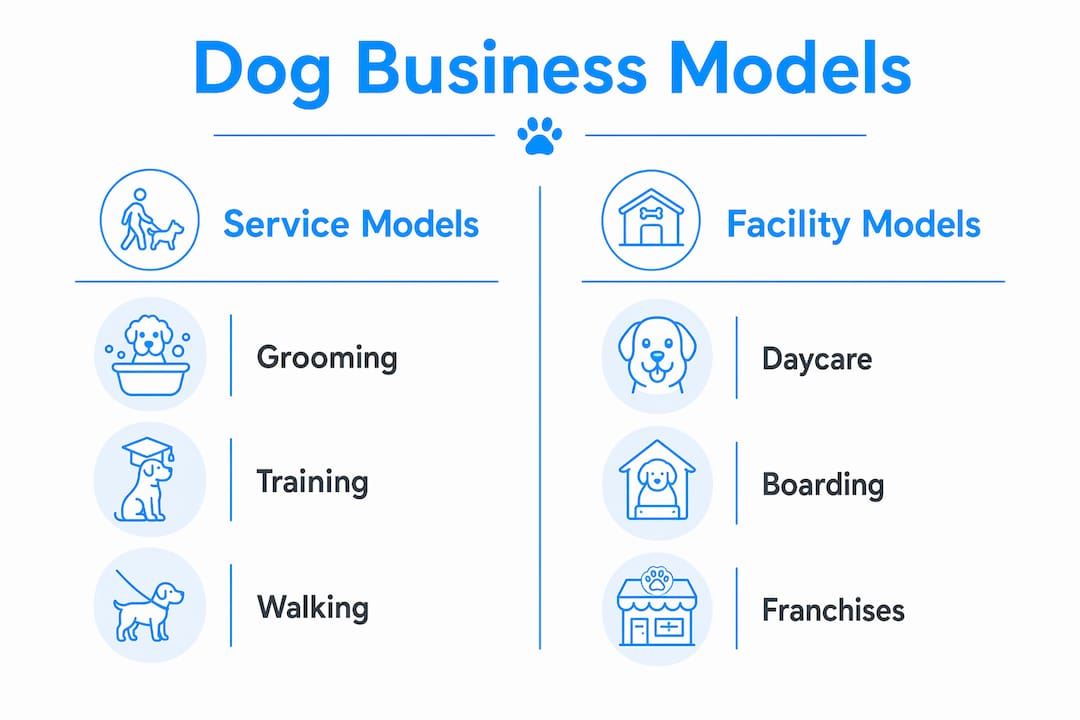
Each model has a distinct operational footprint. Here’s a quick-scan profile of the most viable options.
| Business Model | Startup Cost Shape | Space Needed | Labor Intensity | Time to First Revenue |
|---|---|---|---|---|
| Dog daycare | Medium–High | Large (zoned facility) | High | Several weeks to a few months |
| Fixed-location grooming | Medium | Small–Medium salon | Medium | About one to two months |
| Mobile grooming | Low–Medium | Van/trailer | Low–Medium | Approximately two to four weeks |
| Dog training | Low | Flexible | Medium | Within a few days to three weeks |
| Boarding | Medium–High | Licensed facility | High | About two to three months |
| Pet sitting/dog walking | Very Low | None | Low | Usually less than one week |
| Retail/subscriptions | Medium | Storefront or online | Low–Medium | Between one and three months |
Dog daycare and boarding require the most capital and the longest lead time to first revenue, but they also generate the highest recurring revenue per client. Mobile grooming sits at the opposite end: low overhead, fast launch, and strong demand from pet parents who want stress-free, one-on-one care. Training businesses can launch with almost no fixed costs, especially if you offer in-home or park-based sessions. Retail and subscription models, including a pet supply store or curated dog product box, carry inventory risk but benefit from e-commerce reach.
The smartest operators diversify revenue by pairing high-frequency, lower-margin services like daycare or express grooming with high-margin add-ons like retail products or advanced training packages. That combination stabilizes cash flow and increases customer lifetime value.
How do you choose the right dog business for your skills and market?
Run yourself through five filters before committing.
1. Skills and certifications. Grooming and training require hands-on competency. Daycare and boarding require operational management skills. Honest self-assessment here saves you from expensive pivots later.
2. Space and zoning. Boarding and daycare need commercially zoned facilities with outdoor run access. Mobile grooming needs a parking spot and a van. Training can often start in a client’s backyard or a rented studio.
3. Local demand and competition. If your area has three established daycares and no mobile groomers, the gap is obvious. Use Google Trends, local Facebook groups, and Nextdoor to gauge unmet demand.
4. Hours you’re willing to work. Daycare and boarding are 365-day commitments. Dog walking services and training offer far more schedule flexibility.
5. Cash runway. A full-campus franchise model, like the All Dogs Unleashed franchise example with an estimated initial investment range of $680,500 to $1,098,500, requires serious capital. A pet sitting or training business can launch for a few hundred dollars.
Pro Tip: Run a pilot week before you sign a lease. Offer a pop-up grooming day, a free training workshop, or a trial daycare session to a small group of neighbors. Real demand beats any spreadsheet projection.
What U.S. legal and insurance steps must you complete before opening?
Getting this right protects your business, your clients, and their dogs.
Insurance you need:
- General liability insurance: Covers property damage and bodily injury claims. Non-negotiable for any dog-related business.
- Professional indemnity insurance: Covers negligence claims, such as a grooming injury or a training incident. Strongly recommended for grooming and training operators.
- Workers’ compensation: Mandatory in most U.S. states when you hire staff or volunteers. Protects both your employees and your business from injury claims.
Regulatory must-dos:
- Obtain a local business license and confirm your zoning classification allows your specific service type.
- Apply for a kennel or boarding permit if you’re housing dogs overnight. Requirements vary by county.
- Require proof of current vaccinations (rabies, Bordetella, DHPP) for every dog you accept. Keep records on file.
- Follow your state’s sanitation and animal care regulations. Many states have specific rules for commercial pet care facilities.
Contract basics:
- Use a signed client intake form that captures vaccination records, emergency contacts, and behavioral history.
- Include a clear cancellation and refund policy in your service agreement.
- Add a behavior and liability waiver that sets expectations for what happens if a dog is removed from your program.
Pro Tip: Check your startup legal checklist before your first client walks in. Missing a permit or waiver is far more expensive to fix after an incident than before.
What does a solid operations playbook look like?
Systems are what separate a business from a job. Documented operational playbooks let staff deliver consistent service whether you’re on the floor or not.
Staffing and hiring. Define roles clearly: a daycare attendant is not a groomer, and a groomer is not a trainer. Screen applicants for animal handling experience, calm temperament under pressure, and physical stamina. Onboard every new hire with role-specific training before they work unsupervised. Use a structured staff training program to build competency consistently.

Playgroup safety. Every dog should pass a formal behavior evaluation before joining group play. Premium daycares run strict evaluations and accept only dogs that meet their safety criteria. Maintain appropriate staff-to-dog ratios during play, document any incidents immediately, and have a clear protocol for separating dogs when tension escalates. The two most critical factors in daycare safety are proper dog evaluation and staff supervision.
Grooming hygiene SOPs. Clean and disinfect tables, tubs, and tools between every dog. Prevent cross-contact by using separate equipment for dogs with known skin conditions. Routine grooming visits also let your team monitor skin health early and flag issues before they become veterinary emergencies. When adding grooming to an existing facility, prioritize specialized training for high-maintenance coats like doodles and poodles first. Mispriced or undertrained grooming creates scheduling chaos and margin leakage fast.
Emergency protocols. Every location needs a written emergency evacuation plan and a clear chain of command for medical incidents. Post it. Practice it.
What are the real startup costs and key financial benchmarks?
Financial clarity prevents the most common reason pet businesses fail: underpricing and undercapitalization.
| Cost Category | Low-Capital Model (Training/Walking) | Mid-Capital Model (Grooming Salon) | High-Capital Model (Daycare/Boarding) |
|---|---|---|---|
| One-time startup costs | ranges widely from low amounts for training/walking up to substantial for grooming salons and large daycare/boarding facilities | ||
| Monthly recurring costs | vary from modest to significant depending on business scale and type | ||
| Breakeven timeline | varies widely by business model from a few months for small-scale to one or two years for larger operations |
Key metric to track: Revenue per dog per day. For daycare, a simple breakeven formula is: (Monthly Fixed Costs) ÷ (Daily Rate × Operating Days) = Minimum Dogs Per Day to Break Even.
Watch three sensitivity points closely: occupancy rate (are you filling your capacity?), average ticket (are you capturing add-ons?), and payroll as a percentage of revenue (industry operators typically target this below 40%). If payroll creeps above that threshold, you either need to raise prices or increase capacity utilization before adding headcount.
How do you scale without losing what makes you good?
Scale breaks businesses that run on the owner’s personal effort. The fix is documentation.
- Write your playbooks first. Every core process, from dog intake to closing procedures, needs a written SOP before you hire your second employee.
- Build a hiring pipeline, not just a job post. Define competency benchmarks for each role and create a promotion path so your best people stay.
- Use technology to reduce manual work. Booking software (like Gingr or Pawfinity), automated payment processing, and client communication tools free up hours every week.
- AI tools add the most value in staff training, scheduling optimization, and customer follow-up sequences. Thedoggurus’s AI-powered platform acts as a 24/7 operational accountability partner for exactly this.
- Scale metrics to watch before expanding: consistent 80%+ occupancy, a documented SOP library your team actually uses, and a manager who can run daily operations without you.
Pro Tip: Before opening a second location, ask yourself: can my current team run this one without me for two weeks? If the answer is no, you’re not ready to scale. Fix the systems first. Pair that internal discipline with a scalable content strategy to grow your brand’s reach without proportionally growing your workload.
How do you build total brand trust with modern pet parents?
Pet parents don’t just buy a service. They buy confidence that their dog is safe.
Lead with safety proof points: publish your behavior evaluation criteria, staff certifications, vaccination requirements, and hygiene protocols on your website. Facilities that operate with transparent safety standards convert cautious pet parents far more reliably than businesses that compete on price alone.
Tactical checklist:
- Claim and fully optimize your Google Business Profile with photos, service descriptions, and response to every review.
- Build an email onboarding sequence for new clients: welcome message, safety protocol overview, first-visit tips.
- Create a referral program. A simple “refer a friend, get a free day” offer drives word-of-mouth faster than paid ads in most local markets.
- Post short-form content that shows your facility in action: staff training clips, playgroup footage, before-and-after grooming results.
- Partner with local vets, pet supply stores, and dog trainers for cross-referrals.
Your 90-day checklist to launch or professionalize your operation
- Weeks 1–2: Complete your market scan, choose your business model, confirm zoning, and get insurance quotes.
- Weeks 3–4: Register your business, apply for required permits, draft client intake forms and service agreements.
- Weeks 5–6: Build your core SOP documents: intake process, daily operations, emergency protocols, hygiene standards.
- Weeks 7–8: Hire and onboard your first staff member using role-specific training. Run a soft-launch pilot with 5–10 trial clients.
- Weeks 9–10: Collect reviews from pilot clients, refine your pricing based on real feedback, and launch your Google Business Profile.
- Weeks 11–12: Analyze your first-month financials. Are you on track for breakeven? Adjust occupancy targets, pricing, or marketing spend accordingly.
Milestone indicators: 10+ paying trial clients by week 8, a safety acceptance rate above 80% for daycare evaluations, and breakeven pacing confirmed by week 12. Use the small dog business startup checklist to fill any gaps.
Key Takeaways
Running a profitable dog-related business requires the right model for your skills and market, airtight legal and insurance coverage, documented operational systems, and trust-first marketing.
| Point | Details |
|---|---|
| Choose the right model first | Match your business type to your skills, space, and cash runway before spending on build-out. |
| Legal and insurance are non-negotiable | Secure general liability, professional indemnity, and workers’ comp before your first client arrives. |
| Systems enable scale | Documented SOPs and role-based staff training let your business run without you in the room. |
| Trust-first marketing converts | Publishing safety protocols and staff credentials converts cautious pet parents better than price-led messaging. |
| Thedoggurus accelerates the process | Thedoggurus provides courses, coaching, AI tools, and playbook templates built specifically for pet care operators. |
What actually matters most when building a pet care business
Most operators focus on the wrong thing early on. They obsess over branding, equipment, and facility design before they’ve written a single SOP or hired a single person who can run the operation without them. The result is a business that looks good from the outside but falls apart the moment the owner steps away.
The operators who build something durable do the unglamorous work first. They document every process. They hire for temperament and train for skill. They set pricing that actually covers their costs. And they treat safety not as a liability checkbox but as their primary marketing asset. When you can show a pet parent exactly how you evaluate dogs, exactly how your staff is trained, and exactly what happens in an emergency, you stop competing on price entirely.
Scale for its own sake is a trap. A single well-run location with strong margins, a loyal client base, and a team that doesn’t need you to babysit every shift is worth more than three chaotic locations bleeding cash. Build the foundation right, and growth becomes a natural outcome rather than a constant scramble.
Thedoggurus gives you the tools to build it right
Running a dog-related business is hard enough without starting from scratch on every system, template, and training program. Thedoggurus is the all-in-one platform built specifically for pet care operators who want to grow without the chaos. You get expert-led courses on off-leash safety, team management, and profitability, plus AI-powered tools that act as a 24/7 operational partner, ready-to-use playbook templates, and role-specific staff training modules your team can complete on their own schedule.
Whether you’re launching your first grooming salon or professionalizing a daycare that’s outgrown its systems, Thedoggurus gives you the proven frameworks and coaching support to do it confidently. Explore the owner tools and pricing or visit Thedoggurus to see how the platform works for businesses at every stage.
Useful sources and references
- Thedoggurus — platform overview: Start here for courses, coaching, AI tools, and playbook templates for pet care operators.
- How to start a dog business (legal and insurance): U.S.-focused startup checklist covering licensing, insurance, and compliance steps.
- Managing dog play behaviors: Practical playgroup safety and behavior screening guidance.
- Staff training program guide: Step-by-step framework for building role-based training programs.
- Emergency safety protocols: Templates for evacuation plans and medical incident procedures.
- All Dogs Unleashed franchise page: Reference for full-campus franchise investment ranges and fee structures.
- SumUp — how to start a dog business: Insurance type explanations including workers’ compensation requirements.
- Organic marketing strategy guide: External resource for building a content-led growth strategy for your pet business.