

OSHA oversight applies to kennels through existing standards and the General Duty Clause, not a dedicated “kennel rule.” Start today with three moves: post your OSHA workplace poster and inventory every chemical with a Safety Data Sheet (SDS), complete and document a facility hazard assessment, and get written SOPs and staff training signoffs underway. Skipping these steps carries real financial risk.
- Post the OSHA poster and build your chemical/SDS inventory
- Complete a documented hazard assessment (bites, chemicals, slips, noise)
- Start or update written SOPs with signed training records
Pro Tip: Serious violations can reach $16,550 per incident, and willful or repeated violations climb to $165,514 under OSHA’s 2026 penalty schedule. Documentation is what separates a warning from a citation.
Key Takeaways
OSHA compliance in kennels depends on documented hazard assessments, written HazCom and PPE programs, and accurate training and incident records, not a single dedicated standard.
| Point | Details |
|---|---|
| No dedicated kennel standard | OSHA applies HazCom, PPE, and General Duty Clause obligations to kennels, not one specific rule. |
| Engineering controls first | Prioritize airlocks and secure runs over PPE alone; inspectors view this as stronger evidence. |
| Bites can be recordable | Dog bites requiring more than first aid must go on your OSHA 300 log. |
| Penalties scale fast | Serious violations reach $16,550 and willful ones reach $165,514 under 2026 federal guidance. |
| Thedoggurus provides templates | Adaptable SOPs, audit checklists, and training modules help operators document compliance efficiently. |
Where to Verify the Rules for Your State
- OSHA’s 2026 penalty adjustments and emergency preparedness guidance
- Your state OSHA plan or department of agriculture for kennel-specific codes
- Thedoggurus for adaptable SOP and training resources
Table of Contents
- Which OSHA Compliance Standards Apply to Kennels?
- What Are the Biggest Hazards Inspectors Look For?
- What Documents Do You Need for OSHA Compliance in Kennels?
- Building Your 90-Day OSHA Compliance Checklist
- What Happens During an OSHA Inspection of a Kennel?
- Practical Templates You Can Adapt Today
- Sources
Which OSHA Compliance Standards Apply to Kennels?
There’s no single “OSHA compliance kennels” rulebook. Instead, OSHA regulates boarding and daycare facilities through general industry standards that happen to fit your operation, plus the General Duty Clause, which requires you to address recognized hazards even when no specific standard names them. That last part matters: dog bites and animal handling injuries count as recognized hazards in the eyes of an inspector, even though “kennel” never appears in the regulatory text.
The standards that actually govern your facility:
- Hazard Communication, 29 CFR 1910.1200: requires an SDS for every chemical on site, proper container labeling, employee access to that information, and documented training on reading labels and safety data.
- Personal Protective Equipment, 29 CFR 1910.132: requires a written hazard assessment, PPE selected to match those hazards, maintenance procedures, and training records. Bite-resistant gloves or sleeves belong here when handling reactive or unfamiliar dogs.
- Walking-Working Surfaces, 29 CFR 1910.22: covers wet floors, drainage, and trip hazards common in wash areas and runs.
- Occupational Noise Exposure, 29 CFR 1910.95: applies when barking and equipment noise reach sustained levels that could require monitoring.
- Bloodborne Pathogens, 29 CFR 1910.1030: applies if staff are expected to render first aid involving blood exposure.
- Recordkeeping, 29 CFR 1904: governs your OSHA 300 log obligations, covered separately below.
Think of these as puzzle pieces. None was written with dogs in mind, but together they form your entire compliance obligation.
What Are the Biggest Hazards Inspectors Look For?
Inspectors prioritize what they call the hierarchy of controls: eliminate or engineer out the hazard first, use administrative rules second, and treat PPE as your last line of defense. OSHA views engineering controls as stronger compliance evidence than PPE alone, so a facility relying only on gloves and hope looks weaker on paper than one with physical barriers in place.
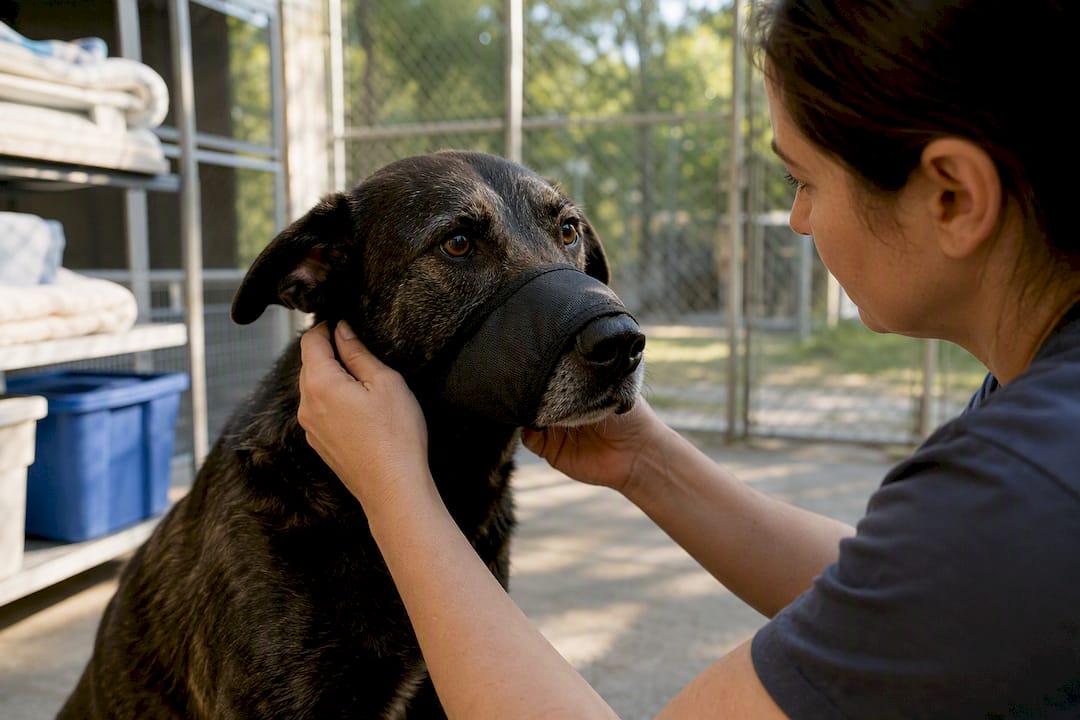
- Animal-related hazards. Bite and escape risk drop sharply with double-door airlocks, secure runs, and clear separation protocols for reactive dogs. This is your top engineering-control priority.
- Biological hazards. Zoonotic disease spreads through waste and close contact. Isolate sick animals immediately, and if staff routinely handle bodily fluids, put a written exposure control plan in place.
- Environmental and physical hazards. Non-slip flooring, working drainage, and smart layout for lifting dog food bags or crates protect backs and prevent falls. Noise mitigation, like sound-dampening panels in loud kennel runs, matters more than most owners assume.
- Chemical hazards. Store disinfectants away from animal areas, follow dilution instructions exactly, and require gloves and eye protection when mixing concentrated cleaners.
Pro Tip: Walk your facility once a week as if you were the inspector, not the owner. You’ll spot the loose gate latch or the unlabeled spray bottle before OSHA does.
What Documents Do You Need for OSHA Compliance in Kennels?
Inspectors don’t just check your facility. They check your paperwork, and gaps there are where most citations originate.
Your HazCom program needs a written plan, an accessible SDS binder or digital equivalent, and training logs showing initial instruction plus refreshers. Your PPE program needs the hazard assessment itself, in writing, paired with a signed policy each employee has acknowledged. Training records are among the easiest citation points precisely because they’re easy to keep. There’s no excuse for missing them.
Recordkeeping deserves special attention. Employers with 11 or more employees generally must maintain the OSHA 300 log, and dog bites requiring more than first aid are recordable incidents. Many operators under-classify bites because staff treat them as routine. The OSHA 300A summary must be posted annually during the required window, typically February through April.
Your emergency plan needs specifics: who recaptures a loose animal, veterinary contacts, and drill frequency, not a generic fire evacuation template borrowed from a retail store.
Building Your 90-Day OSHA Compliance Checklist
You don’t need to fix everything at once. A phased approach gets you inspection-ready without overwhelming your team.
Day 1:
- Post your OSHA workplace poster where staff can see it.
- Build a chemical and SDS inventory, even a simple binder counts as a start.
- Document a basic hazard assessment covering bites, chemicals, and slip risks.
Weeks 1 through 4:
- Draft your written HazCom program.
- Schedule initial safety training and get signatures.
- Fix obvious trip and bite risks, label every unmarked container.
Days 30 through 90:
- Formalize your emergency plan with named roles.
- Retrofit engineering controls where budget allows, airlocks and secure latches first.
- Run a mock inspection and audit your training file for gaps.
When an inspector arrives, they’ll typically ask for:
- Your SDS list and HazCom program
- Signed training records
- Written hazard assessment
- Incident and injury log
What Happens During an OSHA Inspection of a Kennel?
Most inspections start with a complaint, an accident report, or a referral, not a random drop-in. Once an inspector arrives, they’ll request your HazCom documentation, training signoffs, and incident log first, since these reveal whether your compliance efforts are real or theoretical.
The most common citation triggers for kennels: missing SDS files, absent training records, no documented hazard assessment, and housekeeping failures that lead to slips or bites. Serious violations can run up to $16,550 per incident, while willful or repeated violations reach $165,514 under current federal guidance, and state-plan states like California can layer additional requirements on top.
- If cited, correct the hazard immediately where feasible.
- Document every corrective action with dates and photos.
- Loop in your insurer and legal counsel before responding formally.
Practical Templates You Can Adapt Today
A bite-prevention SOP needs three things: the specific triggers staff watch for, the exact response steps, and a signature line confirming the employee read and understood it. Your disinfectant protocol needs dilution ratios, contact time, and who signs off weekly.
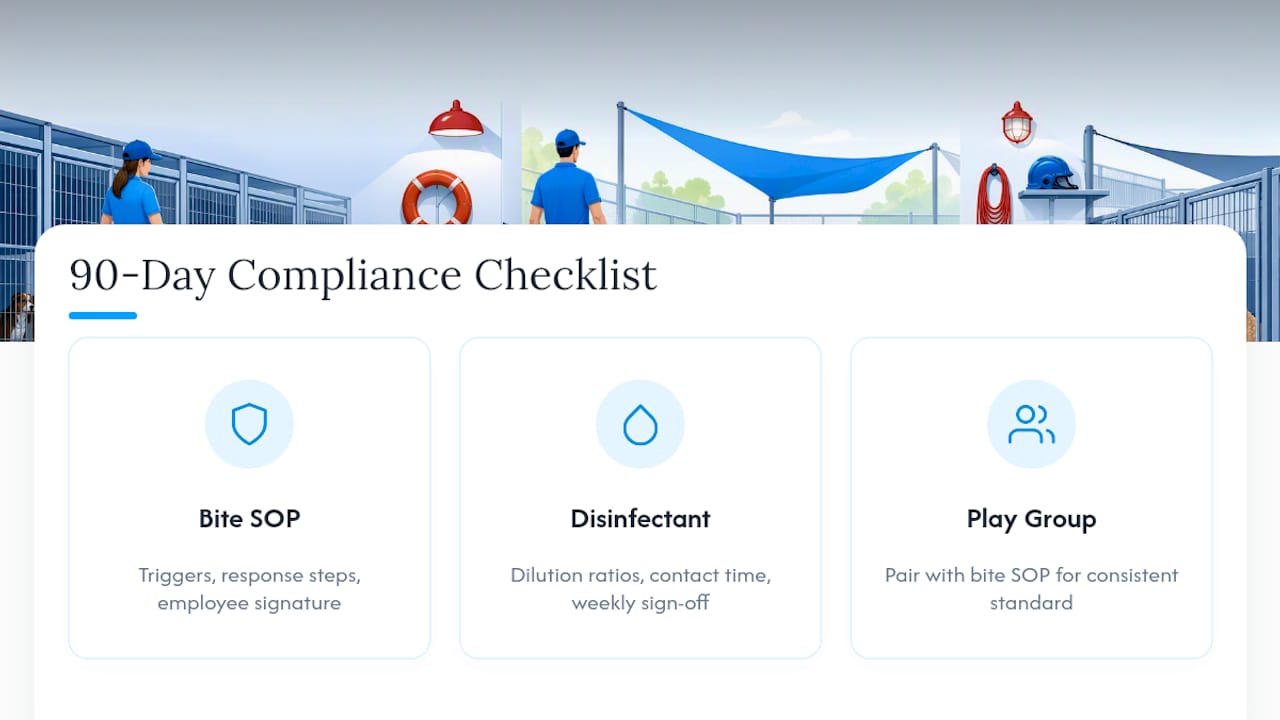
Thedoggurus builds these templates to scale, a five-run facility and a fifty-run operation both need the same core elements, just different staffing depth. Run your audit checklist monthly rather than annually.
Pro Tip: Pair your bite-prevention SOP with a play group safety protocol so staff have one consistent standard for both individual handling and group play.
Author note: the blind spot that costs kennels the most
Owners routinely treat bites as “part of the job” and skip the paperwork. That single habit creates the liability inspectors find first. A visible monthly micro-audit, a clipboard by the door, changes that culture fast.
— Oliver
How Thedoggurus Supports Your OSHA Compliance Work
Building compliant SOPs from scratch while running daily operations is exactly the kind of task that gets pushed to “next week” indefinitely. Thedoggurus gives you a shortcut competitors without a coaching platform simply don’t have: field-tested templates for bite-prevention SOPs, HazCom documentation, and staff training modules that you adapt to your facility rather than write cold.

Beyond templates, the platform’s audit checklists turn your monthly walkthrough into a repeatable habit instead of a one-time scramble before an inspection. Staff training modules track who’s completed what and when refreshers are due, so your training log stays inspection-ready without a separate spreadsheet. If you’re managing both boarding and daycare operations, review our dog boarding facility requirements guide alongside the platform’s coaching resources for a fuller operational picture. Ready to see how the templates and tools fit your facility? Visit Thedoggurus to start a trial or request a demo.
Sources
- OSHA — 2026 annual adjustments to civil penalties
- LegalClarity — OSHA animal safety standards: Hazards, PPE, and penalties
- OSHA — Emergency preparedness