

Run active group play at a conservative ratio around 10 dogs per handler. Many operators stretch this ratio in calm, small-dog groups, but it should be treated as a ceiling, not a target.
Here’s the underwriting reality: insurers view 10:1 as defensible risk. Push past the practical ceiling of around 15 dogs per handler as your everyday norm, and you’re inviting surcharges, coverage denials, or a much harder renewal conversation.
Three situations demand a tighter ratio than your handbook default:
- New intakes and puppies — unknown behavior histories need closer eyes.
- Large or high-energy dogs — bigger bodies and faster arousal mean less reaction time.
- Transition periods — arrivals, departures, and group changes spike unpredictability.
Key Takeaways
Safe staffing depends on matching your ratio to the operating window, the group, and the space, then proving it with documentation every day.
| Point | Details |
|---|---|
| Anchor active play at 10:1 | Treat 15:1 as a ceiling for calm, size-matched groups only, not a default. |
| Adjust by operating window | Rest periods allow 20:1 to 30:1; intake and transitions need 6:1 to 8:1. |
| Watch space and composition | Reduce ratios when square footage is tight or groups mix size and temperament. |
| Schedule with overlap and caps | Use booking caps, staggered shifts, and on-call relief to hold your target ratio. |
| Document every shift | Keep time-stamped logs, camera footage, and incident reports to defend your ratio. |
Table of Contents
- What’s the Right Staff to Dog Ratio for Each Part of the Day?
- What Should Push Your Ratio Tighter or Looser?
- How Do You Turn a Ratio Target Into an Actual Schedule?
- What Records Do Insurers and Inspectors Actually Expect?
- How Does Better Training Raise Your Safe Ratio Ceiling?
- Editorial Perspective on Staffing Ratios That Actually Hold Up
- Frequently Asked Questions
- Sources
What’s the Right Staff to Dog Ratio for Each Part of the Day?
A single ratio can’t govern your whole operation, because not every hour carries the same risk. Active play, rest, and intake each demand a different staffing math.
Active play stays at the 10:1 anchor, with 15:1 as a practical ceiling reserved for calm, size-matched, low-arousal groups. This range shows up consistently in industry and insurance guidance, and it lines up with what experienced daycares report using day to day, per Dog Drop’s operator research. The logic is simple: active supervision means a handler is actively reading body language, breaking up mounting, and repositioning dogs before a scuffle starts. That kind of intervention gets harder past 15 dogs per set of eyes, no matter how skilled the handler is. Our guide on group play safety standards breaks down what active supervision actually looks like in practice.
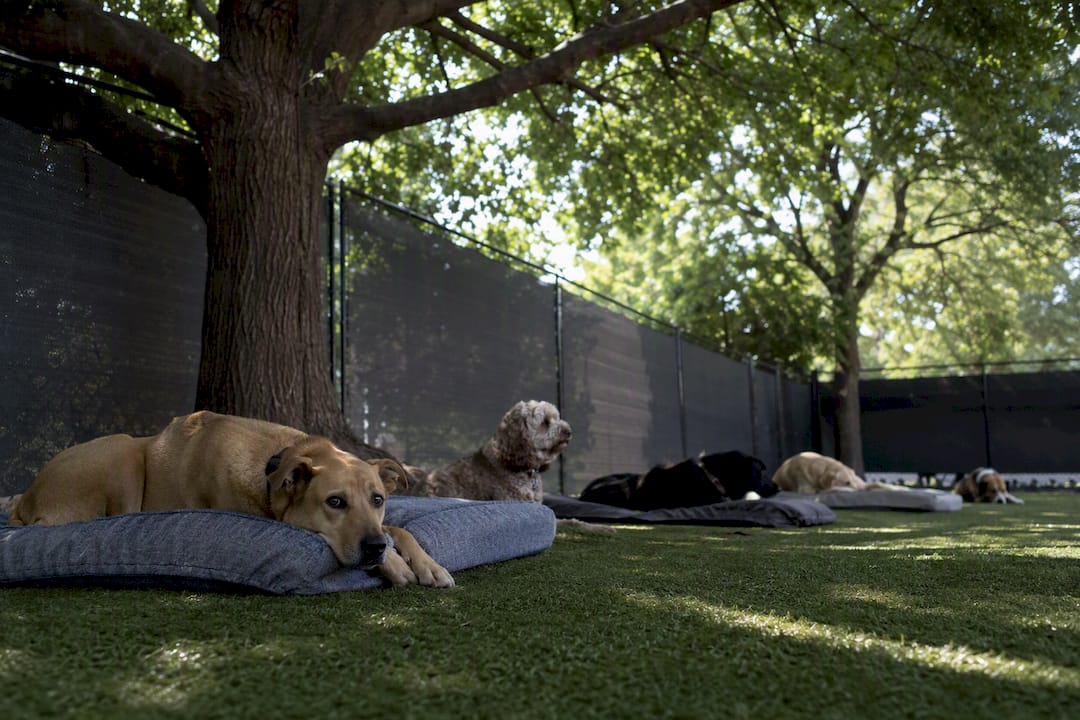
Rest and nap periods can allow much higher ratios, as contained or crated dogs present less collision risk. One staff member watching a quiet rest room serves a different supervision role than one staff member managing an active yard full of moving dogs.
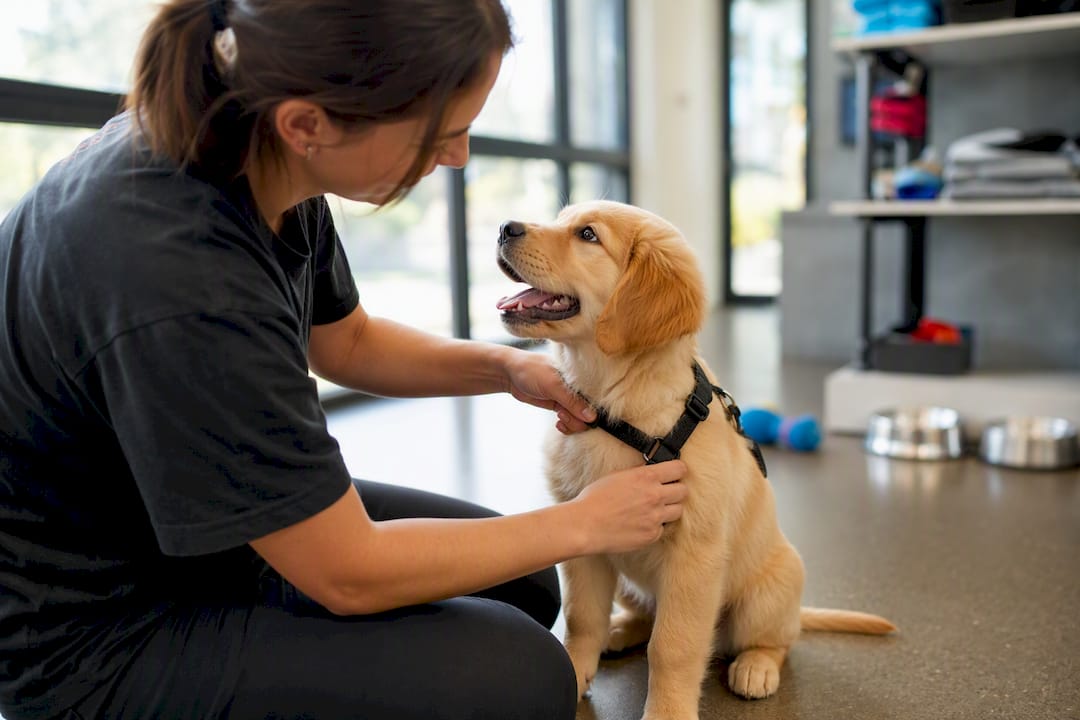
Transition and intake windows require a tighter staff-to-dog ratio due to higher risks during new arrivals and activity such as temperament screening and gear changes, which also tend to distract handlers. Our dog evaluation guide covers how to run intake without letting supervision slip.
Puppies, seniors, and special-needs dogs generally need smaller group sizes and closer supervision than standard active-play ratios because of their unique physical and behavioral needs.
| Operating window | Recommended ratio range | Why |
|---|---|---|
| Active play (mixed adult group) | Staff-to-dog ratios typically range between about 10 dogs per handler and a higher limit for calm groups | Active, hands-on intervention is required |
| Rest / nap (crated or contained) | Higher ratios are possible due to diminished activity and collision risk | Dogs are resting or contained |
| Transition / intake | Tighter supervision advised owing to increased risk | Staff distraction and new activity present challenges |
| Puppy / senior / special-needs | Smaller groups and closer supervision recommended | Unique behavior and health needs |
What Should Push Your Ratio Tighter or Looser?
A handbook number only works as a starting point. The real skill is knowing when to override it.
Usable square footage per dog governs how fast a handler can reach a problem. Industry guidance points to roughly 75 to 100 usable square feet per dog as a baseline and, when your layout falls short of that, tighten your ratio rather than hoping the number still works. Sightlines matter just as much as square footage. A handler who can’t see around a corner or behind an obstacle is effectively supervising fewer dogs than the ratio implies. Our space planning guide and layout guide both dig into this.
Group composition and temperament change the math fast. A group of ten calm, size-matched dogs behaves nothing like ten dogs spanning 15 to 90 pounds with two known resource-guarders in the mix. Mixed-size, high-arousal groups need more handlers per dog, not fewer.
Staff competency is the variable most owners underrate. A brand-new handler simply cannot supervise at the same ratio as a three-year veteran who reads early stress signals on instinct. Build a mentoring period into onboarding and staff new hires at tighter ratios until they’ve proven their read on group dynamics. Certification and training standards, like those outlined in current staff training benchmarks, give you a framework for that ramp-up.
Activity type shifts supervision needs too. Outdoor play in an open yard demands different coverage than feeding time, when food-guarding risk spikes, or grooming, when a dog is restrained and less able to self-advocate.
Pro Tip: Build your schedule around your weakest handler’s competency, not your strongest. If one new hire needs a 8:1 ratio to supervise safely, staff the whole shift to that number until they’ve earned more responsibility.
How Do You Turn a Ratio Target Into an Actual Schedule?
Ratios only protect anyone if they survive contact with your real booking calendar. Here’s how to translate a target ratio into staffing you can actually execute.
- Calculate handlers needed at peak headcount. Divide your expected peak dog count by your target ratio, then round up. Forty dogs at a 10:1 active-play ratio requires four handlers, not three “who can probably manage.”
- Account for group splits. If those 40 dogs are split into two play yards of 20 each, you still need two handlers per yard at 10:1, meaning four total, not two.
- Build in overlap and relief. Stagger shift starts so a handler stepping away for a bathroom break or an incident report doesn’t leave a yard unsupervised. On-call relief staff should be a standing line item, not an emergency scramble.
- Set automated booking caps. Your reservation system should refuse bookings once headcount would push you past your ratio target for that time block. Waiting until the day-of to notice you’re overbooked is how ratios quietly slip.
- Plan surge staffing for holidays and Mondays. Predictable volume spikes deserve a pre-built call list, not a group text sent in a panic.
A simple costing example helps this pencil out. If your daycare charges $35 per dog per day and runs a 10:1 ratio, one handler’s shift covering 10 dogs generates $350 in daily revenue against a labor cost that, at $18 an hour for an eight-hour shift, runs $144. That leaves real margin to staff safely rather than stretch thin. Push the same handler to 15 dogs and revenue climbs to $525, but so does your risk exposure and your insurer’s scrutiny. Capacity models like the one in Animal Friends OS’s planning guide walk through this math in more depth.
One more definition worth nailing down: an “active handler” is someone physically present in the play space, watching dogs rather than doing paperwork, cleaning, or working the front desk. If a staff member steps out to answer phones, they no longer count toward your ratio until they’re back in the yard.
What Records Do Insurers and Inspectors Actually Expect?
The ratio you can prove is the ratio that matters. If an incident happens and you can’t produce records showing you were staffed correctly, your stated ratio is just a claim, not a defense.
Keep these on file, consistently:
- Time-stamped staffing logs showing who was on shift, in which area, at what time.
- Camera footage covering play yards and transition zones, retained long enough to matter for claims timelines.
- Incident reports filed the same day, detailing what happened and who was supervising. Our incident reporting template gives you a workflow that holds up under scrutiny.
- Training and certification records for every staff member, including CPR, canine first aid, and behavior assessment credentials.
Insurance underwriters lean heavily on the 10:1 anchor. Documented compliance can improve how your premium gets priced; running consistently above 15:1 raises red flags that can trigger surcharges or complicate a claim.
State rules add another layer, and they vary more than most operators expect.
Iowa’s administrative code requires one person for every 15 or fewer dogs in a playgroup, and mandates two staff members for any playgroup between 16 and 30 dogs, the maximum group size the Iowa Administrative Code permits.
Check your own state’s rules before publishing a ratio claim on your website, and match your insurance application’s stated ratio to what your logs actually show. Our regulations overview is a good starting point for figuring out what your state requires.
How Does Better Training Raise Your Safe Ratio Ceiling?
Thedoggurus works with dog daycare, boarding, and pet care operators to build the staff training and operational systems that make higher ratios defensible rather than risky. Well-trained handlers read early warning signs faster, which is what actually raises your safe ceiling, not a number pulled from a competitor’s website.
Three checklists worth building into your onboarding:
- Staffing readiness: confirm headcount, ratio, and coverage before doors open each day.
- Intake and transition procedure: screen temperament, confirm gear, and log arrival time before a new dog joins the group.
- Documentation checklist: staffing log, camera check, and incident report template ready before the first dog arrives.
Role-specific training modules, like those available through Thedoggurus’ staff training tools, give new hires a faster, safer ramp to full ratio competency.
Editorial Perspective on Staffing Ratios That Actually Hold Up
Most advice on staff to dog ratios stops at a single number, and that’s the problem. A static 10:1 rule painted on a wall doesn’t tell you anything about whether your space, your group composition, or your newest hire can actually support it.
The research here points somewhere more useful: ratios are a floor, not a formula. Square footage, group temperament, and staff experience all move that floor up or down, and pretending otherwise is how operators end up technically “in ratio” while a handler is actually overwhelmed.
What gets underweighted industry-wide is documentation. Owners obsess over the ratio number and skip the paper trail that proves they followed it. When a claim or inspection happens, an undocumented 10:1 shift is worth less than a documented 12:1 one.
If you take one thing from this article, make it this: build your scheduling and your record-keeping around the same ratio number, every single day. That consistency, more than the number itself, is what protects your dogs, your staff, and your business.
Frequently Asked Questions
What is the standard staff to dog ratio for daycare?
Most insurers and operators use 10:1 as the conservative anchor for active play, with 15:1 as a practical ceiling for calm, size-matched groups.
Does the staff to dog ratio change during rest time?
Yes. Contained or crated rest periods allow much higher ratios, often 20:1 to 30:1, since movement and collision risk drop sharply.
Are staff to dog ratio rules legally mandated?
Rules vary by state. Iowa, for example, requires one staff member for every 15 or fewer dogs and two staff members for groups of 16 to 30 dogs.
What lowers a safe staff to dog ratio?
Tight square footage, mixed-size or high-arousal groups, inexperienced handlers, and transition or intake periods all call for tighter ratios than your standard.
How do I calculate staffing needs for peak headcount?
Divide expected peak dog count by your target ratio and round up, then confirm each play group individually rather than averaging across your whole facility.
Sources
- Iowa Administrative Code r. 21-67.8
- What’s the right dog-to-staff ratio for a daycare facility…? — Pulse RevOps knowledge
- Daycare Capacity Planning Guide — Animal Friends OS
Recommended
- Dog Daycare Design Ideas: A Practical Layout Guide – The Dog Gurus
- The Two Most Important Factors to Operating a Safe Dog Daycare – The Dog Gurus
- Enhancing Staff Accountability in Pet Boarding and Daycare: The Operations Manual Advantage – The Dog Gurus
- Dog Daycare Benchmarks: Key Metrics and Target Ranges – The Dog Gurus